5. 12. 2022
6 tips for a perfectly clean floor + a bonus at the end
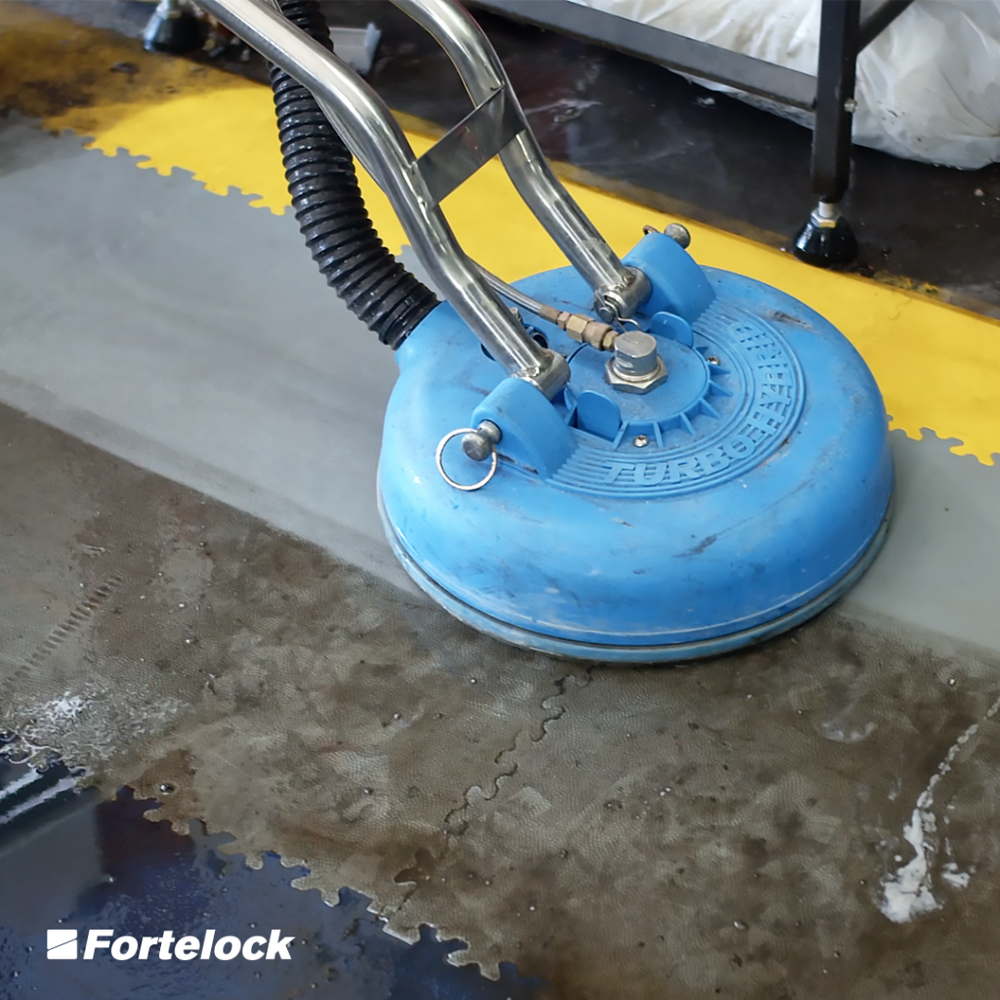
Many customers come to us for advice on how to properly care for and clean Fortelock plastic tiles. They often don't know which cleaning product to use, and the result is, at best, a dirty floor or one that is hard to clean, and at worst, damaged tiles. That's why we bring you 6 tips on how to properly care for Fortelock PVC tiles (or other PVC materials such as linoleum).
1. Prevention
We can surely agree that the best solution is not to get the floor dirty in the first place. That is impossible in practice, but we should try to prevent it as much as we can. An ideal approach is to use so-called cleaning zones at the entrance to buildings. These should be at least 2–3 steps long, which minimises the dirt carried into the space. Mats that are quick and easy to clean can serve this purpose.
2. Regular cleaning
The longer you let dirt sit on the tiles, the harder they will be to clean. Regular cleaning keeps the tiles looking like new and makes your space more attractive and representative. How often you clean depends on how intensively the floor is used, but we recommend cleaning the tiles at least once a week. When you clean regularly with special products such as Dr. Schutz Cleaner R 1000, each cleaning leaves a fine protective wax film on the tiles that shields them from dirt and makes them easier to clean.
3. Cleaning product
We often encounter a problem where a customer buys an ordinary cleaning product and is then disappointed that the tiles cannot be cleaned. But the problem lies not with the tiles, but with the cleaning product. With the right cleaner you can very easily restore the look of brand-new tiles. For all Fortelock tiles we recommend cleaners from the renowned German manufacturer Dr. Schutz.
For general and deep cleaning of ingrained dirt we recommend Basic Cleaner R, which removes even the most stubborn stains and old protective coatings. Simply apply it in the recommended ratio with water, leave it to work for 10 to 15 minutes, scrub with a brush or a scrubbing machine, then rinse with water and the floor is as good as new.
For everyday and regular cleaning we recommend Cleaner R 1000. Its advantage is that it does not foam, leaves no streaks and, moreover, creates a fine protective wax film on the surface of the tiles that shields them from dirt and makes them easier to clean.
Of course, every surface requires a different cleaner – for lacquered surfaces you need to use the special PU cleaner, and for ESD tiles the ESD Cleaner. For local stains you can use the Elatex Universal Stain Remover, which removes stains from wine, fruit juices, chocolate, asphalt, chewing gum and the like.
4. Removing dirt quickly
As the saying goes – there's no use crying over spilt milk. You just have to grab a cloth and wipe it up. This matters with the tiles too. Milk won't harm them, but caustic substances or solvents such as petrol or diesel can cause irreversible damage if left too long. That is why these substances must be removed from the tiles as quickly as possible. If liquid also seeps into the locks, the tiles should be dismantled as soon as possible, cleaned and thoroughly dried before reassembly.
The exact opposite approach is needed when applying cleaning products. When using Basic Cleaner R, the time it is left to act on the dirt is extremely important. We recommend leaving the cleaner to work for at least 10 to 15 minutes and only then removing the dirt. Only in this way can the cleaner effectively break down ingrained grime. For heavier soiling the procedure can be repeated.
5. Not all brushes are equal
You can probably imagine how washing a car with a wire brush would end. The same problem can arise if you clean the tiles with an unsuitable abrasive brush or pad. When cleaning with a machine we recommend choosing a cleaning pad with red bristle brushes. And if you're wondering whether a cleaning disc or a roller is better, we have the answer for you. For patterns like those of Fortelock tiles, cleaning discs with brushes (not pads) are more suitable. They remove dirt better and faster than roller ones.
For manual cleaning we recommend reaching for a classic brush with medium-hard bristles that can get into the fine grooves of the Fortelock tile patterns.
6. A protective shield
An effective way to prevent the tiles from getting dirty is to apply a special polyurethane protective lacquer, which makes subsequent maintenance easier and improves their appearance. The lacquer is applied directly at the factory and the customer receives a ready-made lacquered tile.
Bonus
We have prepared a video for you showing how easily you can make your tiles look like new again. For this purpose we chose extremely dirty tiles, to which we applied the cleaners and procedures mentioned above. See the result for yourself.