29. 11. 2023
Fortelock PVC tiles – resistance to water and moisture
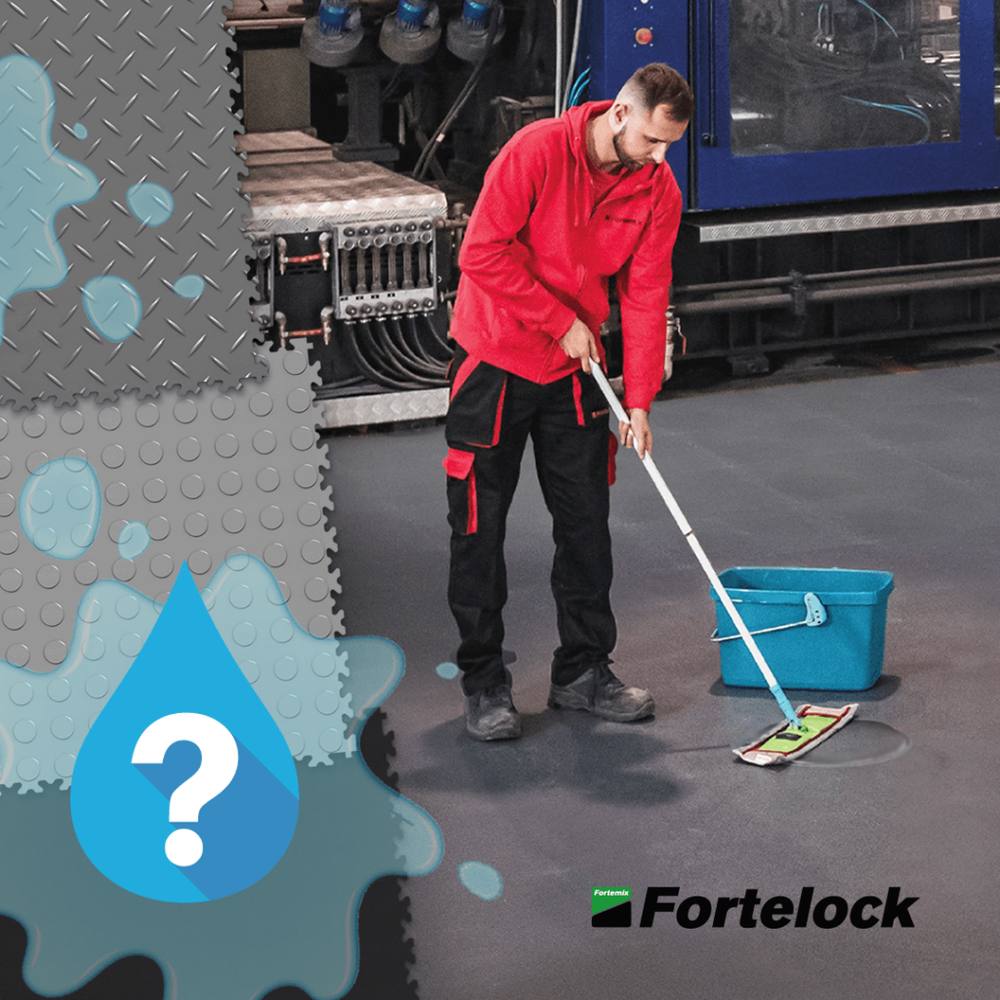
Fortelock PVC tiles are a popular choice for garages, workshops and industrial spaces thanks to their durability and easy maintenance. As winter approaches, there is a greater risk of the tiles coming into contact with water, rain or melting snow. That is why customers often ask us how the tiles cope with these conditions. In this article we focus on the difference between water resistance and waterproofing. We also explain how the Air flow system helps protect Fortelock tiles against moisture.
We designed Fortelock PVC tiles to withstand everyday mechanical stress and various chemicals, which makes them suitable for use in many environments. Because winter brings larger amounts of water and snow, it is important to understand how these factors can affect Fortelock PVC tiles and how to ensure their long-term functionality and appearance.
Water resistance versus waterproofing
Fortelock tiles are water resistant, which means they resist the penetration of water to a certain extent. Water resistance is the ability of a material to withstand water and prevent it from passing through the surface. Waterproofing, on the other hand, is an absolute term that refers to the complete inability of water to pass through a material under any circumstances. In practice, this means that while Fortelock PVC tiles can effectively cope with water on their surface, they are not entirely impermeable. In certain situations, water can penetrate through the joints between individual tiles.
Air flow system
Despite the tight locking joints of Fortelock tiles, water may sometimes find its way underneath them. In such cases the Air flow system, which is integrated into the underside of the tiles, comes into play. The Air flow system consists of so-called drainage channels that allow liquids to drain away and support the process of evaporation and ventilation. As a result, the area under the tiles dries faster and the risk of moisture build-up and subsequent floor damage is minimised. This system is featured in the Industry tiles.
Maintaining Fortelock PVC tiles after contact with liquids
If a larger amount of liquid ends up on the surface of Fortelock tiles – for example from a spilled drink, a dripping car or melted snow – you can remove it easily. A floor squeegee or other tools suitable for collecting and removing water can be used for this purpose. You will also find maintenance tips and advice in our videos.
Recommendations for high-humidity environments
If moisture is already present in the subfloor – for example due to a waterlogged floor or other structural problems – we do not recommend installing Fortelock PVC tiles. In such cases, first resolve the source of the moisture and make sure the subfloor is dry and stable before laying the tiles.
Fortelock PVC tiles provide a durable and practical flooring solution for many environments. Their water-resistant properties, together with the innovative Air flow system, ensure that even when they come into contact with water or snow, the tiles can effectively protect the floor and remain functional. However, in the case of permanent moisture from the subfloor, this condition must be resolved before installing the tiles in order to prevent potential moisture problems in the future.
How much moisture the substrate and air may contain
The technical data sheet gives the maximum moisture content of the substrate: concrete or cement screed 3.5%, anhydrite screed 0.5% and timber substrates 10%. The relative humidity of the air should not exceed 75% over the long term. Glued tiles must not be laid in rooms that are not sufficiently insulated against rising damp. Water-based fixing is not recommended where there is excessive moisture in the substrate or where the floor is cleaned with larger amounts of water; PU adhesive is more suitable.
The Air-Flow system is found not only on Industry tiles, but also on Industry Ultra and Invisible. Even with these, however, you need to bear in mind that moisture can get into the joints.
Frequently asked questions
Are Fortelock tiles waterproof?


No, they are water-resistant. Water does not pass through the surface of the tile, but in certain situations it can get through the joints between the tiles. That is why the Industry, Industry Ultra and Invisible ranges have the Air-Flow system on their underside, which helps to drain and evaporate moisture under the floor.
What should I do if water gets under the tiles?
Small amounts of water evaporate on their own thanks to the Air-Flow channels. With larger amounts, for example after a spill or from melted snow, remove the water with a squeegee, lift the tiles in the affected area and let the substrate dry. Thanks to the interlocking system, you can then put them back without glue.
How does the Air-Flow system work?
Air-Flow consists of grooves and channels on the underside of the tiles through which air circulates. They carry moisture from the substrate to the surface, where it evaporates, thereby reducing the risk of rot and mould. The system is featured on Industry, Industry Ultra and Invisible tiles; it is not listed for the XL and Business ranges.
Can the tiles be laid on damp concrete?
No. If moisture is already present in the substrate, for example due to waterlogging, installation is not recommended and the source of the moisture must be dealt with first. According to the technical data sheet, concrete or cement screed may have a moisture content of no more than 3.5%. Find out more about solutions in the article How to deal with moisture under the floor.
Can I use Fortelock tiles outdoors, for example on a patio?
No. Fortelock tiles are not designed for outdoor use and their colours are not UV-stable. Direct sunlight and UV radiation cause gradual degradation and discolouration, and the warranty does not cover outdoor use. They belong indoors, in spaces such as garages, workshops, warehouses or halls.
What air humidity and temperature can the tiles withstand?
The relative humidity of the air should not exceed 75% over the long term. A loose-laid floor can be used at air temperatures of +15 to +27 °C; with a wider temperature range, the tiles are glued with PU adhesive. For damp or unheated spaces, Industry Ultra is a good choice, as the Air-Flow system keeps it stable.