18. 8. 2026
How to Choose Flooring for an Electric Car Garage
Why the garage floor matters with an electric car
At first glance, a garage for an electric car is no different from any other. You still drive in, and water, snow, salt and small stones still get inside. The key difference, however, is the weight. Because of its batteries, an electric car is noticeably heavier than a comparable combustion-engine vehicle, and you are effectively turning your garage into a home filling station.
A heavier car and new maintenance demands
The floor under an electric car has to cope with far higher point loads under the tyres over the long term and at the same time give you a safe, clean environment for handling the wallbox. So if you are planning to install a charger or renovate the parking space, this is the ideal moment to look at what you are standing on as well.
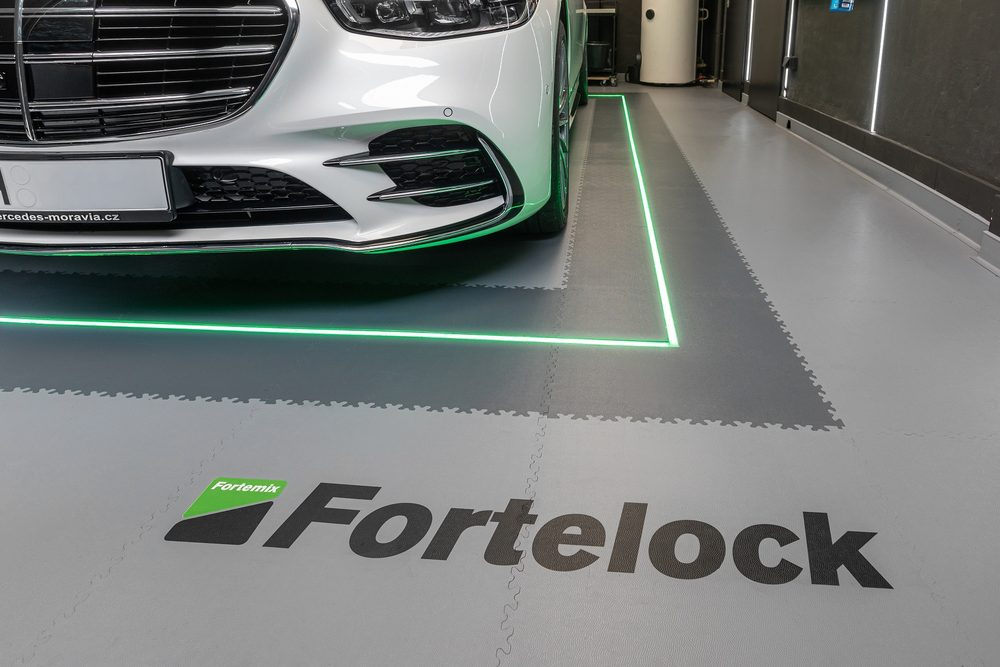
With an electric car you do not want to deal with puddles, crumbling concrete or pointless dust settling on the cables. You need flooring that is extremely durable, easy to maintain and non-slip. A bonus is the option to divide the space visually – for example, using colour to set the charging zone apart so the garage looks modern and well organised.
The weight of an electric car and long-term loads
Electric cars have a heavy battery, which makes them significantly heavier than similarly sized combustion-engine cars. For a garage floor that means one thing above all: long-term point loads where the tyres stand.
Where old concrete stops being enough
If the subfloor is new and perfectly executed, it may not be a problem. Weak spots show up quickly on old concrete that is dusty, crumbling, cracked or uneven. What is more, a car usually parks in the same place, so the load is repeated again and again. Add temperature swings, running water and aggressive winter salt, and a poor-quality floor will degrade fast.
What to focus on when choosing
When upgrading a garage for an electric car, concentrate mainly on:
- the strength and durability of the floor covering itself
- a level surface where the car parks
- the ability to handle everyday point loads
- easy clean-up of water, salt residue and dust
- a safe, non-slip area around the wallbox
The important thing is not to choose a floor with your eyes alone. A garage for an electric car has to be functional first and foremost. Good looks are a welcome bonus, but mechanical durability and practical maintenance are the absolute basics.
Charging in the garage and the space around the car
Home charging is one of the biggest advantages of an electric car. For it to work comfortably, though, it is not enough to pick a wallbox and a spot on the wall. The whole area around the parked vehicle matters.
Moving safely around an electric car
In day-to-day use, the floor is crucial. You need to move safely around the charging point, and the cable definitely should not lie in puddles of water or in a tangle across the whole garage.
The surface should therefore be level, stable and above all non-absorbent. If you often walk around the car, plug in the cable, hang it back on its holder or clean up after winter driving, you will quickly notice the difference. Dusty, damp concrete is hard to maintain, whereas a sealed surface only needs to be swept or wiped dry.
Smart routes and a well-organised garage
It is extremely practical to think through the route of the cable as well. It should not cross the places where you normally walk with shopping, carry tools or keep your things.
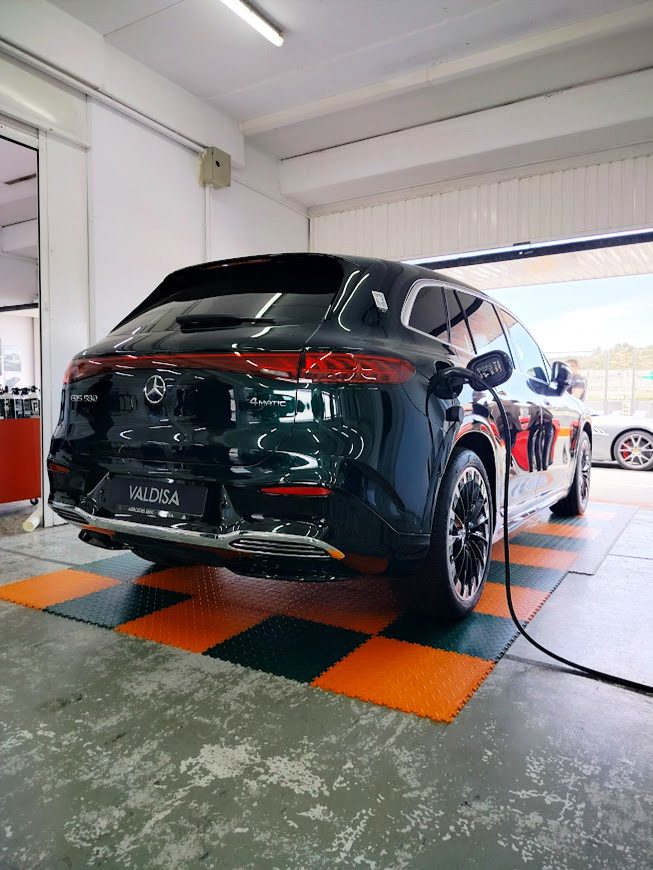
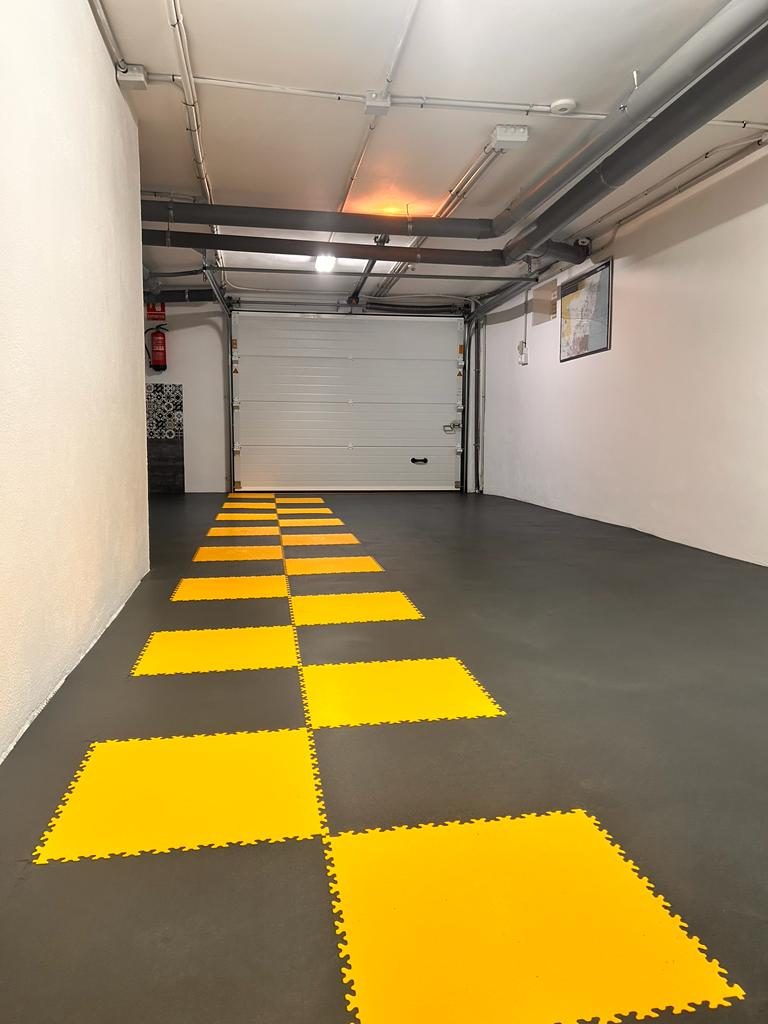
This is where visual zoning of the space works beautifully. Colours on the floor let you mark out safe walkways as well as an area intended purely for handling the charging equipment. The clearer the layout of your garage, the lower the risk of tripping, needlessly dirtying the cable or even damaging expensive charging accessories.
Water, salt and dirt from the car
An electric car may not have a conventional combustion engine, but from the garage floor's point of view it is still a car. It reliably brings in wet tyres, snow, mud, sand and aggressive road salt. In winter, water from melting wheel arches can keep dripping onto the ground long after you have parked.
Old concrete copes with this very badly. It creates dust, absorbs moisture, develops stains, and dirt collects in the cracks. If you use the garage every day, the floor will soon look neglected even though you sweep it regularly. And with an electric car you spend far more time in the garage – you are constantly plugging in the cable, checking the charge and generally moving around the space. All the more reason to appreciate a clean environment.
Which flooring options make sense for an electric car garage
You have several options when choosing a garage floor. Each has its strengths and weaknesses. With an electric car it pays to judge them mainly by everyday loads, maintenance requirements, how quickly they can be installed and overall durability in normal use.
Bare concrete
The original concrete is the cheapest option, because it is usually already there. If it is new, solid and dust-free, it can serve well for some time. In older garages, however, the subfloor tends to be absorbent, cracked and very dusty.
For a garage with an electric car this is not an ideal solution, mainly because of maintenance. Water, salt and dirt stay in the unevenness, the surface is hard to clean, and both the charging cable and the things you store there get needlessly covered in dust.
Concrete paint
Paint can even out the look of concrete and reduce its dustiness. It is, however, extremely dependent on subfloor preparation: the surface must be perfectly dry, sound, clean and grease-free.
If the preparation is underestimated, the paint starts to peel or wear away quickly – very often exactly where the tyres sit. In a garage where you park a heavier car every day and regularly deal with running water and salt, it will soon need local repairs.
Epoxy coating
An epoxy floor looks very clean and, if it is done properly, it is durable and easy to maintain. Its drawbacks are demanding preparation, sensitivity to residual moisture in the subfloor and problematic local repairs. If you want a perfect result, you cannot do without a specialist company.
In a garage you need for charging and do not want to take out of service for several days while the coating cures, that can be a major complication.
Ceramic tiles
Ceramic tiles can look great, but in a garage they have to be one hundred per cent frost-resistant, anti-slip and perfectly laid. The weak point tends to be the grout lines, where dirt and aggressive salt collect.
With an electric car, the higher weight of the vehicle is a real concern. The risk of cracking a tile under a point load or when a heavy object is dropped is much greater here. Replacing a single tile also means lengthy chiselling, dust and new grouting.
Interlocking PVC floor tiles
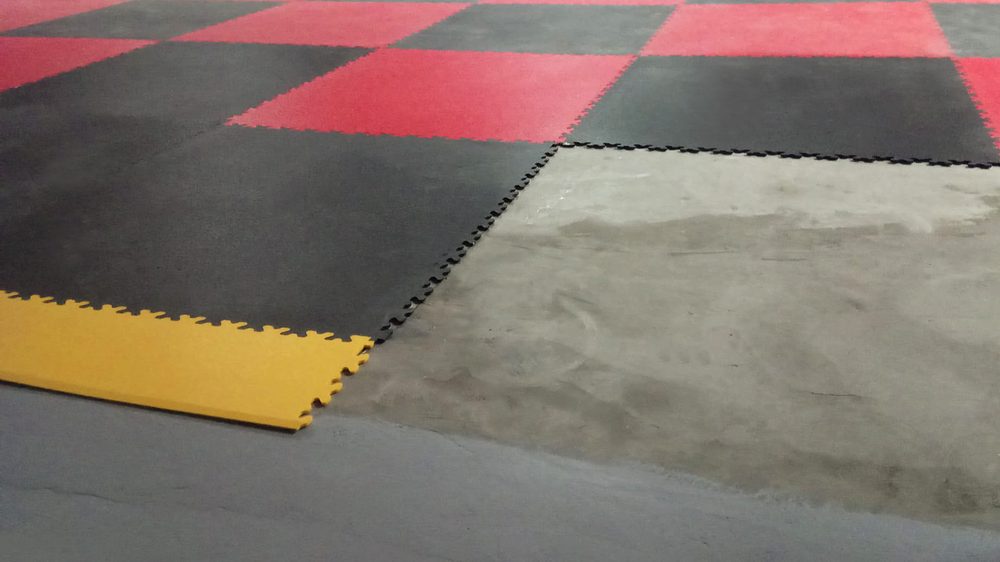
Interlocking PVC floor tiles are an exceptionally practical choice wherever you want an extremely durable, easy-to-maintain surface without a complicated construction project. The tiles are joined by sturdy interlocks, they are quick to lay and usually need no full-surface adhesive.
In a garage for an electric car you will appreciate not only that the flooring handles heavy loads with ease, but also that it hides the imperfections and dustiness of old concrete. The surface provides thermal insulation, protects charging connectors if they are dropped, and if it is damaged you simply replace one particular tile without touching the rest of the floor. All you need to do is follow the recommendations on expansion gaps and installation conditions.
Why Fortelock is a practical choice for an electric car garage
Fortelock interlocking PVC floor tiles make sense above all where old concrete no longer does the job but you want to avoid a lengthy, dusty renovation. They are ideal for garages, workshops and technical spaces that need an extremely strong, durable and easily maintained surface.
Durability for everyday parking
An electric car is usually significantly heavier than an ordinary one, so the floor has to handle high, repeated point loads with ease. Fortelock is developed specifically for heavy-duty industrial operations, so parking a heavy vehicle every day is no problem at all.
The subfloor itself always matters too. If the concrete really is badly deteriorated, cracked or damp, it needs to be dealt with before installation.
Easier cleaning around the car and the wallbox
Old concrete constantly produces dust and dirt is hard to get out of it. With an electric car this is doubly annoying, because you move around the vehicle far more often to plug in the cable.
Fortelock in a garage creates a continuous, sealed surface that you simply sweep or mop. Handling the wallbox on such a floor is far easier, winter salt residue and water dripping from the wheel arches wipe away without effort, and the garage always looks tidy.
Fast installation without a long garage shutdown
If you already own an electric car or are planning to install a charger, you certainly do not want to take the garage out of service for weeks while concrete or epoxy cures. The key benefit of interlocking PVC tiles is how fast they go down, and they can even be laid in sections. You will appreciate that above all when the garage is full of heavy shelving, plenty of tools or charging equipment that is already installed and you do not want to move everything out for a long time.
Replacing a single tile if it is damaged
A garage is and always will be a working space. Heavy tools get dropped, something gets damaged locally or extremely dirty. With interlocking tiles you will appreciate one exceptionally practical thing: you simply click the damaged tile out and replace it with a new one. There is no need to demolish the whole floor, endure clouds of dust or fiddle with grout, as you would with a broken ceramic tile.
A clearer, more presentable garage
Switching to electric mobility often leads owners to start thinking of the garage as a fully fledged, clean, functional space rather than just a dark storage room. The floor plays a key role in that transformation.
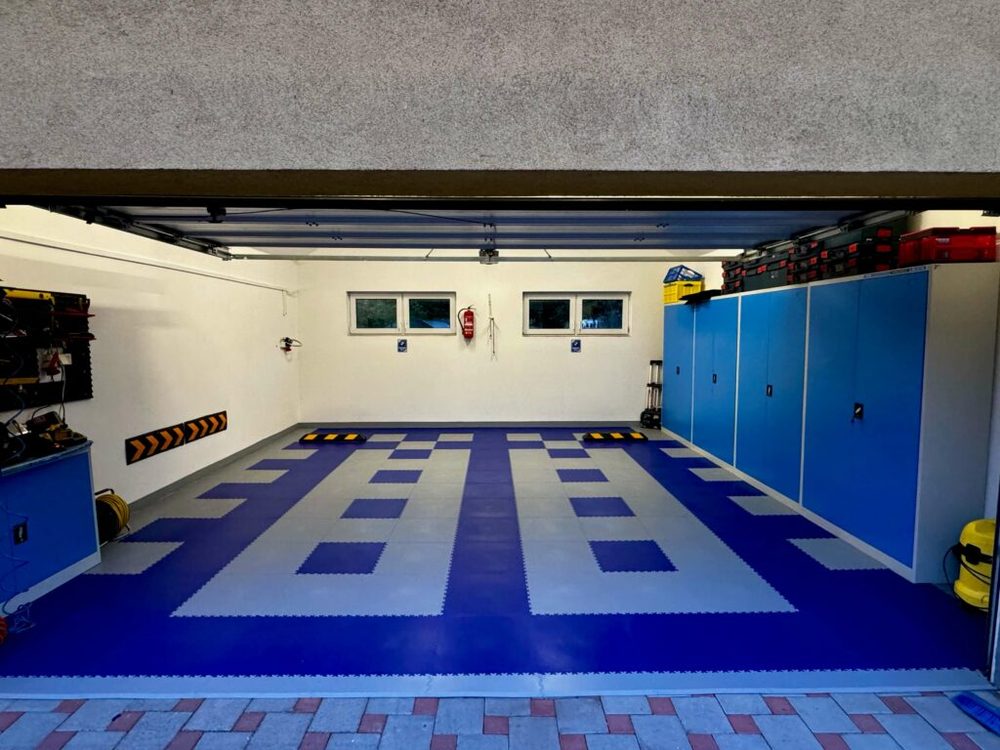
With Fortelock tiles you can also work visually – different colours make it easy to separate the parking zone, mark out a safe area for handling the wallbox or define a work corner by the shelving.
What to think about before installation
Before you make the final decision and get to work, walk through the garage in purely practical terms. It is not enough to measure the total floor area. What matters is thinking about how you actually move around the space and exactly where the electric car will park.
Check these points in particular:
- The state of the subfloor – Look at the strength of the concrete, deep potholes, larger irregularities and any moisture.
- Garage traffic – Determine the exact spot where the tyres will stand, and remember to leave enough room to open the doors comfortably and to clear away water in winter.
- The charging zone – Think through the position of the wallbox and the safest route for the charging cable so that it is never in the way.
- Technical details – Do not forget to sort out a smooth transition at the door or thresholds, and find out in advance what expansion gaps the manufacturer recommends.
If the garage is permanently damp, water gets in or the concrete stays wet for long periods, a new floor should not be your first move. The cause of the problem has to be removed first. Thanks to its underside profile, interlocking PVC flooring can let ordinary operational moisture ventilate away and makes maintenance far easier, but it is in no way a substitute for missing waterproofing.
Specific values to work with
For a garage with a heavier car, the tile range is decisive. According to the technical data sheet, loose-laid Fortelock Industry can take vehicles with tyres up to 6,600 kg, and Invisible up to 3,500 kg. For car traffic, the large-format XL is only rated once glued or fixed. The compressive point load is 520 kg/cm² for all ranges. Leave a 10 mm expansion gap from walls, columns and racking, which is then covered by a skirting board. Acclimatise the tiles for at least 48 hours at 18–26 °C before installation. Areas exposed to sunlight or a heat source need to be glued. Concrete should not have a moisture content above 3.5%.
A functional floor as the basis for home charging
Buying an electric car is the ideal opportunity to turn your garage into a clean, well-organised and safe space. A quality floor makes everyday parking of a heavier vehicle easier, simplifies handling the charging cable and saves a great deal of time when clearing away water and aggressive winter salt.
If you are looking for a solution that comfortably handles heavy loads, hides the imperfections of old concrete and that you can install yourself without lengthy building work, Fortelock interlocking PVC flooring is a safe bet.
Would you like to see how a new floor would suit your garage? Browse the available colours, design your own zone layout in the online configurator or have a sample tile sent straight to your home.
Frequently asked questions
Can PVC tiles in a garage take the weight of a heavy electric car?


Yes, if you choose the right range. Fortelock Industry is tested for traffic from cars and handling equipment with tyres up to 6,600 kg, including the weight of the vehicle. It can withstand a compressive point load of 520 kg/cm². You will find the specifications on the page Fortelock Industry.
Is an epoxy coating or PVC tiles better for a garage?
It depends on the condition of the subfloor and how long the garage can be out of use. An epoxy coating is sensitive to residual moisture and, according to the Fortelock website, takes 3 to 7 days to dry. PVC tiles are finished in 3 to 4 hours, and a damaged piece can be replaced on its own. A comparison is given in the article Epoxy or PVC tiles?
How do I lay interlocking tiles on old concrete in a garage?
Sweep and inspect the concrete. Cracks up to 4 mm do not need repairing, wider ones should be filled, high spots of more than 7 mm over 2 m should be ground down, and check that the moisture content does not exceed 3.5%. Then, after acclimatisation, lay the tiles from the garage door along two perpendicular lines. Read more in the article Can you lay a new floor over old concrete?
What should I do about the snow and salt a car brings onto PVC flooring?
Small amounts of water evaporate thanks to the Air-Flow system under the tiles. Larger amounts need to be wiped up, and if necessary the affected tiles removed and the area dried. The surface is highly resistant to common chemicals and dirt does not soak into it, so salt residue simply needs to be swept and mopped regularly.
Is PVC flooring around a wallbox slip-resistant?
Yes. Fortelock tiles have an R10 slip resistance rating according to DIN 51130 and, according to the manufacturer, the surface keeps its grip even in increased humidity. Around the charging point, you can also use coloured tiles to mark out a zone for handling the cable, separating it from the area where water drips from the wheel arches.
Will PVC tiles fix a permanently damp garage?
No, they are not a substitute for waterproofing. The Air-Flow system draws normal operational moisture away from the subfloor, but the technical data sheet does not recommend the tiles where the relative humidity exceeds 75% over the long term. In addition, glued tiles must not be laid in rooms that are insufficiently insulated against rising damp. The cause of the damp must therefore be dealt with first.