16. 7. 2025
Epoxy or PVC tiles? The pros and cons of both solutions
Epoxy flooring: A seamless surface for specific operations
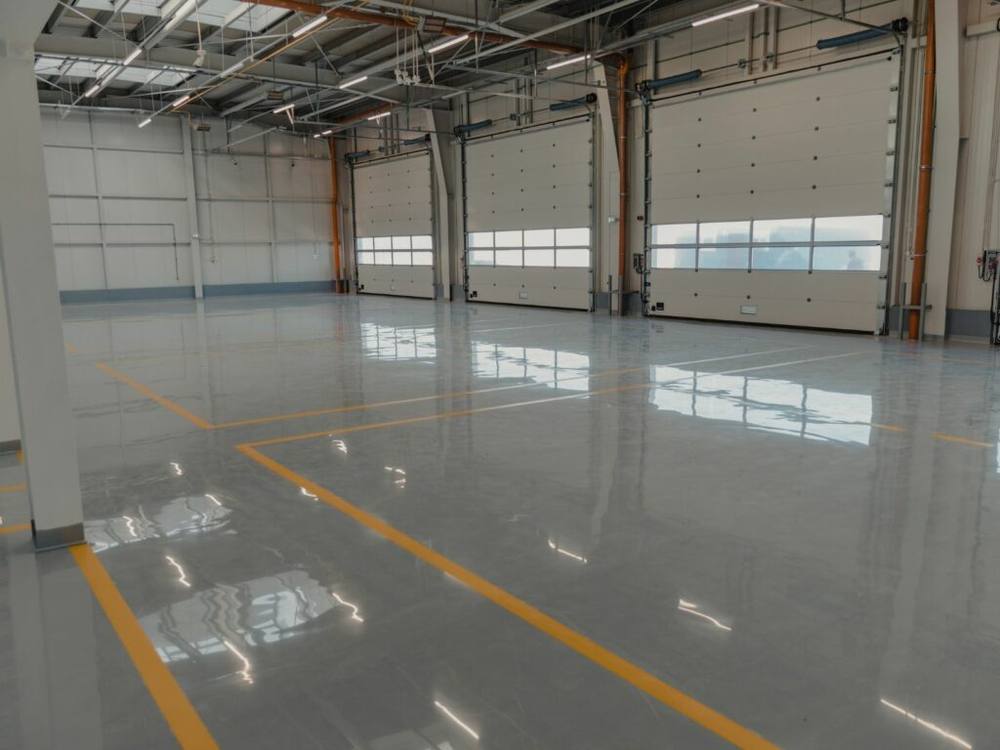
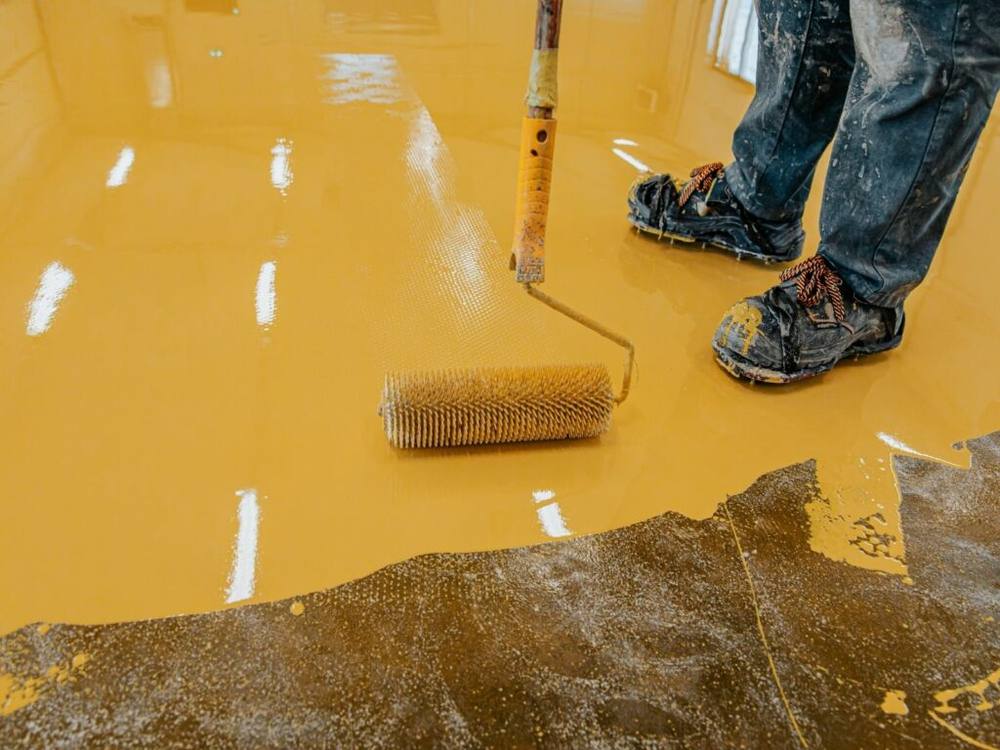
An epoxy floor is a poured system applied directly onto prepared concrete. After curing, it creates a solid, seamless surface that resists mechanical and chemical stress well. It is used mainly in new buildings or in specific sectors such as the food industry, pharmaceuticals or heavy industry.
However, its durability depends to a large extent on the quality of the substrate and the care taken during application, and above all you have to factor in technological breaks during its application. For many ordinary operations, therefore, a PVC floor may be the more practical choice—it adapts, requires no downtime and allows easy repairs and future changes.
Applying epoxy is more complicated
A drawback, however, can be that applying an epoxy system is not a matter of a few hours and the substrate must be completely clean, dry and level. The curing itself can then take several days, so you have to reckon with a shutdown or restriction of operations.
When does epoxy make sense?
- In operations where a seamless surface is needed to meet hygiene standards.
- Where there is time and space for technological breaks, because installation takes several days.
- When you expect extreme loads in the space.
What do you need to consider?
- Installation usually takes several days, during which the space cannot be used.
- The substrate must be solid, level, free of cracks and moisture. Otherwise there is a risk that bubbles or cracks will form in the surface.
- Repairs and any future changes are more difficult. You can't simply “replace a piece of the floor” without visible transitions.
Interlocking PVC tiles: A modular solution that adapts to you
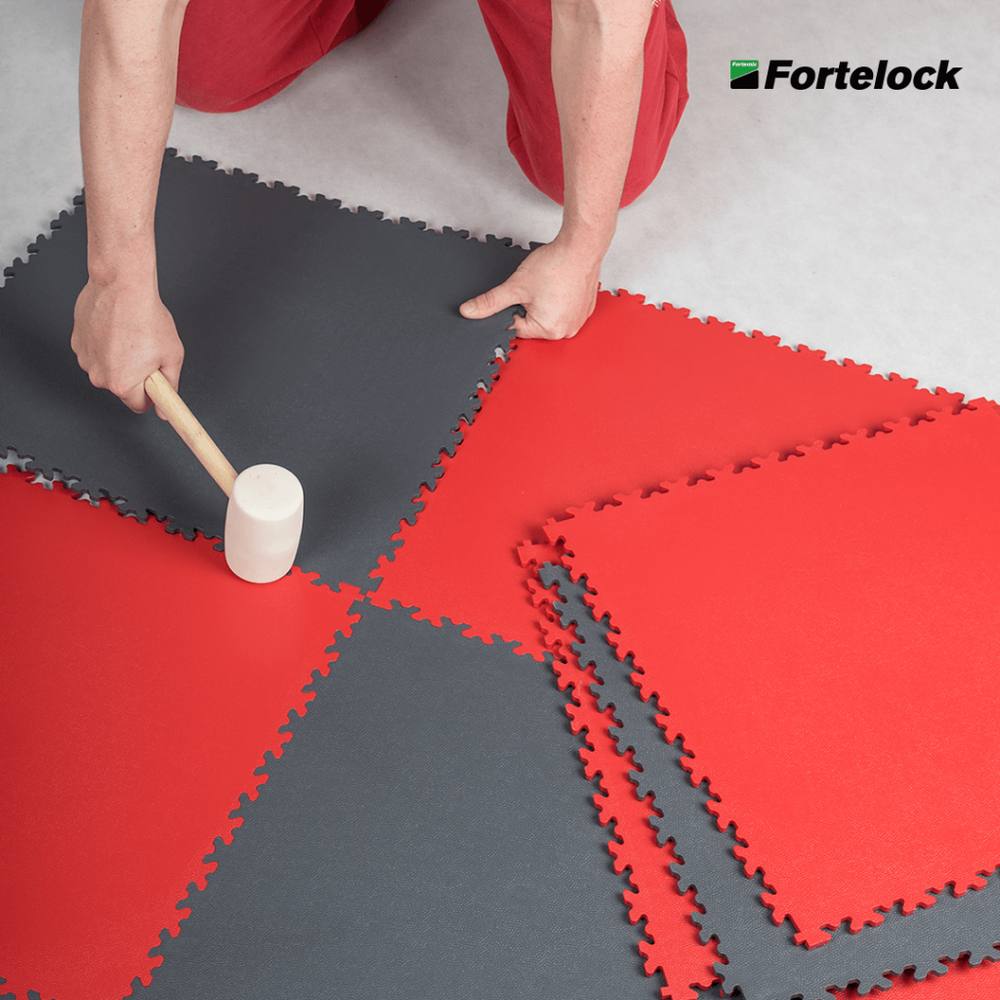
Fortelock PVC tiles take a different approach. This is not a screed or a coating, but a fully modular system that you can lay dry—without gluing, without grinding, without waiting. Thanks to the precise interlocking system, the tiles fit together like a puzzle, yet hold firmly even under heavy loads.
Installation without waiting
The main advantage of this system is above all its fast and easy installation. The floor can be laid directly onto existing concrete, which doesn't even have to be perfectly level, and any cracks or residual moisture are no problem either. For companies that need to renovate while remaining operational, this is often a key benefit.
What's more, a PVC floor dampens noise and vibration and feels more comfortable to walk or stand on. Both employees and visitors will appreciate this—whether it's a workshop, garage, warehouse, or perhaps a showroom or sports facility.
Where does Fortelock excel?
- Installation without downtime – The floor can be laid during normal operation and used immediately after completion.
- Flexibility – If something gets damaged, you replace just a single tile. When the layout of the space changes, for example, the floor adapts very easily.
- The option to lay it even on problematic substrates – You can apply PVC tiles even on a damp, cracked surface without having to remove the old layer.
- A choice of various designs – You can also customise the look of the floor, from technical textures to attractive wood, metal or concrete décors.
And what should you watch out for with PVC tiles?
As with any solution, it's good to know the limits of Fortelock floors too:
- The joints between the tiles are visible. Even though they fit precisely and firmly, it is not a completely seamless look.
- When heavy machinery is used, you need to choose reinforced tile types (e.g. Fortelock Industry).
When does it make sense to choose epoxy?
Epoxy floors are used mainly where a compact, smooth surface is needed that will face frequent movement of heavy machinery or chemical loads. Typically you'll find them in the food industry, laboratories or warehouses, where easy maintenance and a seamless look play a role.
You do, however, have to bear in mind that even an epoxy floor is not entirely universal and maintenance-free. For epoxy to keep its properties, it's important to design, apply and, above all, consistently maintain the floor correctly. You also have to reckon with the fact that any future repair or modification tends to be more demanding. Epoxy is a permanent system—which is both its advantage and its limitation at once.
When to avoid epoxy
If you know that the space will change over time, that you need greater flexibility or that the substrate cannot be perfectly prepared, the more practical choice may be a floor that can adapt—ideally, then, PVC tiles.
Epoxy floors are suitable for:
- pharmaceutical facilities and laboratories
- large warehouse halls
- the chemical and heavy industries
And when is it better to reach for PVC tiles?
The interlocking system of PVC tiles (such as Fortelock) is today a very common choice where durability needs to be combined with practicality and flexibility. That means, for example, in operations where equipment, machinery or goods are handled, but where it is not possible to interrupt operations for several days to install a new floor. This applies to warehouses, workshops, car repair shops, but also schools, commercial spaces or multipurpose halls.
Why choose a PVC floor
PVC tiles are laid without glue and can be installed even on substrates that are not entirely ideal (e.g. perfectly level). If you are also struggling in the space with moisture, cracked concrete, remnants of an old floor or various differences in height, a modular system may be an advantage. It allows installation without major construction work, and on top of that you don't have to wait for the floor to cure after laying.
A great advantage is also the easy replacement of damaged pieces and the option to modify the space or relocate individual tiles. It's also worth mentioning that the PVC surface dampens vibration and noise, feels more pleasant underfoot and is not as hard as classic industrial coatings. In operations where people move around regularly (especially if they stand for a long time or walk a lot) this can make a noticeable difference in working comfort.
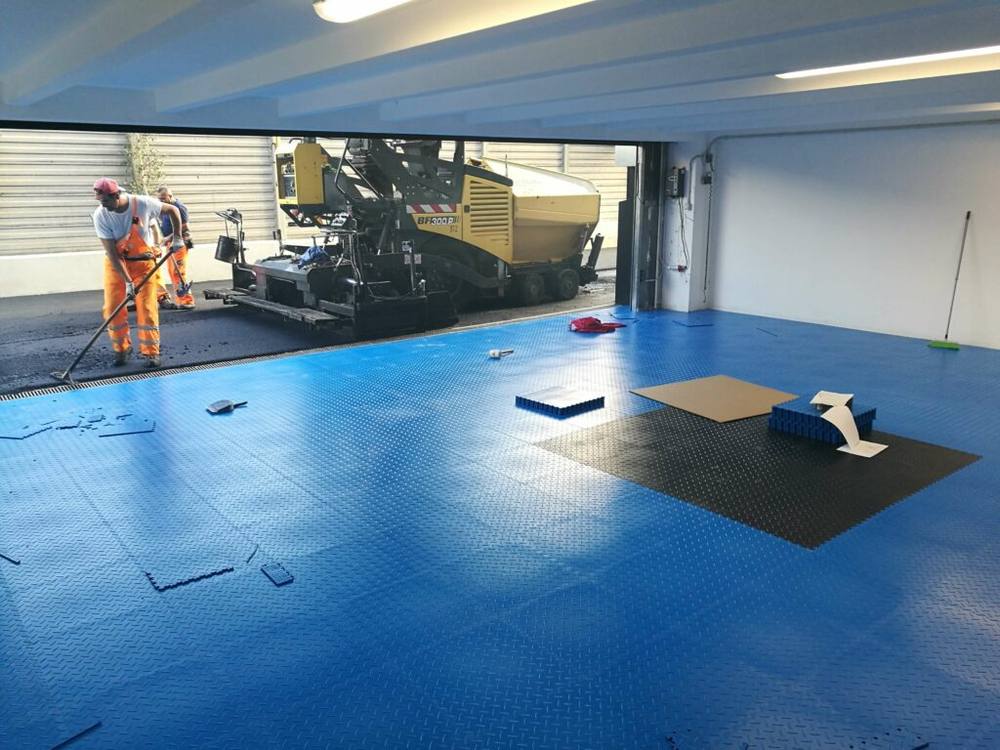
And as for looks? Fortelock offers not only classic technical textures, but also design décors of wood, metal or concrete. So if you're looking for a floor that is both durable and good-looking, you have plenty to choose from. And if you fancy anti-slip properties, ESD properties or higher chemical resistance, these variants are available too.
PVC tiles are suitable for:
- car repair shops, garages and technical workshops
- assembly and packaging operations
- warehouses where fast installation without downtime is important
- commercial spaces, showrooms and shops
- schools, sports and multipurpose halls
- spaces that will change and be modified over time
Epoxy and Fortelock in figures
According to the manufacturer, an epoxy floor can take 3 to 7 days to dry, whereas a Fortelock floor is finished in 3 to 4 hours. Installation rates reach up to 30 m² per hour. For virgin PVC tiles, the manufacturer provides a warranty of up to 12 years from delivery and states a service life of 25 years. The standard ranges have R10 slip resistance according to DIN 51130 and a compressive strength of 520 kg/cm². According to the manufacturer, a damaged tile can be replaced within a few minutes without affecting the rest of the floor.
Epoxy vs. PVC: So which option should you choose?
Both a poured epoxy floor and Fortelock interlocking PVC tiles have their place. One offers maximum durability suitable for specific industrial sectors, the other speed of application, easy maintenance and flexibility. It's not about which of them is objectively better, but which suits your specific space, mode of operation and technical conditions better.
Fortelock tiles are an excellent choice if you're looking for a solution that:
- you can install quickly, without any downtime
- will work even on a problematic substrate
- allows easy replacement or modifications in the future
- offers durability, comfort and an attractive look
Whether you're dealing with a workshop, garage, warehouse or school space, we'll be glad to help you find the most suitable type—from technical versions to design variants. Just get in touch with us.
Frequently asked questions
What are the main disadvantages of an epoxy floor?


Long installation, demands on the subfloor and difficult repairs. Application and curing usually take several days, during which the space cannot be used. The subfloor must be solid, level and free of cracks and moisture, otherwise bubbles and cracks may form. A damaged spot cannot simply be replaced without a visible transition.
Can PVC tiles be laid over old ceramic tiles?
Yes. The technical data sheet permits ceramic and stone tiles as a subfloor, provided they are firmly bonded and the joints are no wider than 4 mm. Fortelock tiles are laid dry on top, so the original tiles usually do not need to be removed. Any loose pieces must be repaired before installation.
Are PVC tiles suitable for operations with hygiene requirements?
For many of them, yes. All ranges meet the requirements for resistance to bacteria according to EN ISO 846, and dirt does not soak into the material. The Business range has the ZeroGap system, which minimises water permeability at the joints, and is easy to clean and disinfect. Where standards require a completely seamless surface, epoxy remains the choice.
Is a PVC floor warmer underfoot than epoxy?
Yes. PVC acts as a thermal insulator with a conductivity of 0.155 W/(m·K), similar to laminate, so the floor does not feel cold. According to the manufacturer, the flexibility of Industry tiles absorbs impacts and reduces back and leg fatigue compared with concrete or epoxy. PVC also dampens noise and machine vibrations.
Are the joints between PVC tiles visible on the floor?
With some ranges, yes. Industry, Industry Ultra and XL have a visible jigsaw-type lock. With Invisible, the joints run in straight lines and the surface looks like a single continuous area. Business has hidden locks and graphite-coloured joints. However, interlocking tiles do not offer a completely seamless surface like epoxy.
How fire-resistant is Fortelock PVC flooring?
All standard ranges have a reaction to fire classification of Bfl-s1 according to EN ISO 13501-1. This applies to Industry, Industry Ultra, Invisible, XL and Business, as well as to both ESD ranges. The technical data sheet also points out that hot and smouldering objects leave permanent marks on the tiles.