10. 9. 2025
A new floor in 24 hours without stopping operations
Why fast floor installation is key
Replacing or renovating a floor is a nightmare in many facilities. It is not just about the construction work itself, but above all the fact that the space has to stay closed for the duration of the installation. In a warehouse, this means goods cannot be dispatched. In a production hall, the lines stand idle and employees have nowhere to work. And in commercial spaces such as fitness centres, car repair shops or school gyms, customers are left standing in front of closed doors.
How long does floor installation take
Traditional flooring systems have one thing in common: their installation is time-consuming and always means shutting down operations. And it is not just the laying itself, but above all the technological breaks that simply cannot be avoided.
- Concrete floor – After pouring, you have to wait for the mixture to cure and dry out sufficiently. It can take several weeks before the surface can take full loads.
- Epoxy coating – It requires a perfectly prepared subfloor and needs several days to cure after application, during which the space is out of service.
- Ceramic tiles – They are laid using adhesive followed by grouting. You therefore need to allow time for drying and hardening before the floor can safely be walked on or driven over by equipment.
Fortelock: a floor without waiting
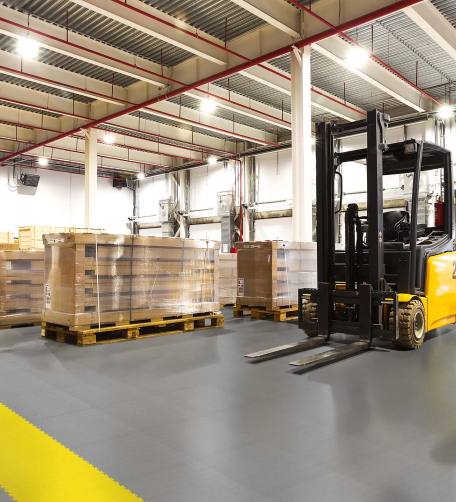
Fortelock takes a different approach. Thanks to the interlocking system, the tiles are laid using the so-called dry method, i.e. without adhesives and long waiting times. The floor can be installed even during full operation, because newly laid areas are immediately walkable and ready to use. In practice, this means you can have a new floor finished within 24 hours on your premises (even on areas larger than 100 m²) – without bringing your business to a halt.
How a floor without downtime works
Fast installation is not an empty marketing promise, but one of the many advantages of Fortelock floors – and above all the practical experience of hundreds of companies that use Fortelock. Thanks to the special interlocking system, PVC tiles are laid completely differently from traditional floors. Gluing, long waiting, complicated construction work… all of that disappears with a PVC floor. In practice, this means you can start using the floor to its full potential immediately after it is laid.
Installation without adhesive and waiting
The speed of installing Fortelock PVC tiles is based on the so-called dry system. The tiles are connected with interlocking joints and laid directly onto the existing subfloor, so there is no need to remove the old floor, use adhesives or wait for mixtures and joints to harden. The newly laid floor is immediately ready for use and full loading.
Levelling out unevenness
Another advantage is the tiles' ability to even out minor irregularities or cover a damaged subfloor. Where a costly repair or complete renovation would otherwise be necessary, simply laying Fortelock is enough. The floor has a robust construction and behaves stably even on an imperfect surface.
Step-by-step installation by zones
In large halls or warehouses, it is often unrealistic to close off the entire area at once. The modular system, however, makes it possible to work in sections. So while installation is under way in one zone, the rest of the hall remains in operation. For you, this means you do not have to interrupt operations – not even for a single day.
Finished in a single day
Thanks to the combination of fast installation and the option of working by zones, a new floor can be installed even on large areas within 24 hours. Unlike epoxy or concrete, where long technological breaks have to be factored in, Fortelock is functional immediately, with no waiting and no need to shut down operations.
No adhesive odour
Because no adhesives or chemical mixtures are used, no unpleasant odour arises during installation. This is an advantage especially in enclosed spaces, where a traditional solution could complicate employees' work or the running of equipment beyond the shutdown during the installation itself.
How Fortelock tile installation works
One of Fortelock's greatest advantages is that installation requires no complicated construction work or long shutdowns. Thanks to the interlocking system, the whole process is fast, clean and can be completed even on an area of hundreds of square metres in a single day.
1. Preparing the subfloor
Unlike epoxy or glued tiles, the subfloor does not need to be perfectly levelled or specially treated. It is enough to remove larger irregularities, dust and loose parts. The subfloor can be concrete or asphalt, and even an original old covering is not a problem.
2. Laying the tiles
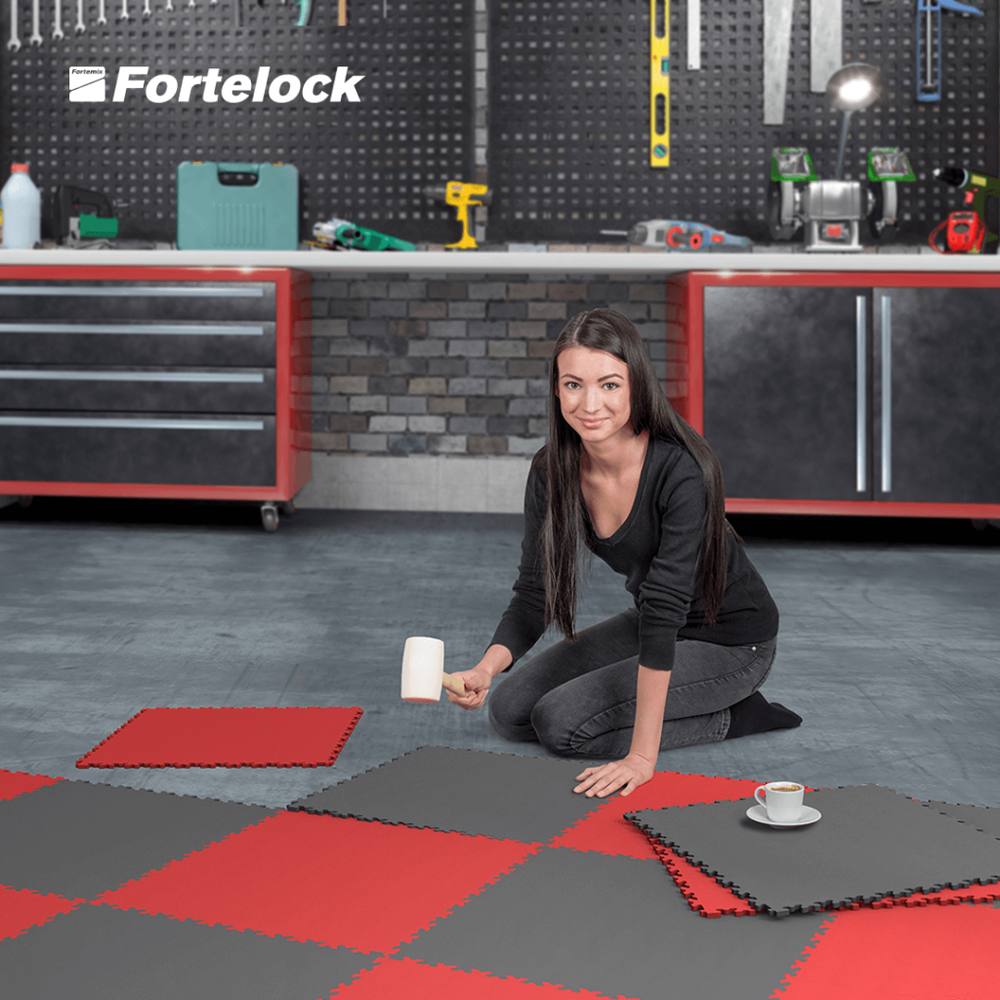
The tiles are joined using precise interlocking joints that click into each other. Installation is done dry, without adhesives and without waiting for anything to cure. When laying a larger area, it is advisable to start from the centre of the room and work towards the edges so that the surface is evenly tensioned.
3. Cutting and fitting
Edges and corners are easily adapted by cutting. This makes it possible to lay the floor even in more complex layouts, around machines or structures.
4. Immediate use
As soon as the floor is laid, it is immediately ready for use. No waiting, no technological breaks – operations can continue virtually without restriction.
5. Easy future modifications
If the layout of the space changes over time or a specific tile gets damaged, it can be easily removed and replaced with a new one. This is another big advantage of Fortelock floors over traditional solutions, where any repair means a complicated intervention across the entire surface.
What needs to be in place before installation
For the floor to be laid within a single day, the tiles must be prepared in advance. The technical data sheet requires acclimatisation for at least 48 hours at 18–26 °C directly in the room of installation, with the tiles removed from the pallets and spread out. The subfloor temperature must not drop below +15 °C, and during installation and for 24 hours afterwards the temperature must remain stable within 18–26 °C. An expansion gap of 10 mm is left from walls, columns and racking, and is covered by a skirting board. On areas larger than 100 m², a grid of perpendicular lines is marked out before installation.
Who Fortelock flooring is ideal for
Fortelock tiles can be used practically anywhere a durable floor is needed and where stopping operations for several days would pose a significant problem. And it does not matter whether it is a smaller space or vast halls covering hundreds of square metres.
Flooring for warehouses and logistics centres
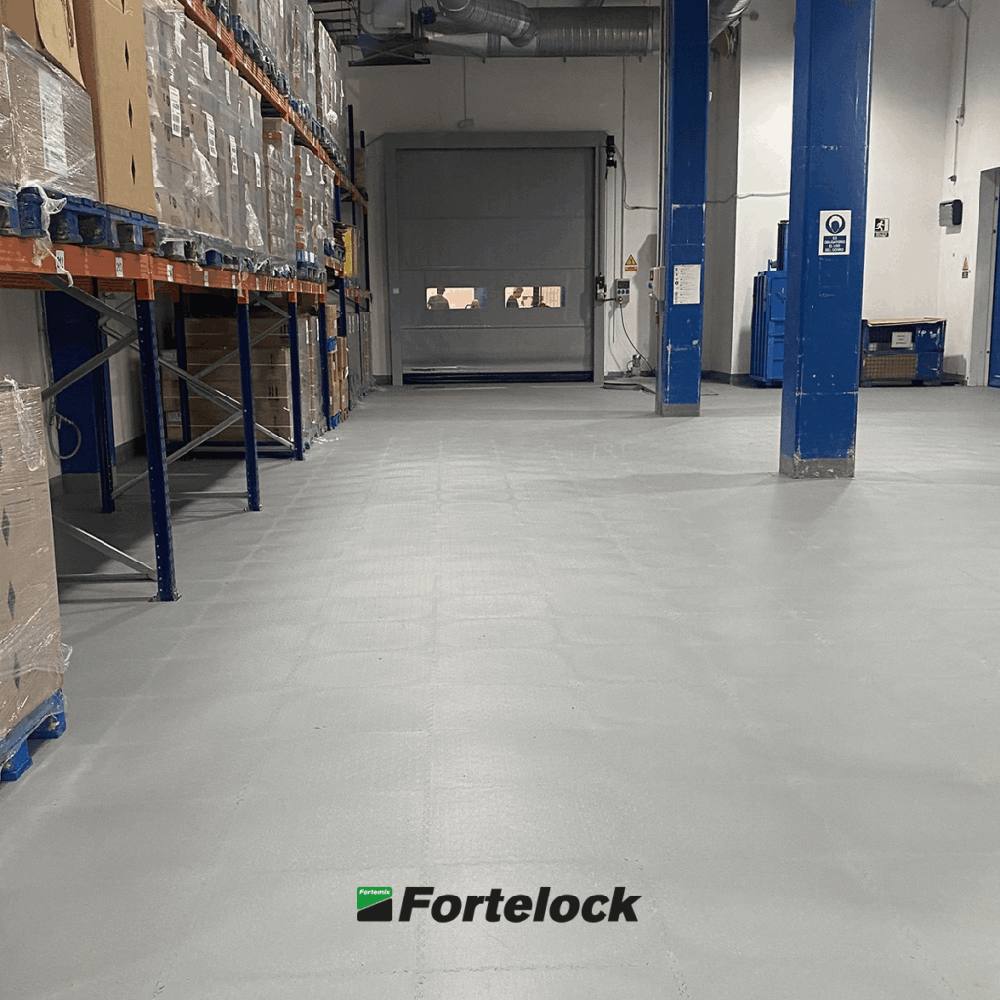
In warehouses, downtime means immediate financial losses. That is why a Fortelock floor pays off not only in the long run, but from the very moment it is laid. Because it can be installed in a single day (and in sections, on top of that), there is no need to interrupt the operation of the warehouse or logistics centre even for a moment. In addition, it offers excellent resistance to point loads and chemicals, making it the ideal choice for the everyday operation of forklifts and handling equipment.
The most suitable tile types for warehouses
- Fortelock Industry – a universal choice for warehouses with heavy loads and forklift traffic
- Fortelock Industry Ultra – for logistics centres with round-the-clock operation and extreme loads
- Fortelock Invisible – when a clean, representative look matters as much as durability
Main advantages of Fortelock flooring for warehouses
- the floor is laid within 24 hours, with no need to interrupt operations
- withstands point pressure of up to 520 kg/cm²
- resistance to oils, fuels and chemicals
- quick local repairs possible without downtime
- anti-slip surface for greater safety
Flooring for production halls without stopping operations
Stopping production is always costly and complicated. In production halls, Fortelock can also be laid zone by zone, so part of the hall stays in operation while another is being renovated, and the complete floor installation can easily be finished within 24 hours. On top of that, the floor withstands the demanding mechanical and chemical loads that are common in industry.
The most suitable tile types for production halls
- Fortelock Industry – suitable for engineering production, light and medium industry
- Fortelock Industry Ultra – for heavy industry, steelworks or automotive plants where the floor faces the greatest loads
- Fortelock ESD – for production areas with electronics or electrical components where electrostatic discharge control is required
Main advantages for production halls
- the floor can be laid within 24 hours, even in sections
- high resistance to mechanical loads and machine vibrations
- resistance to liquids, oils and industrial chemicals
- fast installation, even by zones, without interrupting production
- easy maintenance and a hygienic, non-absorbent surface
Frequently asked questions
Is it really possible to have a new floor in a hall within 24 hours?


Yes, as long as everything is prepared. With dry laying without adhesive, there is no waiting for anything to cure, and the manufacturer states an installation rate of up to 30 m² per hour. The work can be done zone by zone during operation. However, the tiles must first acclimatise for at least 48 hours in the room where they will be laid.
Can Fortelock PVC tiles be laid on an asphalt subfloor?
Yes, the technical data sheet permits asphalt and bitumen subfloors, but with conditions. The maximum load of the subfloor itself must be respected, and the asphalt must be covered with a separating layer, for example a 500 g/m² non-woven geotextile. This separates the tiles from the subfloor material. Before installation, it is advisable to check whether the subfloor can bear the planned traffic.
Where do you start laying tiles in a hall?
It depends on the range. Industry, Industry Ultra and XL are laid from the entrance along two perpendicular lines running from the centre of the room, with the visible part of the lock facing the direction of laying. Invisible, Invisible XL and Business are laid from left to right diagonally from a corner. You will find details in the installation instructions.
What point load can Fortelock PVC tiles withstand?
The compressive point load for all ranges is 520 kg/cm² (50 MPa) according to EN ISO 604-1, and the technical data sheet prohibits exceeding this value. Separate dynamic load limits, which vary by range, apply to trucks and cars driving over the floor. More is explained in the article What is point load on a floor and why you shouldn't underestimate it.
Does laying a Fortelock floor create odours or dust?
Practically none. With loose laying, no adhesives or chemical mixtures are used, so there is no odour and no mixing or grinding. PU adhesive is used only where gluing is necessary, for example in direct sunlight, near heat sources or with large temperature fluctuations.