1. 2. 2026
Can you lay a new floor over old concrete?
The trouble is that not every floor can cope with old concrete. Some require a perfectly level, dry and solid subfloor. Others, by contrast, handle minor unevenness and defects without any impact on their functionality or lifespan. In this article we look at which floor you can lay over old concrete and what is better to avoid.
Why old concrete is a problem for most floors
Unevenness and defects in old concrete are not just a matter of appearance. In practice they very quickly affect the behaviour of the whole floor, its lifespan and the safety of operation. What looks like a slight bump or a hairline crack at first glance often turns into a recurring problem once the new covering is laid, one that can no longer be fixed locally.
Unevenness and local depressions
Old concrete tends to be wavy, sunken in places or has differences in level that developed gradually through loading, settling of the building or long-term operation. Hard floors on such a subfloor do not distribute the load evenly. The weight of machinery, racking or a car then concentrates in specific spots where the floor takes a much heavier beating. The result is cracks, peeling coatings, breaking tiles or permanent surface deformations that gradually get worse.
Cracks and a moving subfloor
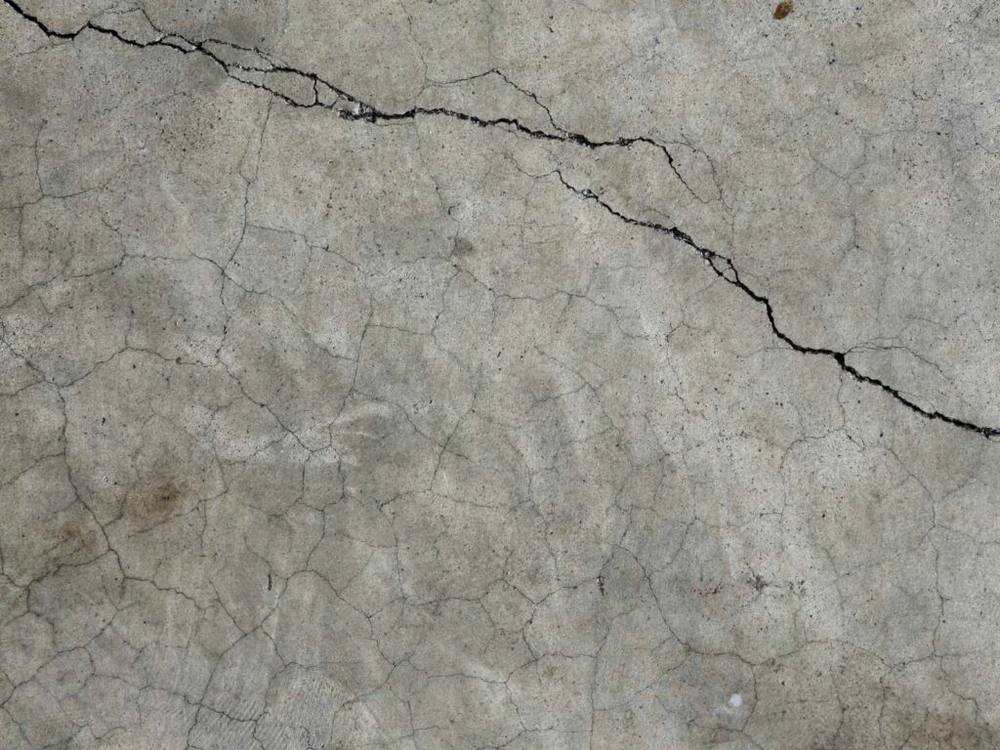
Even after years, concrete keeps moving, expanding and contracting, reacting to temperature, moisture and loading. Cracks that look like cosmetic flaws today widen over time or join up with other cracks. If you cover them with a rigid floor, the problem is not solved, it simply moves upwards. The new floor starts copying the movement of the concrete, and hairline cracks, flaking or visible marks appear where the original cracks were.
Moisture in the subfloor
Moisture is a very common problem in older buildings. The concrete often has no proper waterproofing, or it has stopped doing its job. Residual or rising moisture is a major complication above all for glued and poured flooring systems. Adhesives and screeds do not hold long-term on a damp subfloor, and over time blisters, stains, peeling or softening of the surface appear. Moreover, these defects usually cannot be repaired locally and require work on the entire area.
Dust and a degraded surface
Many old concrete slabs have a weakened top layer. The concrete gives off dust, crumbles or the surface gradually breaks down. If a new floor is laid on such a subfloor without thorough preparation, it has no stable base. The floor then quickly loses its properties, starts to move, the surface gets damaged and problems appear much sooner than they should. This applies especially to coatings, epoxies or glued coverings, which are extremely sensitive to the quality of the subfloor.
Which types of floors fail most often on old concrete
When choosing a new floor for old concrete, the common mistake is to focus mainly on price or looks rather than on the actual condition of the subfloor. Some systems only work trouble-free when the concrete is nearly perfect. As soon as it is not, problems start to appear sooner or later.
Epoxy and polyurethane screeds
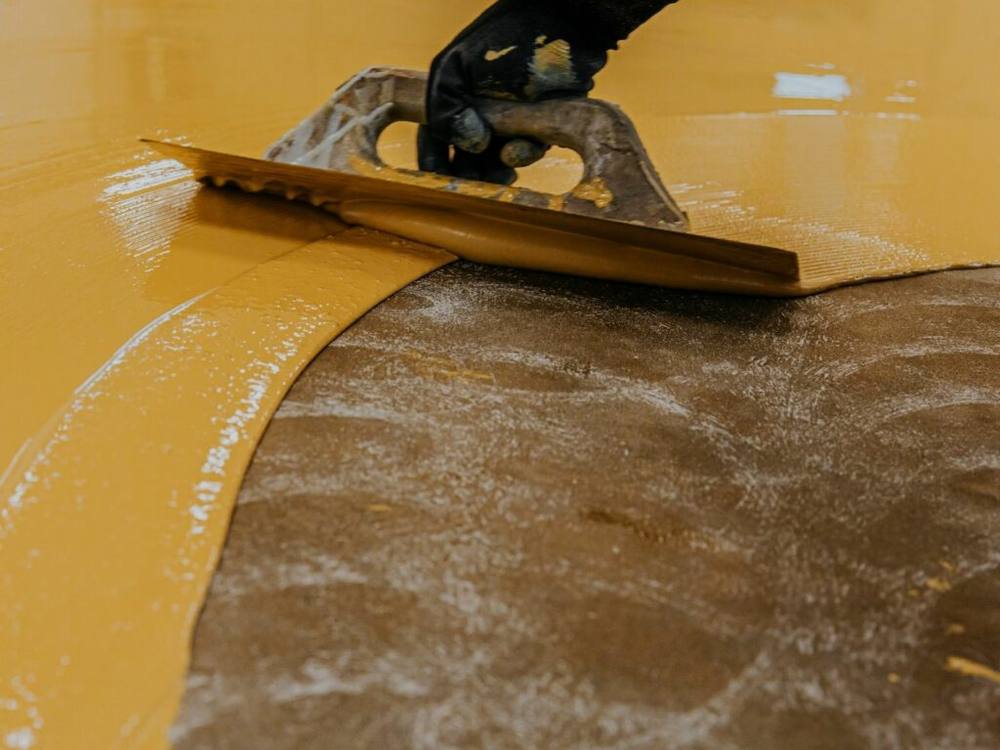
Poured screeds look like the ideal solution at first glance. They are smooth, seamless and easy to maintain. The problem is how demanding they are on the subfloor. Epoxy requires level, dry and solid concrete free of cracks and moisture.
When laid over old concrete, blisters, stains or peeling patches therefore appear very often. As soon as the concrete starts to move or moisture appears, the screed has no ability to absorb the movement and starts to crack. Repairs tend to be complicated and almost always visible.
Concrete and protective paints
Paints are tempting mainly for their price and easy application. On old concrete, however, they usually work only for a short time. If the surface is dusty, absorbent or cracked, the paint quickly starts to peel, fade and lose adhesion. In areas with heavier traffic, worn tracks and stains appear that can no longer be removed. Paint therefore often solves the problem only visually, not technically.
Ceramic tiles
Ceramic tiles can look good on old concrete, but only at the cost of very thorough subfloor preparation. Unevenness, cracks or slight movements of the concrete quickly show up as cracking tiles or crumbling grout. Point loads from machinery, racking or a car further increase the risk of damage. Once one tile starts to crack, the problem often spreads.
What demanding subfloor preparation for these floors looks like
Precisely because most conventional floors fail on old concrete, there is so much talk about the need for "thorough subfloor preparation" when installing them. In reality, though, this is no minor touch-up but a separate and often the most demanding phase of the entire renovation.
In practice it often means:
- milling or grinding the entire surface
- repairing cracks and local unevenness
- applying primers and levelling compounds
- waiting for the subfloor to dry and cure
- and last but not least, completely clearing out the space
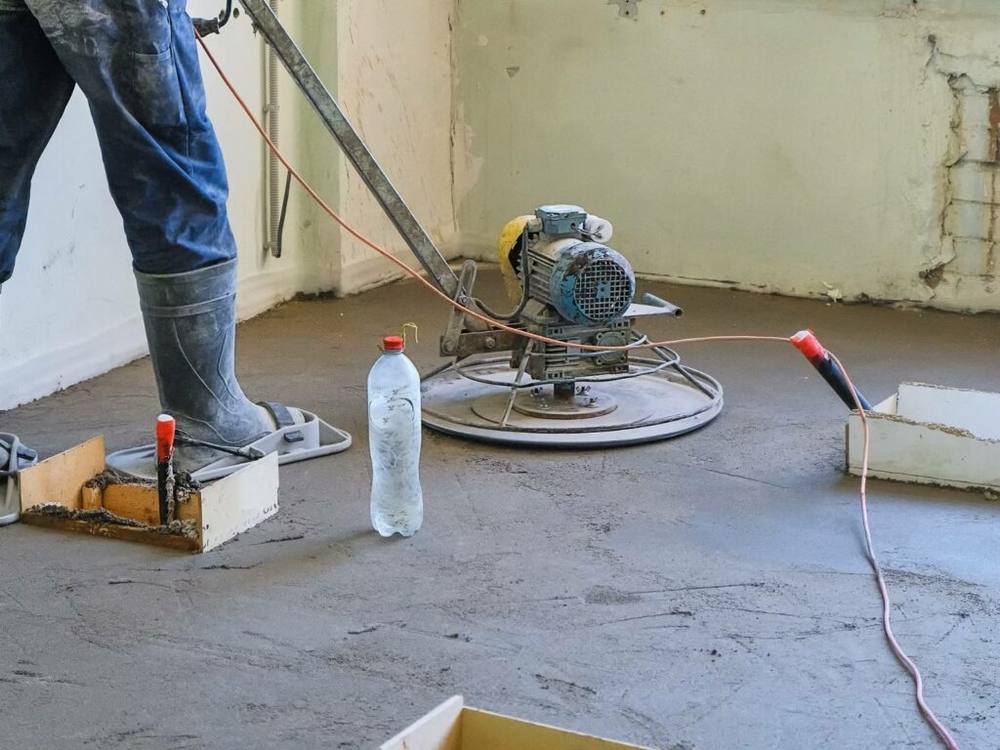
Such a process is not only costly but above all time-consuming. In working facilities it often means a shutdown of several days, sometimes even weeks, during which the space cannot be fully used. That is exactly why it makes sense to look for a solution that can handle old concrete without these steps, without milling, levelling compounds and long technological breaks.
Which floors can handle old concrete without milling and levelling
If you do not want to deal with costly grinding, screeding and long technological breaks, the choice of floors narrows considerably. Below are the types of floors that cope best with the reality of an old subfloor.
Modular interlocking PVC tiles
The most reliable solution for old concrete without complex preparation. Thanks to their design they are in most cases laid loose and "float" on the subfloor, so they do not pick up minor unevenness or hairline cracks. The partial flexibility of the material spreads the load more evenly and dampens the micro-movements of the concrete. The result is a stable surface with no cracking, staining or peeling.
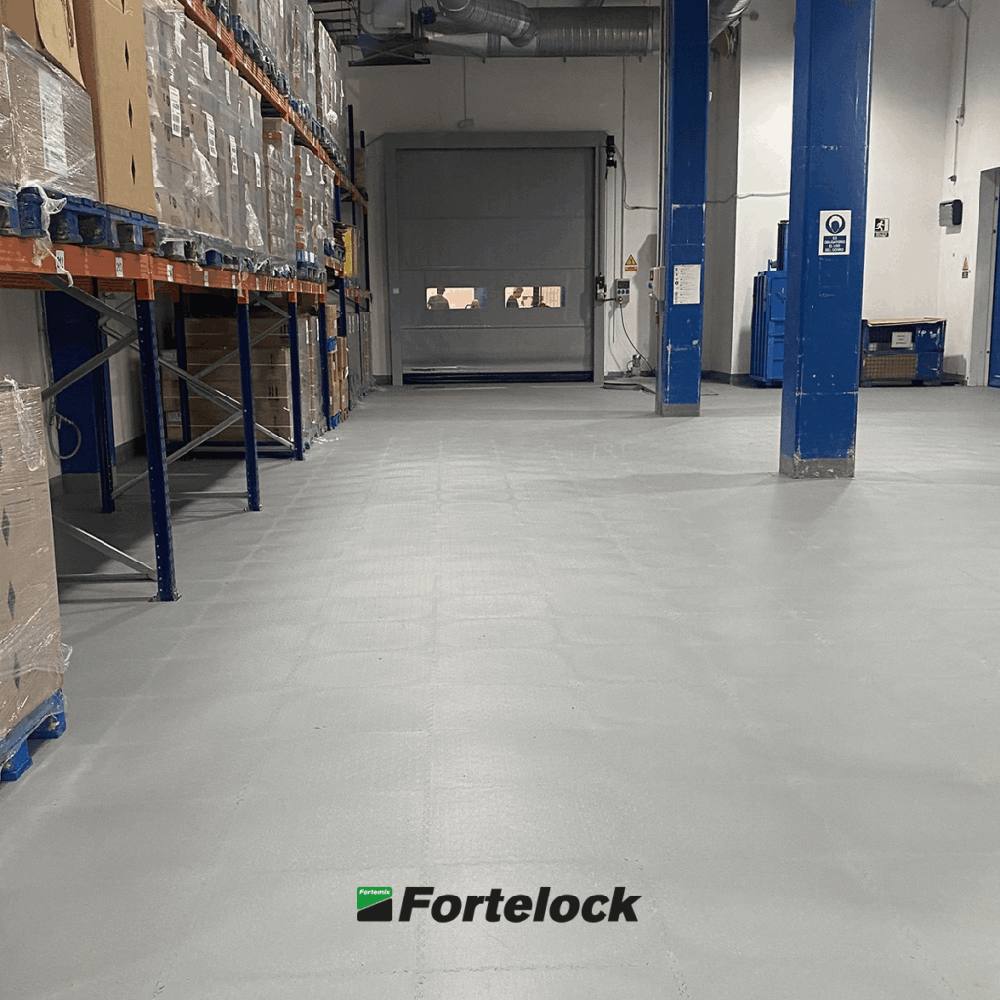
Another big advantage is their tolerance of slight residual moisture and the option of local repairs. If a spot gets damaged over time, you replace just one tile. This is exactly how the Fortelock interlocking PVC tiles are designed. Our clients have been using them for years in warehouses, workshops, garages and production halls, in short wherever the subfloor is not ideal and investing in demanding concrete preparation does not pay off.
Thicker rubber tiles
Rubber mats can partially bridge minor unevenness and absorb impacts well. On old concrete they can work where absolute flatness is not required and where a greater build-up height is not an issue. You do, however, need to bear in mind that they solve neither moisture nor degraded concrete, and on larger areas the stability and appearance of the joints can be problematic.
Floating systems with a high build-up height
There are also special floating floor systems with load-bearing panels that "cover up" the unevenness. These systems are, however, expensive, structurally complex and often needlessly robust for ordinary operations. In practice they are used only rarely, for example when dealing with an extremely poor subfloor.
Why modular PVC tiles work even on uneven concrete
The main difference between modular PVC tiles and most conventional floors lies in how they work with the subfloor. While poured or glued systems try to "tame" the concrete and force it into perfection, modular tiles are designed to adapt to its actual condition.
They are not firmly bonded to the subfloor
Interlocking PVC floor tiles are usually laid loose, without adhesive and without a fixed bond to the concrete. This means that minor unevenness, hairline cracks or local height differences are not transferred directly into the floor surface. On concrete the tiles spread the load over a larger area instead of concentrating it in problem spots.
Partial flexibility dampens the movement of the concrete
Concrete keeps moving slightly over time. It reacts to changes in temperature, moisture and loading. Hard, rigid floors cannot cope with this movement and crack. PVC tiles, on the other hand, have controlled flexibility that lets them absorb these micro-movements. The floor therefore does not deform, and no cracks or peeling patches develop.
Tolerance of minor defects and residual moisture
Unlike glued systems, modular PVC tiles are not bothered by slight residual moisture in the concrete. No blisters or stains form, because the floor is not sealed under an impermeable layer of adhesive or screed. Minor crumbling of the surface or old repairs are no problem either. The tiles cover these imperfections without any negative effect on functionality.
The option of local adjustments and repairs
If a spot proves more problematic over time, there is no need to touch the whole area. Individual tiles can be lifted out, the subfloor locally repaired and the tile put back. This is a great advantage especially in old buildings, where the condition of the concrete can vary from one part to another.
What old concrete must meet before installation
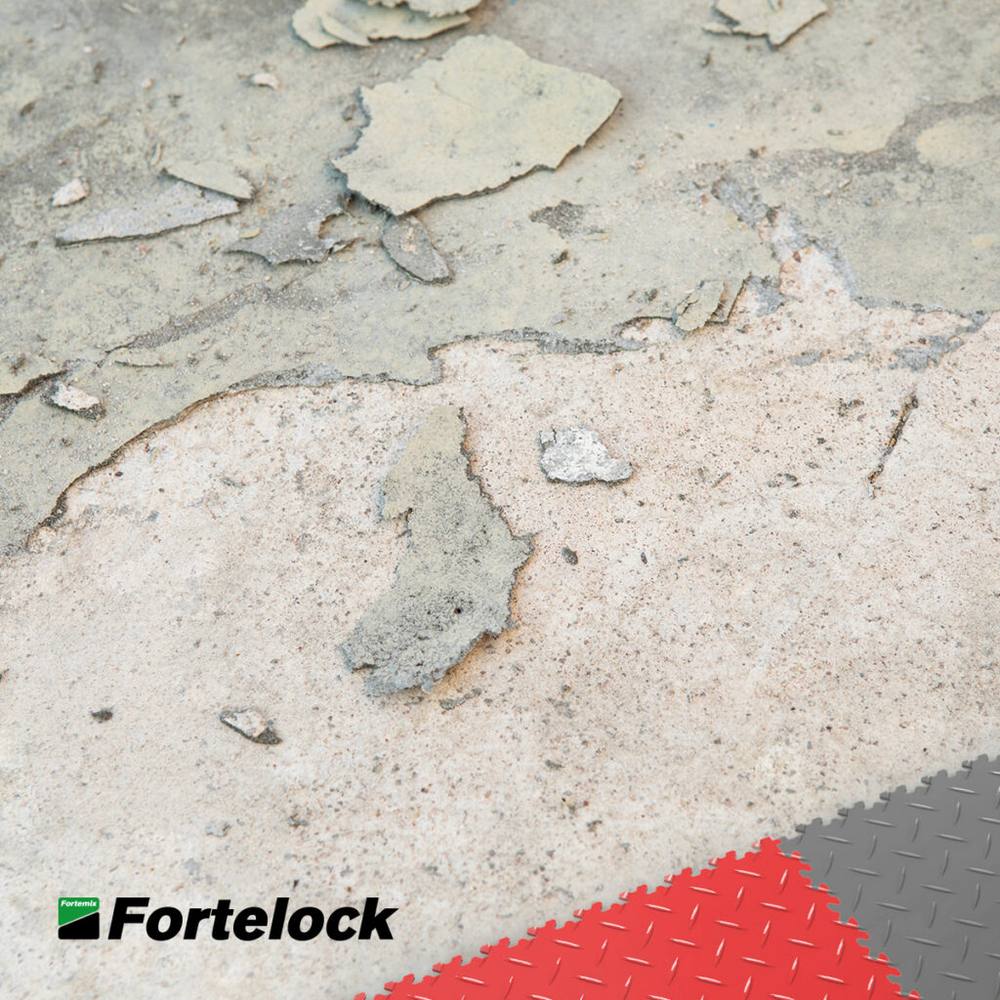
The Fortelock technical data sheet sets several clear limits for a concrete subfloor. The concrete must be level and solid, with a moisture content of no more than 3.5%. Raised areas of more than 7 mm over 2 m must be ground down. Cracks up to 4 mm do not need to be repaired; wider ones must be filled. Before installation, the tiles are left to acclimatise for at least 48 hours at 18–26 °C, and the subfloor temperature must not drop below +15 °C. An expansion gap of 10 mm is left from walls and fixed points. If the subfloor does not meet these limits, its preparation is taken care of by professional installation from Fortemix.
Frequently asked questions
Can you lay interlocking floor tiles on old concrete?


Yes, Fortelock interlocking PVC tiles can be laid on both new and old subfloors, mostly loose without gluing. However, the old concrete must be solid, with a moisture content of up to 3.5% and no raised areas of more than 7 mm over 2 m. Minor cracks up to 4 mm do not need to be repaired.
What should you do about cracks in old concrete before laying a new floor?
According to the technical data sheet, cracks up to 4 mm wide do not need to be repaired, as the tiles cover them. Wider cracks must be filled and raised areas of more than 7 mm over 2 m ground down. How to deal with more significant unevenness is explained in the article Flooring for Uneven Concrete: A Solution Without Milling.
Why does epoxy peel off old concrete?
Epoxy requires level, dry and solid concrete. On an old subfloor without working waterproofing, residual moisture trapped under the impermeable layer creates blisters and stains, and the screed starts to peel. When the concrete moves, the screed cannot absorb the movement and cracks along with it. Repairs tend to be complicated and visible.
Can PVC tiles be laid over old tiles or epoxy?
Yes, as long as the original layer is solid. Ceramic and stone tiles must be firmly bonded, with joints of up to 4 mm. You can lay over epoxy, linoleum or PVC if the surface is solid and cohesive, but compatibility must be tested first, because old plasticised PVC can damage Fortelock tiles.
How long do you have to wait before laying flooring on concrete?
It depends on moisture, not on the number of days: for laying Fortelock tiles, concrete or cement screed may have a moisture content of no more than 3.5%, and anhydrite screed 0.5%. The tiles themselves also need to acclimatise in the room for at least 48 hours at 18–26 °C before installation.