7. 9. 2025
Warehouse Flooring: What Withstands Forklifts and Chemicals
What demands must a warehouse floor meet
A warehouse floor has to cope with conditions that would quickly damage an ordinary floor. Every day it faces heavy loads from forklifts, pallets and racking, contact with oils and chemicals, and frequent cleaning. On top of that come the safety requirements that a warehouse environment often places on the floor, such as slip resistance, a level surface and the ability to carry out quick repairs without shutting down operations. For a warehouse floor to hold up in the long term, it must be designed to combine mechanical resistance, easy maintenance and the simplest possible operational solution.
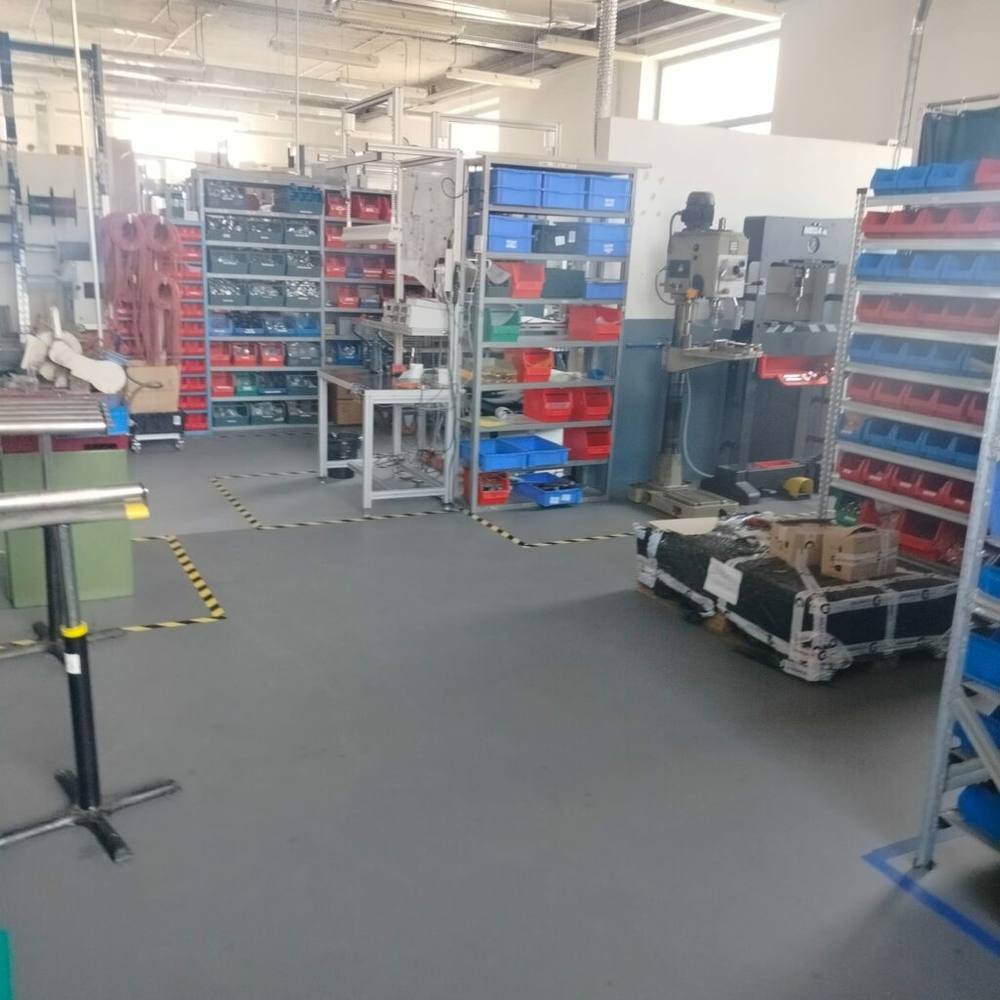
High resistance to point pressure and loads
Forklifts and pallet trucks exert enormous pressure concentrated into the small contact areas of their wheels. If the floor lacks sufficient compressive strength, it gradually deforms, cracks and loses its flatness. This complicates not only the operation of equipment but also workplace safety. A warehouse floor must therefore be designed for long-term loading without the risk of damage.
Resistance to chemicals and oils
Warehouses handle all kinds of liquids, from motor oils and hydraulic fluids through cleaning agents to highly aggressive chemicals. Spilled substances must not damage the floor or leave permanent stains. A quality surface is therefore non-absorbent, resistant to chemicals and easy to clean, so that it stays safe and looks presentable even after years of use.
Easy maintenance and safety
Practice shows that it is precisely maintenance that determines the lifespan of a floor. A surface that can be cleaned and maintained easily saves both time and operating costs. Another key requirement is slip resistance. Heavy loads are frequently carried and equipment is handled in a warehouse, so even a small slip can have serious consequences.
Fast installation and the option of repairs
Every day of warehouse downtime means a financial loss. It is therefore essential that the floor can be installed quickly, ideally without interrupting operations. The option of easy repairs is just as important. If part of the surface gets damaged, it should be possible to replace only the specific piece, not the entire area.
What types of flooring are used in warehouses
When it comes to flooring for warehouse spaces, there are several options. Each of them, however, has different properties, lifespan and maintenance requirements. Let's take a look at which variants are used in practice and where their weaknesses may lie.
Concrete – a cheap base with a limited lifespan
A concrete slab is the most common solution because it serves as the basic structural element. On its own, however, it quickly shows its weaknesses. Without a special treatment it absorbs oil and chemicals, starts to get dirty and gradually generates dust.
Under heavy loads, for example with frequent forklift traffic, which is a common occurrence in a warehouse, cracks and unevenness develop as well. Concrete therefore works as a substrate, but for long-term warehouse operation it usually requires an additional protective layer.
Advantages of a concrete floor in a warehouse:
- low purchase costs
- easy availability and fast installation
- strong enough as a structural base
Disadvantages of a concrete floor in a warehouse:
- without a surface treatment it is absorbent, gets dirty quickly and generates dust
- prone to cracking under point loads and temperature fluctuations
- more demanding maintenance
Epoxy coating – a smooth surface, but demanding maintenance
Epoxy creates a uniform, seamless surface that is easy to clean and resists chemicals. But even epoxy has its "buts". Installation is technically demanding, requires a perfectly prepared substrate and a longer curing time, during which operations are shut down.
If the floor gets damaged, repairs tend to be complicated and often mean intervening in a larger area. For warehouses that expect frequent handling and high point loads, epoxy may not always be the most practical choice.
Advantages of an epoxy floor in a warehouse:
- a uniform, seamless surface suitable for hygienic operations
- high resistance to chemicals and oils
- easy to clean as long as the surface is undamaged
Disadvantages of an epoxy floor in a warehouse:
- high demands on substrate quality
- time-consuming installation (downtime required)
- difficult and costly repairs when part of the floor is damaged
- cracks may appear under heavy point loads
Rubber tiles – impact absorption, but load-bearing limits
Rubber tiles are used mainly where impacts and noise need to be dampened. In typical warehouses, however, they run into their limits, especially when it comes to point loads from forklifts. When heavy racking stands in place for long periods or equipment drives over them, deformation can occur. Rubber is therefore better suited to workshops or lighter operations than to large warehouse halls.
Advantages of a rubber floor in a warehouse:
- excellent absorption of impacts and vibrations
- significant noise reduction during operation
- a slip-resistant and durable surface
Disadvantages of a rubber floor in a warehouse:
- lower resistance to point loads (forklifts, heavy racking)
- harder to relocate due to the higher weight of the tiles
Fortelock interlocking PVC tiles – durability and practicality in one
Modular PVC tiles are proving to be one of the most versatile solutions in warehouses. Thanks to their robust construction they handle high point loads from forklifts and pallet trucks, the surface is resistant to chemicals and easy to clean.
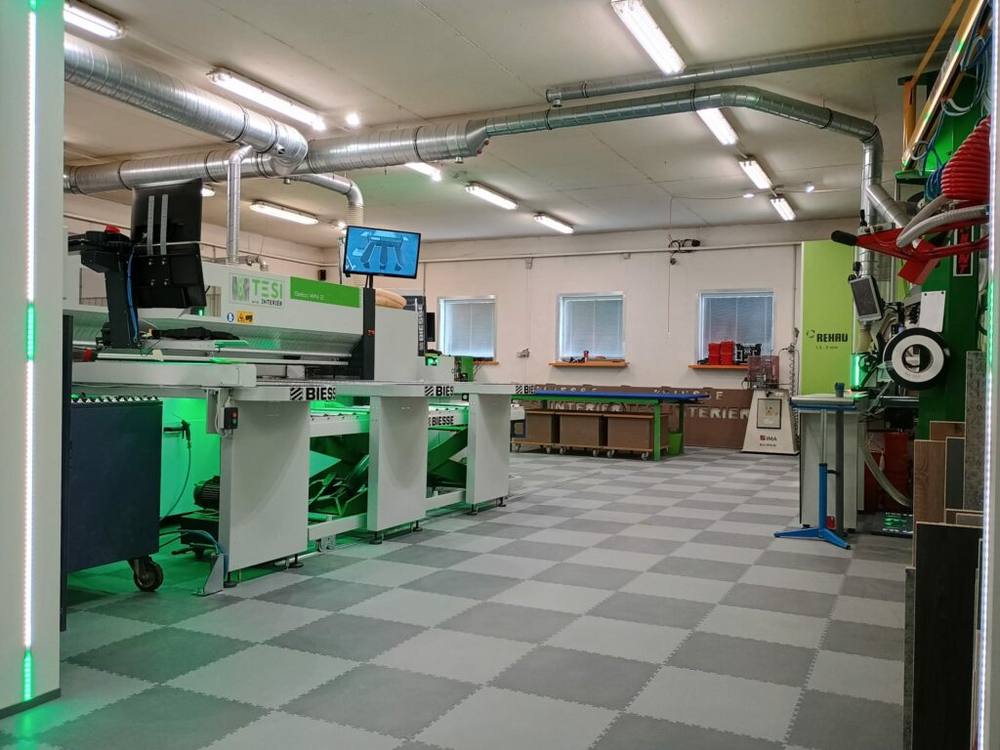
Another big advantage is glue-free installation. The floor can be laid quickly, without downtime, and if damage occurs, it is enough to replace only the specific piece. This makes Fortelock flooring the ideal choice for warehouses that expect intensive traffic as well as a long service life.
Advantages of a Fortelock floor in a warehouse:
- high load capacity and resistance to point pressure
- resistance to oils, chemicals and salt
- fast, glue-free installation with no operational downtime
- local repairs possible simply by replacing individual tiles
- easy maintenance and a slip-resistant surface
- a wide range of types and formats to suit the type of operation
Disadvantages of a Fortelock floor in a warehouse:
- a higher purchase price than basic concrete (but offset by a long lifespan and easy maintenance)
Why Fortelock PVC tiles prove themselves in warehouses
A warehouse is an environment where every detail counts. The floor here has to handle not only the weight of pallets and frequent forklift traffic, but also oils, chemicals and dust. Fortelock interlocking PVC tiles have therefore become a popular choice for small warehouses as well as large logistics halls. They combine everything you expect from them in the demanding conditions of warehouse spaces: durability, flexibility and easy maintenance.
Thanks to their robust construction they can carry even long-term point loads from forklifts and racking systems. The surface is non-absorbent, so it withstands oils, fuels, salts and cleaning agents. It is easy to clean, even in operations where you deal with dust or frequent cleaning.
A major advantage is also the fast, glue-free installation. The floor is ready for use practically immediately, which minimises downtime. Moreover, if a tile gets damaged, there is no need to touch the entire area – you simply replace the specific tile. That saves time, money and worry.
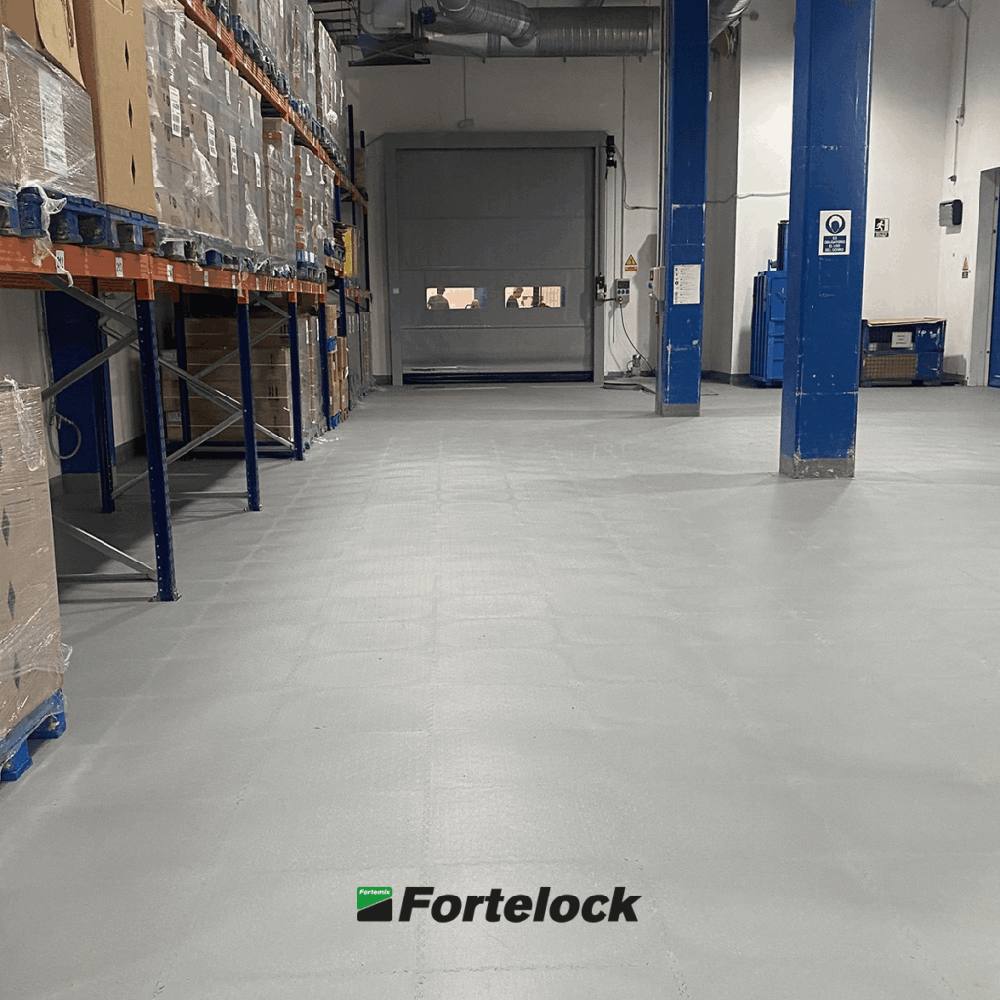
The most suitable types of Fortelock flooring for warehouses
Not every warehouse has the same conditions. In some, the floor faces only lighter loads from smaller trucks; in others, it has to handle non-stop forklift traffic. That is why Fortelock offers several variants of interlocking PVC tiles that differ in load capacity, format and other properties – so you can choose exactly the one that matches the requirements of your warehouse.
Fortelock Industry and Industry Ultra for maximum durability
These ranges are designed for operations with the highest loads. The Fortelock Industry range is intended for warehouses where the floor faces heavy loads but is not exposed to truly extreme conditions. It easily handles the daily operation of forklifts, racking systems and handling equipment in a typical logistics or production warehouse. It is suitable wherever long service life, chemical resistance and easy maintenance are required, but operations are not constantly pushed to the limit.
Where Fortelock Industry fits best:
- typical logistics warehouses with daily forklift traffic
- production halls with racking systems and handling equipment
- warehouses with frequent movement of pallets and goods, where long service life matters
By contrast, Fortelock Industry Ultra is the solution for environments with truly extreme loads. Thanks to its reinforced construction it can handle even higher point loads (up to 520 kg per 1 cm²) and frequent on-the-spot turning of heavy machinery. It is suitable for warehouses handling heavy metal parts and oversized pallets, or where intensive forklift traffic runs practically non-stop. Industry Ultra therefore finds its place above all in the automotive industry, metallurgical plants, engineering works and large logistics halls where durability comes first.
Where Fortelock Industry Ultra fits best:
- the automotive industry, metallurgical and engineering plants
- large logistics halls with non-stop forklift traffic
- warehouses handling heavy metal parts or oversized pallets
- environments with extreme point loads
How much each range can carry under truck traffic
The technical data sheet states the maximum dynamic load including the weight of the truck, tested at 23 °C and a speed of 5 km/h. When laid loose, Industry withstands a pallet truck with PU wheels of up to 500 kg, an electric pallet truck of up to 700 kg and forklifts on pneumatic tyres of up to 6,600 kg. Industry Ultra handles a pallet truck of up to 1,300 kg, an electric forklift with PU wheels of up to 2,900 kg and an electric reach truck with rubber wheels of up to 5,100 kg. Invisible can carry vehicles on pneumatic tyres of up to 3,500 kg. Once glued or fixed, the technical data sheet gives the same values for Industry, Industry Ultra and Invisible, for example an electric forklift of up to 2,900 kg. During operation, avoid spinning wheels on the spot and sharp braking.
Fortelock Invisible for a clean look
Invisible combines the same technical durability as Industry, but with a more aesthetic finish. Thanks to special interlocking joints, the seams are almost invisible, which you will appreciate in logistics centres, showroom warehouses or warehouses with an emphasis on a presentable appearance.
Where Fortelock Invisible fits best:
- logistics centres with an emphasis on the aesthetics of the operation
- showroom warehouses and exhibition spaces
- warehouses that need to combine durability with a presentable look
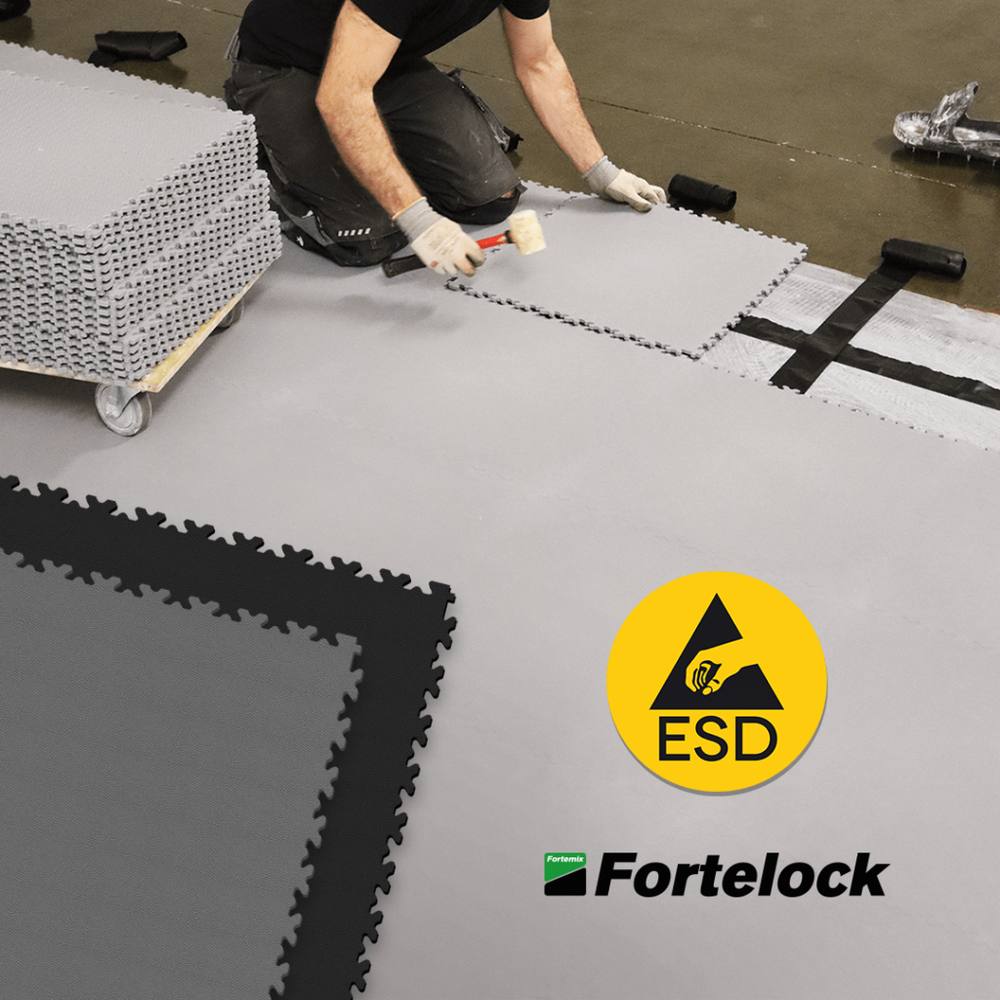
Fortelock ESD for electrostatically sensitive areas
If you store or handle electronics, components or explosive substances, you need to prevent electrostatic discharges. Fortelock ESD has a conductive finish that dissipates the charge in a controlled way, protecting the goods as well as personnel and equipment.
Where Fortelock ESD fits best:
- warehouses with electronics and electronic components
- areas where explosive substances or chemicals are handled
- pharmaceutical and medical warehouses with sensitive instruments
- production and service areas where ESD protection is required
Why Fortelock pays off in a warehouse
The right floor is just as important for a functioning warehouse as racking or handling equipment. If it cannot withstand demanding operations, the result is not only higher maintenance costs but also frequent downtime and lower workplace safety.
Fortelock interlocking PVC tiles combine high mechanical and chemical resistance with simple installation and the option of local repairs. Thanks to the Industry, Invisible and ESD variants and solutions for uneven substrates, you can choose exactly the floor that matches the character of your warehouse. What's more, even after years of operation, individual tiles can be easily replaced, keeping the floor in perfect condition without complicated and expensive repairs.
Frequently asked questions
Do tiles under warehouse racking have to be glued?


Yes, where the racking stands. If a heavy load such as racking or a machine stands on the laid tiles, the technical data sheet considers the installation to be fixed, and the tiles in that area must be glued or mechanically secured. The point load must not exceed 520 kg/cm². Find out more in the article Flooring under racking: What loads it must withstand and why it matters.
Is PVC warehouse flooring resistant to oils and chemicals?
Yes. The surface is highly resistant to oils, petrol and common chemicals, and liquids do not soak into the material. However, spilled oils and petroleum-based substances must be wiped up as soon as possible, otherwise there is a risk of discolouration. Fortemix's sales department can advise on resistance to specific chemicals.
How do you mark out routes and zones in a warehouse directly in the floor?
With coloured tiles and marking strips. Marking strips for Industry, Industry Ultra and XL mark out pedestrian walkways, handling routes or areas for goods. A narrow and a wide tile together make up the size of one standard tile, so the markings fit into the grid without cutting and can be changed at any time by swapping tiles.
How often should a warehouse floor be cleaned?
Daily, according to the maintenance guide. For commercial spaces and warehouses, daily cleaning with Forteclean Daily Cleaner and deep cleaning twice a year with Forteclean Intense Cleaner are recommended. For machine cleaning, choose soft brushes and do not use abrasive pads or solvents.
Are recycled tiles suitable for a warehouse with electric trucks?
Only with restrictions. The technical data sheet does not recommend loading tiles made of ECO material with electric trucks whose total weight including the load exceeds 2,500 kg. Recycled tiles can also expand more than tiles made of virgin PVC. For intensive forklift traffic, the virgin PVC variants are therefore more suitable.
How can we check that the floor will carry the trucks in our warehouse?
By testing it directly in your facility. The technical data sheet recommends testing the tiles with the specific trucks, and that is what the tile loan is for: Fortemix lends up to 5 m² for one month. Loads above the values in the technical data sheet require an individual technical assessment.