28. 2. 2026
Flooring under racking: What loads it must withstand and why it matters
What point loading is and why it is crucial for racking
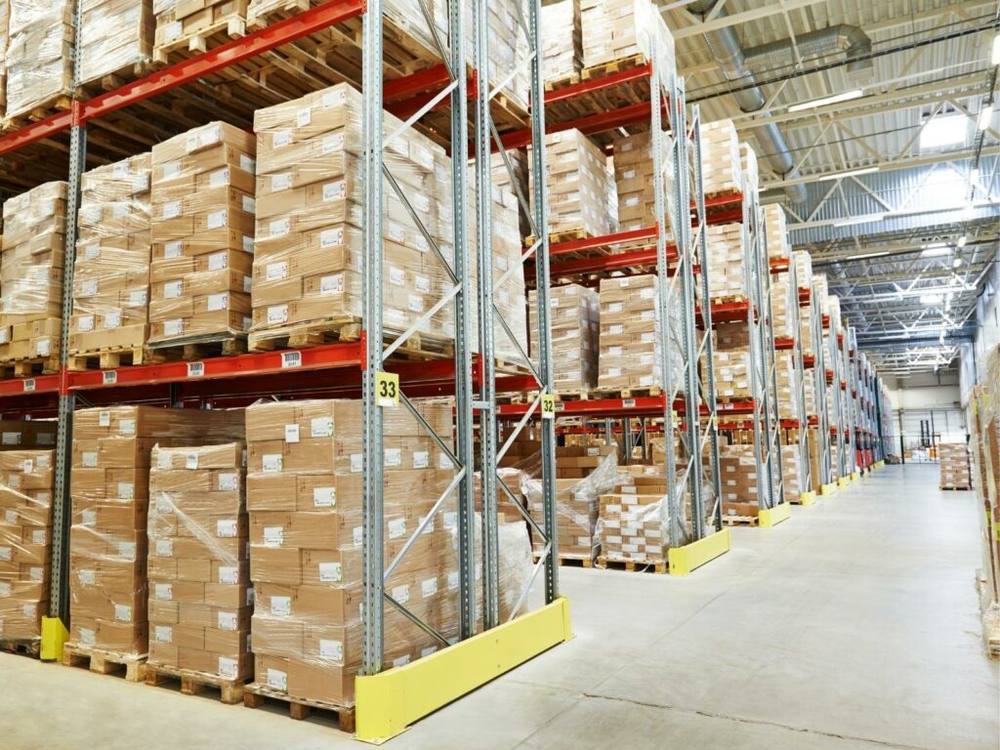
Point loading means that a large weight is transferred onto a very small area. With racking, this typically means the weight of:
- the structure itself
- the stored goods
- plus any dynamic effects during handling
While a distributed load spreads out evenly, a point load acts in a concentrated way, for example through the metal base plate of a rack upright, which has an area of just a few square centimetres.
A real-world example
A rack filled with goods can weigh several tonnes. This weight is usually transferred through only a few uprights (often four base plates). Each of them therefore concentrates a very high pressure into a relatively small contact area. And it is at these points that it is decided whether the floor will hold up over the long term, or start to give way under the load, deform or crack.
What problems arise when the floor cannot handle the load
Point loading is not a problem that shows up immediately. It is often a slow process that starts inconspicuously, perhaps with a slight deformation or a barely visible hairline crack. But if the warehouse floor does not have sufficient compressive strength, the consequences gradually multiply.
Indentation and deformation
A softer or structurally weaker floor may gradually begin to sink under the rack uprights. At first it is a matter of millimetres you may not even notice. Yet it is precisely these small changes that cause an uneven distribution of the load across the whole structure.
The rack then no longer stands level, the load is transferred asymmetrically and some uprights are disproportionately overloaded. This can lead to tilting, greater stress on the joints, and it also increases the risk of instability when handling goods.
Surface cracking
Hard and inflexible systems, such as some poured floors, respond to high point pressure by cracking. A hairline crack forms at the upright and gradually widens with further loading.
Once the surface is damaged, it loses its integrity. The cracks can let in moisture, dust or chemicals, which accelerates the degradation process even further. The result is not only a shorter floor lifespan but also the need for costly repairs.

Safety at risk
An unstable rack is not just a technical problem, but above all a safety risk. Even a minimal unevenness can change the distribution of forces in the structure and create a dangerous situation when handling heavy pallets.
In an environment where employees and handling equipment move around, any instability can pose an extreme risk. That is why it is important to take point loading seriously when choosing the floor, not only when the first visible problems appear.
How to calculate what the floor under racking needs to withstand
The biggest trap with racking is that most people only think about how much the rack can carry. From the floor's point of view, however, the more important question is: How much pressure will build up under a single upright, and how often will equipment be driving around it? That is usually where it becomes clear whether the floor is really strong enough.
Determine the maximum weight of the rack including goods
The first step is to add up the actual load you want to design for. That means not only the weight of the rack structure itself, but above all the maximum possible load of goods at the moment the rack is full.
Ideally, take into account:
- the weight of the rack structure itself
- the maximum weight of the stored goods (including pallets, boxes, etc.)
- any reserves for the future (a change in product range often increases the weight)
In warehouses, it is common for a rack to be loaded unevenly. It is therefore worth considering a scenario where the load is concentrated on one part.

Divide the weight between the uprights, but allow for unevenness
Most racks transfer the load through several uprights (often 4, 6, 8…). In theory the weight would be distributed evenly, but in practice it rarely is. A slight unevenness in the concrete or uneven loading is enough for one upright to carry a larger share of the weight than the others.
Therefore take into account:
- unevenness of the subfloor
- small differences in rack assembly
- uneven loading of goods
- local settling of the floor
Determine the contact area of the upright base plate
Here we come to the most important parameter: the point load.
Imagine two racks with the same weight. One has wide base plates, the other narrow uprights with a small contact area. The weight is the same, but the pressure on the floor can be several times higher in the second case. Because the smaller the area through which the weight is transferred, the higher the pressure per square centimetre.
You need to know the dimensions of the upright base plate (or footplate), and possibly the type of anchoring. The smaller the area, the higher the pressure at the point of contact. Some racks have a really small contact area, and the pressure can then be surprisingly high even at ordinary weights.
Do not forget the traffic around the racking
The pressure under the racking is static, but the area around it is often under even greater strain, because that is where the handling takes place.
Consider whether the aisles will be used by:
- forklift trucks
- reach trucks
- pallet trucks
- or whether everything will be handled manually
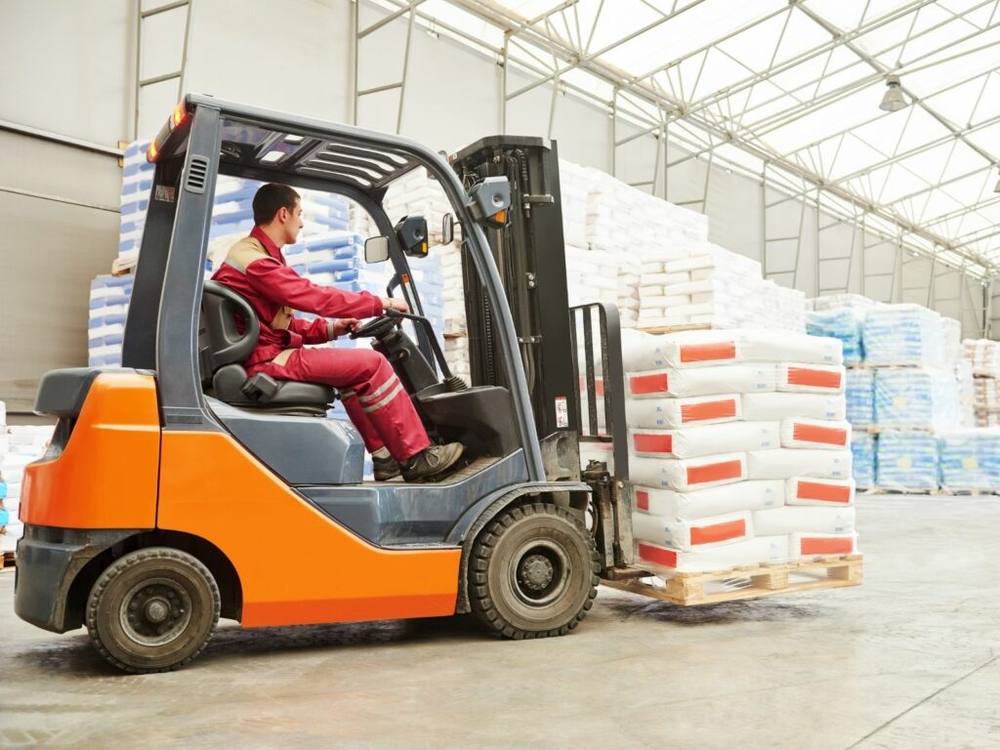
Handling equipment creates not only point loads under its wheels, but also a dynamic load when turning, braking and accelerating. And if it also drives right next to the racking, the floor is loaded both by the rack and by the traffic around it.
Which floors are truly suitable for racking systems
Choosing a floor under racking is not just a question of load capacity "on paper". What matters is how the material behaves under long-term point loading, how it responds to equipment moving in the aisles, and how it copes with small irregularities in the subfloor. Let's look at the most common solutions and their limits.
Concrete
Concrete is the foundation of most warehouses. If it is newly designed, thick enough and properly reinforced, it can carry a great deal. In new logistics halls this is the common standard.
Problems often arise in older warehouses, however. The concrete may be cracked, weakened in places or uneven. Under a heavy rack carrying several tonnes of goods, the pressure is then concentrated into a small area, the cracks gradually grow, and the surface may crumble or turn dusty.
Then there is maintenance. Concrete without a protective layer easily absorbs oil, moisture and chemicals. Over time it looks dirty and worn, even though it is still structurally sound. So concrete can carry a lot, but on its own it is not an ideal final surface.
Epoxy coating
Epoxy looks compact and clean. It is easy to maintain and resists chemicals well, which is why it is often used in warehouses.
But epoxy is hard and inflexible. And that is a fundamental problem with point loading. If the subfloor moves, or if the pressure under an upright is really high, the surface may eventually crack. Sometimes fine hairline cracks appear, other times a larger piece starts to flake off.
It is also very sensitive to the quality of the subfloor. If the concrete is not perfectly prepared or contains residual moisture, the problem may only show up after some time. And repairing an epoxy floor means working on a larger area. So epoxy works well when everything is ideal. In real operations, however, conditions are often far from ideal.
Modular PVC tiles
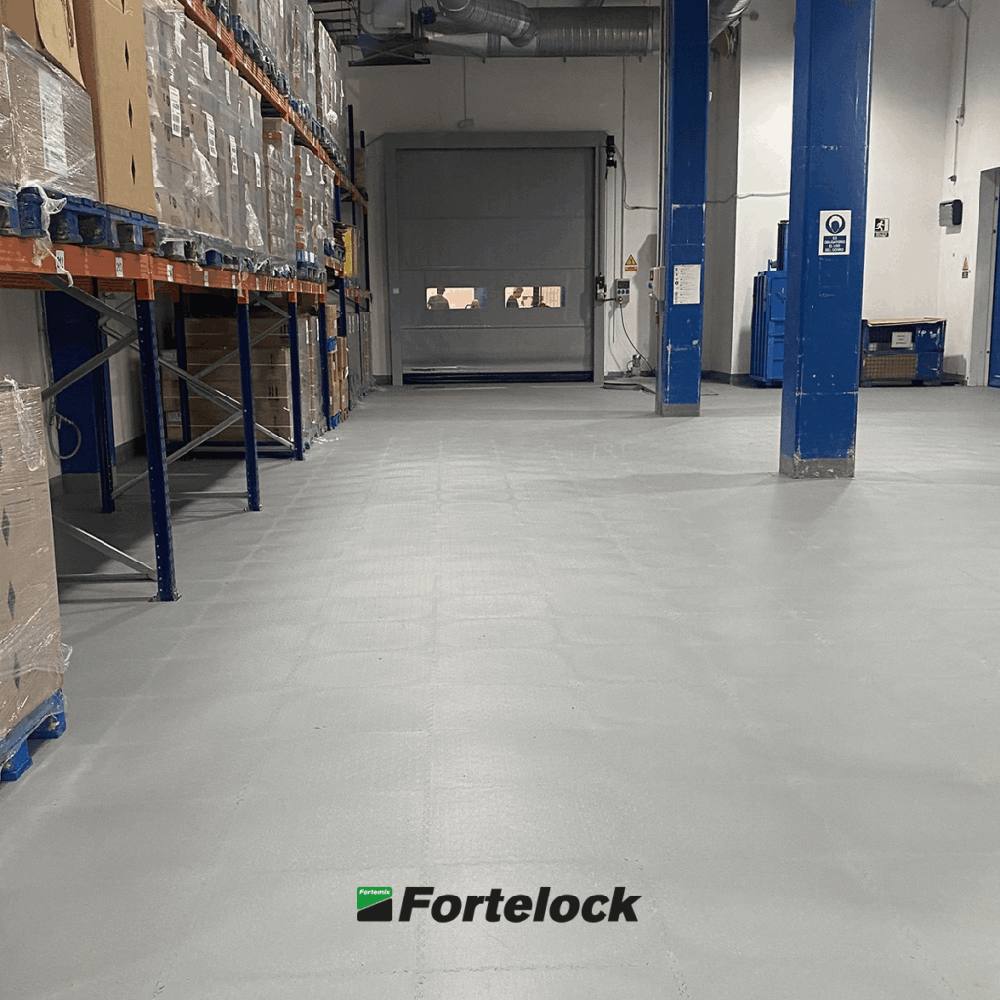
Industrial PVC tiles, such as Fortelock Industry or Industry Ultra, behave somewhat differently from a poured surface. They are neither brittle nor completely rigid. They have high strength, yet they can flex slightly with the subfloor.
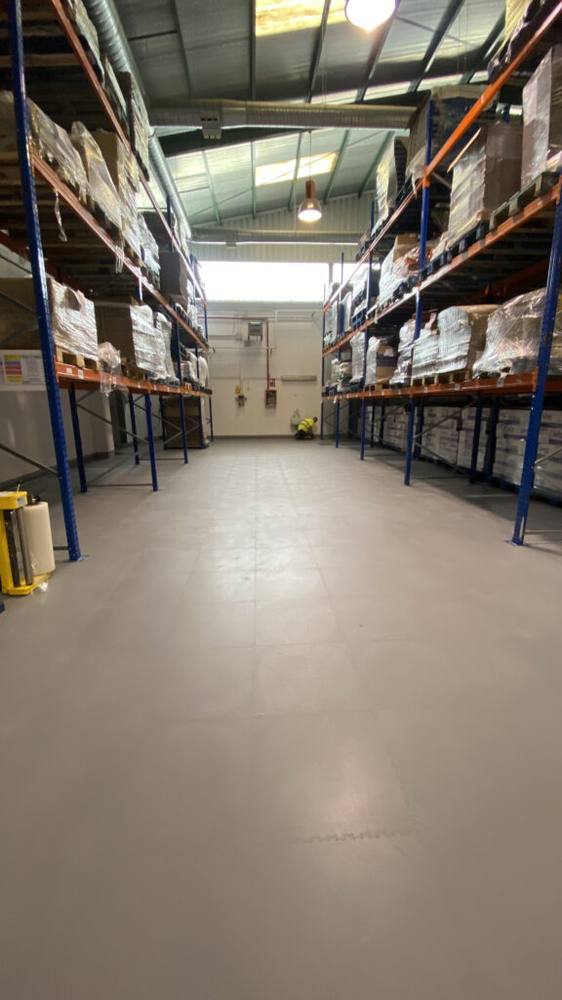
In practice, this means that under a rack upright they distribute the pressure better and reduce the risk of cracks. The Industry Ultra range is moreover designed for really high point loads and forklift traffic, so it can handle both the static weight of the racking and the dynamic movement of equipment around it.
Why Fortelock PVC tiles are a good fit under racking systems
If you are looking for a solution directly under rack uprights and in the surrounding handling zones, here are the main reasons why Fortelock is so often chosen in practice:
- High load capacity under point loading
The Industry ranges (and especially Industry Ultra) are designed to handle very high pressure concentrated into a small area, which is exactly what occurs under rack uprights. - Better distribution of local pressure
The combination of strength and slight flexibility helps limit the cracks that can appear over time in hard poured systems. - Resistance to equipment traffic
The floor handles not only the static weight of the racking, but also the dynamic loads from forklifts and pallet trucks. - Installation without downtime
The tiles are laid dry, so work can proceed zone by zone and there is no need to empty the entire warehouse for several days. - Easy local repair
If a specific spot gets damaged, only a single tile is replaced without touching the rest of the surface. - Protection of the original concrete
The PVC layer protects the concrete from further crumbling, dusting and chemical stress, extending the life of the entire warehouse floor.
What to bear in mind when laying Fortelock under racking
The compressive strength of all Fortelock ranges is 520 kg/cm² according to EN ISO 604-1, and the technical data sheet gives this value as the point load that must not be exceeded. It is therefore a good idea to compare the calculated pressure under the upright base plate with this figure. If a heavy load such as racking or a machine stands on the laid tiles, the installation is considered fixed and the tiles in this area must be glued or mechanically secured. A 10 mm expansion gap is left from racking, just as from walls and columns. The technical data sheet gives the dynamic load values for each type of truck in the aisles separately for each range.
Why it is important to think about the future too
A warehouse is not a static space. Goods change, racking systems expand, more equipment arrives and the pressure for efficiency grows. What the floor handles without problems today may be at the edge of its capabilities in a few years. And that is when it becomes clear whether it was chosen with a sufficient reserve.
A floor that operates at its limit from the very beginning will be more prone to deformation, cracks and gradual wear. Every change in load, relocation of racking or installation of heavier technology then poses an additional risk. By contrast, a solution designed for higher point loads and intensive traffic gives you peace of mind for the future as well.
Investing in a floor with a load-capacity reserve means:
- a longer lifespan without the need for frequent interventions
- fewer repairs and local problems under the uprights
- greater safety for employees and stored goods
- lower long-term operating costs
Frequently asked questions
What point pressure can PVC tiles carry under racking?


The compressive strength of Fortelock tiles is 520 kg/cm² according to EN ISO 604-1 and applies to all ranges. The technical data sheet gives this value as the maximum point load on the floor covering. To check, divide the weight carried by one upright by the area of its base plate in cm².
Do the tiles under racking need to be glued?
Yes, in the area where the racking stands. If a heavy load such as racking or a machine stands on the laid tiles, the installation is considered fixed and the tiles in that spot are glued or mechanically secured. For heavily loaded areas, the technical data sheet recommends PU adhesives, such as Uzin KR 430. Gluing is done only after the whole area has been loose-laid.
How big a gap should there be between the tiles and the racking?
A 10 mm expansion gap is left from every fixed point, i.e. walls, columns and racking. PVC naturally expands with temperature, and the gap prevents the tiles from pressing against the structure. At walls it is covered by a skirting board. Why expansion matters is explained in the article Expansion gaps in PVC flooring.
Can the floor under racking also handle truck traffic in the aisles?
It depends on the range and the type of equipment. When loose-laid, Industry Ultra can carry a pallet truck with PU wheels of up to 1,300 kg, an electric forklift with PU wheels of up to 2,900 kg and an electric reach truck of up to 5,100 kg, always including the weight of the truck and its load. Industry is designed for lighter handling equipment, such as a pallet truck of up to 500 kg. After gluing or fixing, the limits are higher.
Why is the point load under racking so high?
Because the weight of a full rack is transferred through only a few uprights, often four base plates with an area of just a few square centimetres. The pressure under one base plate can therefore be several times higher than with an equally heavy rack with wide base plates. Racking is also often loaded unevenly, so some uprights carry a larger share of the weight.