7. 3. 2024
How to choose the right ESD floor?
In previous parts of our series, we explained why companies should address ESD issues and how they should equip their EPA area. Today we will focus on choosing the right floor that meets the requirements of European regulations and effectively dissipates electrical charge.
Why the floor?
As we pointed out in the previous article, a functional floor is one of the most important elements in the fight against ESD. The investment in a functional ESD floor is by no means negligible and often reaches the level of hundreds of thousands of crowns. It is therefore very important to choose one that is reliable, proven and that will serve for many years without problems. How to choose the right one?
Which floor?
There are many types of floors on the market that help dissipate electrical charge. The authoritative standard that helps you find your way when choosing floors and that sets requirements for the protection of electrical components is the EN 61340-5-1 standard. It sets criteria for floor manufacturers that floors must meet in order to effectively dissipate electrical charge.
Functional parameters
One of them is the resistance to a groundable point, which in the case of floor qualification must be Rgp < 1 × 10⁹ Ω, i.e. lower than 1 Giga Ohm.
Here, however, it is necessary to take into account that the floor, for example in an EPA area, is always part of a system for dissipating electrical voltage. It is therefore appropriate and recommended that electrical resistance be tested not only on the floor, but in the system. In this case, the system consists of a person performing an activity on the floor, the ESD footwear this person wears, and the floor itself. In such cases we test the so-called system resistance. This is also specified by the EN 61340-5-1 standard.
The standard states that the system resistance measured according to EN 61340-4-5 is Rg < 1 × 10⁹ Ω and at the same time the voltage generated on the human body must be < 100 V. This ensures that the charge is properly discharged and also guarantees that human movement will not generate a charge higher than 100 V that could damage electronic components.
Quality guarantee
If you are choosing a floor, it is important to request a technical data sheet for the floor from the manufacturer, in which these data are declared. However, you should not settle for the values alone. Ask the manufacturer for a certificate from an independent testing laboratory that confirms these values. Only then can you be sure that the floor will really work correctly.
Types of floors
How to choose the right type of floor for your space? We bring you an overview of several types of floors, comparing their advantages and disadvantages.
1. Acrylic ESD coatings
They are used as a temporary conductive layer at individual workstations or in EPA areas. This is a relatively cheap solution, which, however, has no long-term use. It needs to be renewed after a few years.
Pros:
- low price.
Cons:
- demanding application,
- short service life,
- the ability to dissipate electrical charge decreases over time,
- low durability.
The price of acrylic coatings is around 125 CZK incl. VAT / m2.
2. Epoxy ESD floor
Epoxy coatings are popular for their appearance. An aesthetic solution that is also 100% waterproof and impermeable. But it has its price. Applying epoxy is not entirely simple and only experienced professionals can handle it. In the case of floor renovations, the entire area must be emptied before you can apply. Removing defects associated with unprofessional application is very complicated – often it has to be sanded down and applied again. It is also not as durable as other types of floors. The higher application price may also be off-putting. In the case of relocating the operation, the floor cannot be dismantled.
Pros:
- nice appearance,
- waterproof and 100% water impermeability.
Cons:
- demanding to process,
- higher costs associated with application costs,
- lower durability,
- harder to repair local damage,
- cannot be moved when relocating to another place,
- a perfectly level floor is required for application,
- a primer must be applied to the original substrate.
The approximate price for material and work associated with application is around 2,000 CZK/m2 (material – a 30 kg package priced at 9,500 CZK incl. VAT is enough for 10 m2; work approx. 1,000 CZK/m2).
3. ESD linoleum
Linoleum is a traditional material known to almost everyone. It is normally sold in rolls measuring 2 x 20 m and is glued to the base layer. It offers a wider range of decors, is waterproof, but not completely water impermeable. It is used in hospitals and operating theatres.
Pros:
- wider range of decors,
- higher durability,
- waterproofness.
Cons:
- demanding installation,
- demanding maintenance,
- gluing required,
- difficult to repair local damage,
- a level floor required,
- cannot be relocated.
The price of this material is around 1000 CZK incl. VAT per m2. Additional costs for adhesive must be taken into account.
4. PVC ESD tiles
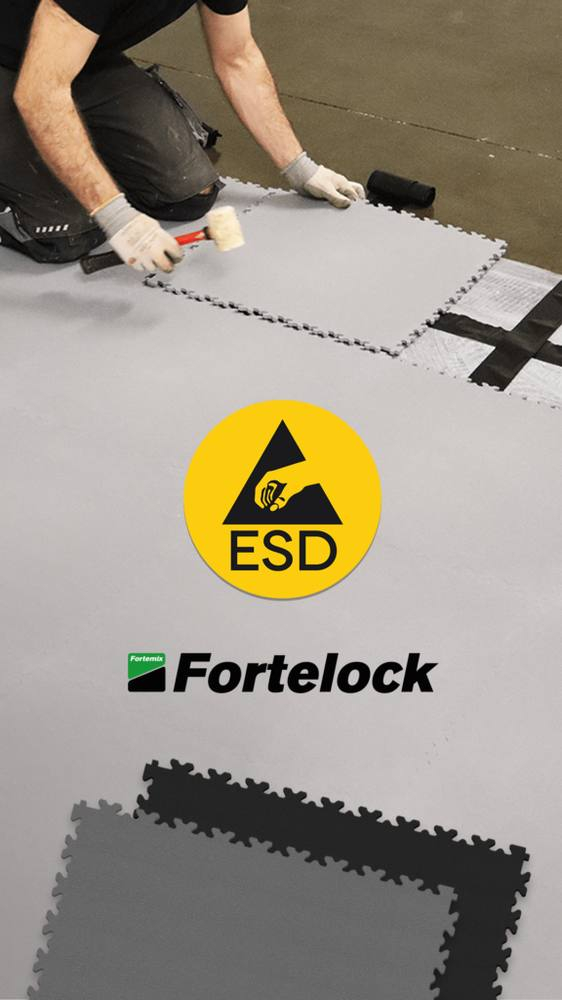
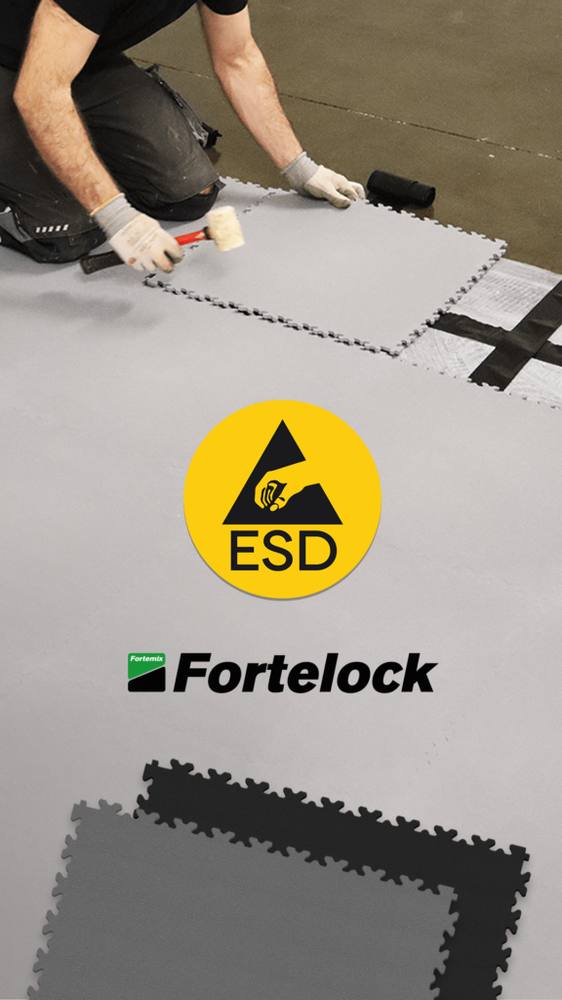
In recent years, the popularity of ESD tiles has been rising. They have won many fans with their ease of installation. Their installation requires no gluing, the surface does not have to be 100% level and almost anyone can install them. They are very durable, in the event of damage the damaged piece can be easily and quickly replaced, and they reduce noise. On the other hand, they do not offer such a wide range of decors and only basic colours are available.
Pros:
- easy and quick installation,
- increased chemical and mechanical resistance,
- can be laid in stages during full operation,
- easy maintenance and cleaning,
- in the event of relocating the operation, they can be easily dismantled and moved,
- noise reduction,
- conductivity throughout the entire thickness of the material (usually 7 mm),
- anti-slip design,
- long warranty (up to 12 years in the case of Fortelock tiles).
- service life of up to 25 years.
Cons:
- limited colour range – only basic,
- the need to apply grounding tape,
- relatively higher price.
The price for PVC ESD tiles is around 2,500 CZK per m2. The advantage of this solution is that you no longer incur any additional costs for other material or installation – anyone can handle it. In addition, in the case of renovation, you save enormous costs for clearing the space, which is essential with other solutions. Here you can lay the tiles during full operation.
Conclusion
When choosing a floor, it is necessary to take into account various parameters that influence its selection. Whether it is financial possibilities, requirements for service life, warranty or whether it is a new space or a renovation, it is always necessary to keep in mind that, especially in the case of floors, it is always better to invest in a quality floor than to deal with problems later. These are then only very difficult to remove.
Tip: Maintenance
In the case of ESD floors, maintenance plays an extremely important role and should by no means be underestimated. Because the generated voltage passes from the person through the footwear and floor into the grounding point, it is extremely important that the floor is always free of any impurities. These slow down the conductivity of the system and could cause higher resistance or even degrade the entire system.
We recommend cleaning the floor every day, but at least once a week. You should only use products that are intended for cleaning ESD floors. These are special cleaners that leave no coating or wax on the floor. Equally important is thorough cleaning after installation, which helps remove impurities created during production, transport or installation.
For more information, technical specifications or an individual quote contact our experts. We will help you find the best flooring solution that meets your specific requirements.
WRITE TO US