
7. 2. 2024
What is ESD and what is an ESD floor for?

The ESD phenomenon causes damage worth up to several billion USD worldwide. It is estimated that for manufacturers of electronic components, ESD-related damage accounts for anywhere from 8 to 30% of total production defects. It is therefore extremely important to prevent such damage as much as possible. The Fortelock ESD floor will help you do just that.
What is ESD?
ESD stands for ElectroStatic Discharge. A charge is created when two materials rub against each other or during simple separation (e.g. of adhesive tape). Through this process, the neutral atoms of the materials become positively or negatively charged. If these charged atoms then come into contact with a grounded element, an electrical discharge occurs.
We have all experienced this first-hand, especially during the winter months, when grabbing a door handle that then “zaps” us. This happens because the air is dry in winter and therefore struggles to dissipate the accumulated electrical charge. What is more, by walking on a carpet or moving your arms in a woollen jumper you can accumulate an enormous charge.
The body as a giant battery
Did you know that simply by standing up from a chair you can generate a charge with a voltage of up to 18,000 V? If you take off a woollen jumper, you create a voltage of up to 25,000 V. And if you walk on a nylon carpet in a dry environment, you can very easily accumulate up to 35,000 V!
You can hear these discharges as soon as the body accumulates 6,000 V – that is when you hear a crackling sound. You can see a small spark when the charge reaches 9,000 V.
What affects the size of the charge?
The level of charge is influenced by several factors. One of the most important is the relative humidity of the air. In a humid environment, the charge can easily escape via the conductive path formed by water droplets in the air. In winter, on the other hand, it is harder for the charge to dissipate; for example, while handling a plastic bag generates 1,600 V in summer, in winter it can be up to 17,000 V.
| Relative air humidity | 20% | 80% |
| Walking on a nylon carpet | 35,000 V | 1,500 V |
| Taking off a woollen jumper | 25,000 V | 1,900 V |
| Standing up from a chair | 18,000 V | 1,800 V |
| Handling a plastic bag | 17,000 V | 1,600 V |
| Walking on a vinyl floor | 12,000 V | 250 V |
| Machining plastic | 6,000 V | 100 V |
Another important factor is the type of materials. If you rub an inflated rubber balloon against your hair, the voltage will be enormous. This is because materials with opposite tendencies to become charged are rubbing against each other. While hair charges positively, rubber and plastic tend to charge negatively. This difference can create a large voltage. If you would like to learn more about this topic, we recommend looking into the so-called “Triboelectric series”.
The speed at which we walk on a carpet, or unwind adhesive tape, also affects the size of the charge. If we walk more slowly, the charge will not be as large as if we walked quickly. And last but not least, there is the size of the contact area between materials. The larger the area, the greater the charge.
Delicate electronics
ESD began to be addressed more seriously in manufacturing companies from the 1970s onwards. Until then, robust and often large electronic components could withstand higher voltages, but the trend towards miniaturisation of products changed this. Large old televisions were replaced by slim LCDs, a phone fits in your pocket, and large desktop computers were replaced by small, compact laptops or tablets. All these devices require the smallest possible components.
Did you know that the smallest chip currently measures just 0.1 mm3?
All these components are extremely sensitive to higher voltages. Even 20 V can cause irreversible damage. What is most insidious about ESD, however, is the fact that ESD may damage electronics only partially, while the component may continue to function. Such damage is not detected even by output inspection. It is often so small that we cannot detect it by eye. The extent of the damage may only become apparent under magnification of several thousand times. Over time, however, the damage may grow until it results in complete failure of the product. In many cases this happens while the product is still under warranty, generating enormous costs for the manufacturer to repair or replace the product.
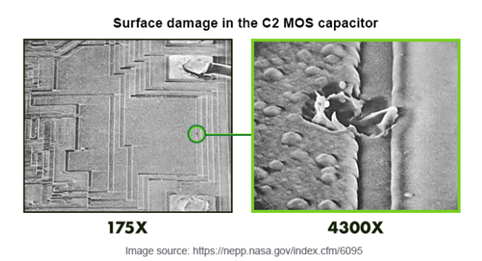
Where can we encounter ESD, and how can we protect against it effectively?
Preventing ESD is extremely important in manufacturing companies. And not only there. It can also cause major problems in other sectors, such as:
- airports,
- the textile and paper industries,
- paint shops,
- drying rooms,
- the photographic industry,
- the pharmaceutical industry,
- operating theatres,
- dental surgeries,
- and logistics centres where products are handled or packed.
Programmes aimed at preventing ESD focus on two basic objectives – to minimise the risk of electrostatic discharge as much as possible and, if it does occur, to gradually conduct the charge to a grounding point.
To prevent ESD effectively and efficiently, we recommend implementing an ESD control programme in your company. Among other things, this requires setting up a so-called “EPA area” (ElectroStatic Discharge Protected Area). This is an area within which the risk of ESD is minimised. It can be a single workstation where delicate electronics are handled, or even an entire production hall. Among other things, it includes:
1. ESD equipment: special ESD wrist straps, ESD flooring, ESD footwear and clothing, special ESD containers, chairs, lamps, tools, packaging material and more.
2. Measuring equipment at the entrance to the ESD area: it measures the voltage value on the human body and the system resistance created by the worker and their footwear.
3. Trained staff: as part of the programme, it is important to train operators on how to enter the area and how to work within it.
4. An ESD coordinator: every company should have its own coordinator who will carry out regular inspections, train new staff and oversee the correct functioning of the programme.
Tip: If you work mainly seated and only come into contact with electronics at a single workbench, get at least ESD wrist straps. They can effectively conduct static charge away. If, however, you also need to move around and walk while working, invest in a quality ESD floor. It does not generate an electrical charge and at the same time conducts it effectively to a grounding point.
For more information, technical specifications or an individual quotation, contact our experts. We will help you find the best flooring solution to meet your specific requirements.
WRITE TO US