18. 3. 2026
An overview of solutions based on real-world practice, not just the catalogue
Which flooring should you choose?
Choosing a floor is not just about looks or the price per square metre. In practice, entirely different factors make the difference: how long operations have to be shut down, how demanding the installation is, what happens when it gets damaged and how much it will cost you over the long term.
Let's take a look at the most common solutions and their real-world properties.
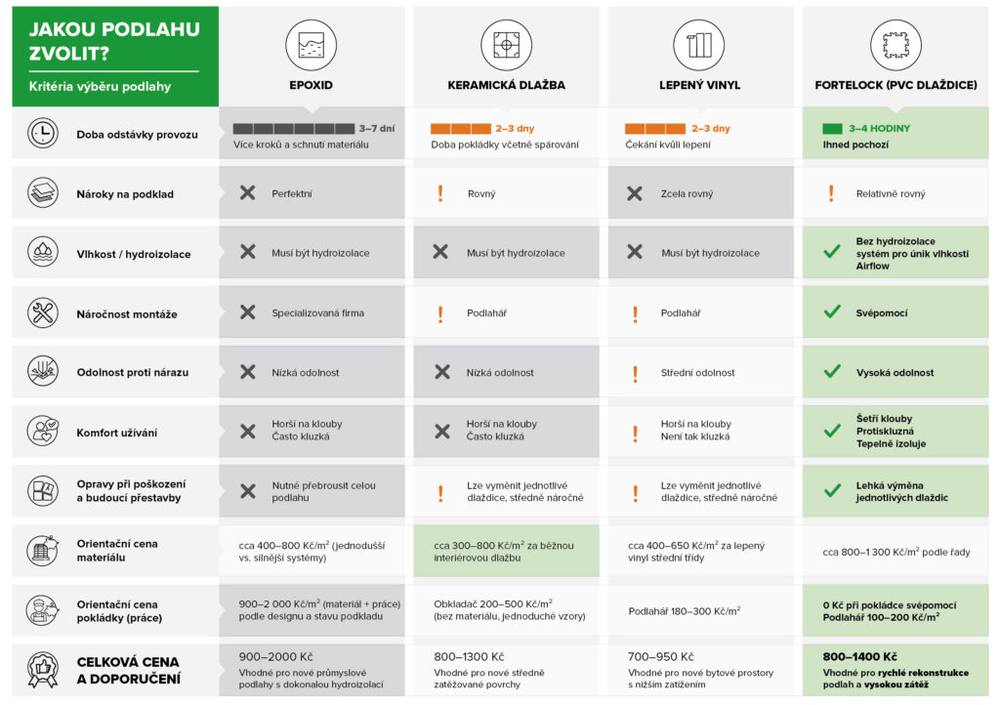
What really matters when choosing a floor
When making your decision, we recommend focusing on these key criteria:
- Operational downtime
- Subfloor requirements (flatness, preparation)
- Moisture and the need for waterproofing
- Installation complexity
- Impact and load resistance
- Comfort in use (joints, slip resistance)
- Options for repairs and future modifications
- Total cost (material + labour)
How interlocking PVC tiles meet the criteria
With Fortelock interlocking PVC tiles, the criteria from the list work out as follows. Downtime: the tiles are laid without glue or drying time, gradually and even during operation. Subfloor: they can be laid on new and old subfloors; the technical data sheet sets a maximum unevenness of 7 mm over 2 m. Moisture: the Industry, Industry Ultra and Invisible ranges have the Air-Flow system on their underside, which carries moisture away from the subfloor. Load: the load capacity differs by range, so it is a good idea to compare it with the equipment that will drive over the floor. Repairs: a damaged tile is replaced without dismantling the whole floor. A tile sample will show you the colour and surface.
Summary
The right floor is not the cheapest one.
It is the one that matches your operations - today and several years from now.
Not sure which one to choose?
Get in touch with us. We'll help you find the right solution to match your operations exactly.
Frequently asked questions
How should I choose flooring for business premises?


By how the floor will perform in your specific operation, not just by its looks. The main factors are the downtime during installation, subfloor requirements, moisture, resistance to impacts and loads, comfort and slip resistance, repair options and long-term costs for materials and labour. The right floor must suit your operation today and several years from now.
How long does it take to lay an interlocking PVC floor?
Installation takes place without glue, drying time or technological breaks, and the manufacturer states a speed of up to 30 m² per hour. For comparison: an epoxy floor can take 3 to 7 days to cure, whereas with Fortelock tiles the job is done in 3 to 4 hours, according to the manufacturer. The floor can also be laid in sections while operations continue.
What happens if a tile gets damaged in operation?
Only the damaged piece is replaced. A tile can be taken out and replaced even in the middle of the room, without dismantling the whole floor and without a long shutdown. According to the manufacturer, the replacement takes just a few minutes. The floor can be modified just as easily later, for example when the layout changes or the operation expands.
Can I try interlocking tiles in my own premises before buying?
Yes. Fortemix will lend up to 5 m² of PVC tiles for 1 month so that you can test them on site. If the floor suits you, you order the rest and the tiles you keep are added to the invoice. If not, you clean the tiles, pack them and return them in person or by post.
How do I work out how many tiles I need for a room?
The quickest way is with the online configurator, which calculates the minimum number of tiles needed from the room dimensions and the selected parameters. The quantity calculator on the product pages of each range also offers the option of adding 5% extra tiles for cuts at walls and in corners.