15. 11. 2026
Pool surround flooring: how to choose a non-slip, long lasting surface
Around a pool people walk barefoot and the surface is almost always wet. We explain how much slip resistance the floor needs, which materials work and how to lay a pool surround so it is safe and lasts for many years.
What a pool surround has to do
Around a pool people walk barefoot and the surface is almost always wet. So the demands are higher than for a normal patio. A badly chosen floor shows itself in the very first summer, when someone slips or burns their feet. A good pool surround has to:
- stay non-slip when wet and underfoot barefoot,
- resist chlorine or other pool chemicals and sun cream,
- cope with frost, because it stays outside all winter,
- drain water, so no puddles form around the pool,
- not burn your feet in the sun,
- be easy to clean of leaves, sand and algae.
Slip resistance: pendulum PTV and barefoot classes A, B and C
In the UK, slip resistance is usually measured with the pendulum test, which gives a Pendulum Test Value, PTV. The UK Slip Resistance Group treats a wet PTV of 36 or more as low slip potential. For barefoot areas the most widely used reference in Europe is the German standard DIN 51097 with its classes A, B and C. In that test a barefoot person walks on a wet tile on a ramp and the angle at which they start to slip is measured.
| DIN 51097 class | Angle of slope | Where it is used |
|---|---|---|
| A | at least 12° | Changing rooms, barefoot walkways in dry areas |
| B | at least 18° | Showers, pool surrounds, paddling pools |
| C | at least 24° | Steps into the water, sloping edges, starting blocks |
For a pool surround, aim for class B or better, or a wet PTV of at least 36. If you are building a public or commercial pool, ask the supplier for the test certificate and check the requirements with your designer. For a pool at home it is a good guide when choosing.
Which materials work for a pool surround
Natural stone
Travertine, sandstone or granite look elegant and last for decades. But the stone needs a non-slip finish, a sealer against chlorine is often recommended and it is laid on concrete in adhesive. It is the most expensive and most labour intensive option.
Porcelain tiles
Frost resistant porcelain with a non-slip surface is tough and easy to clean. Next to a pool, choose only tiles with a declared slip rating. Laying them needs waterproofing, falls, flexible adhesive and grout, so a contractor usually does it.
Timber
Wood is pleasant underfoot and stays cooler in the sun. But next to a pool it is constantly wet, so it needs a durable species, regular oil and good ventilation. Without care it goes grey and splits quickly.
Composite decking
Composite boards need no staining and cope well with water. But dark shades get very hot in the sun and the boards sit on a frame. You will find composite compared with other materials in the article Composite, timber or plastic decking tiles.
Plastic tiles
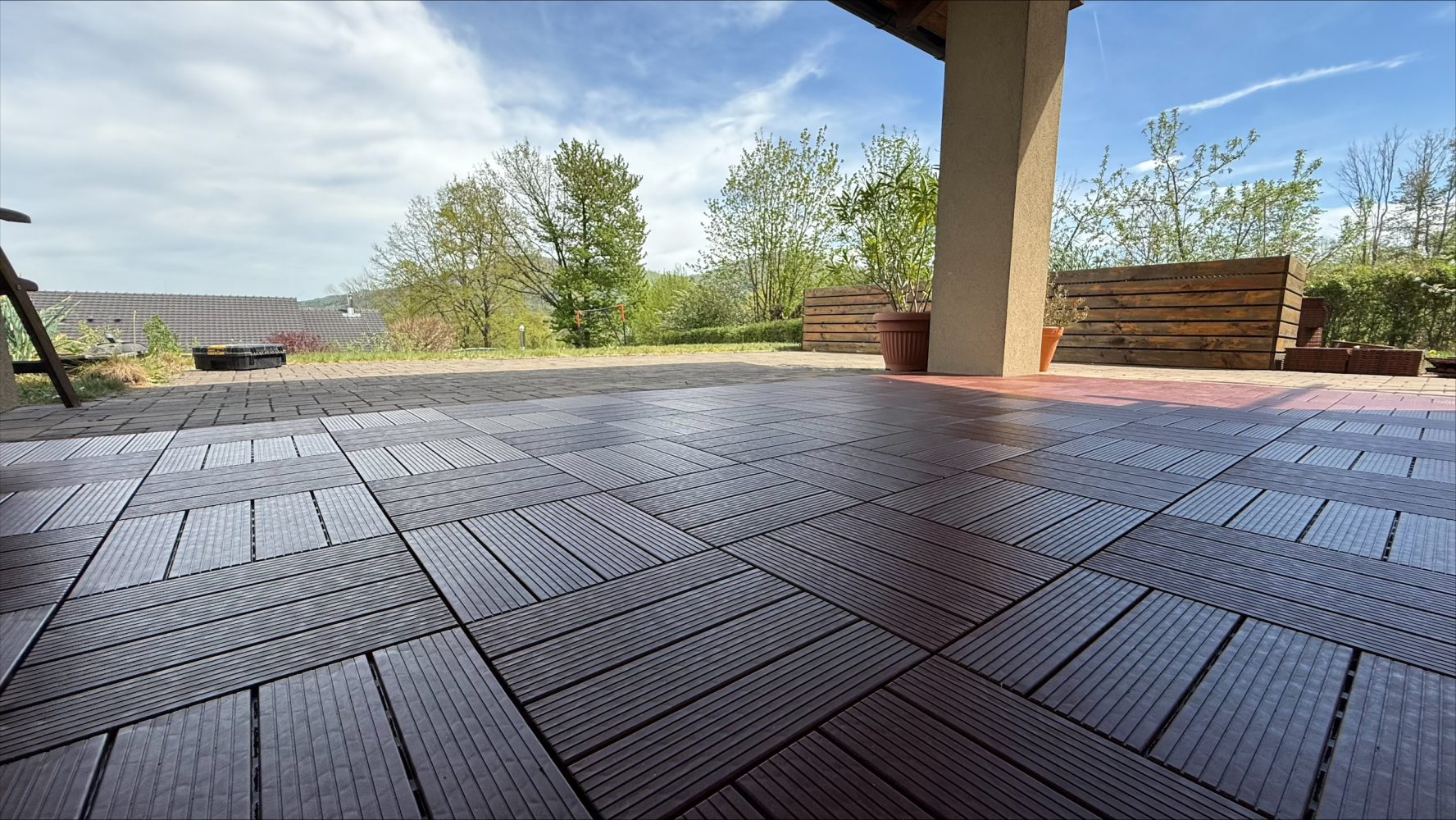
Interlocking plastic tiles go straight onto a solid base with no adhesive. Water runs away underneath, they do not absorb it and chlorine does not harm them. They are the quickest option if there is already concrete or old paving around the pool.
Tereco Slate: slate effect tiles for the pool
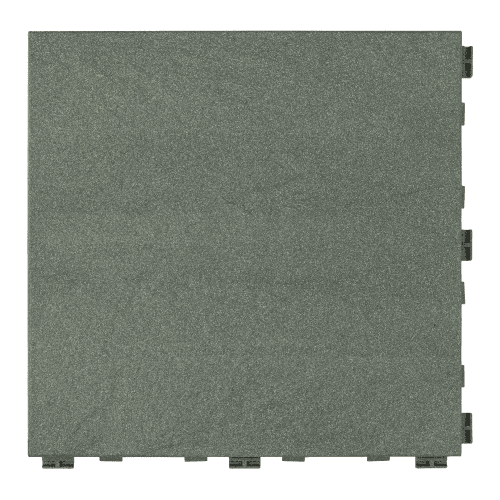
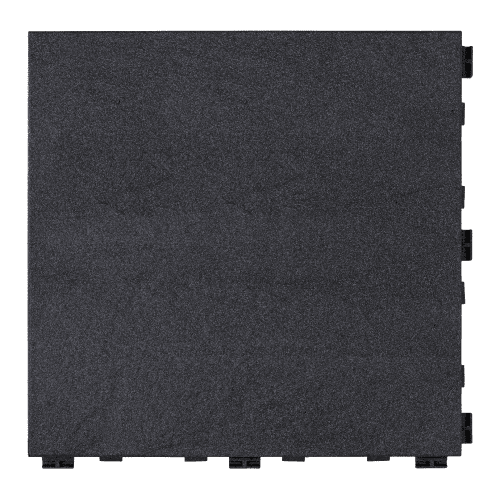
The Tereco Slate range has a textured slate effect surface. The manufacturer states a low slip risk even when wet. The tiles are made from 100 % recycled polyethylene, are 17 mm high and, according to the manufacturer, resist pool chlorine, normal cleaning products and sun cream.
On the underside they have AirFlow channels that drain water away and let air circulate, so no mould forms underneath. They handle temperatures from −20 °C to +70 °C, so you do not have to lift them in winter. They connect with 7Locks locks, and a damaged tile can be swapped without any building work.
Good to know: the Tereco Slate data does not yet include a PTV or a class A, B or C from the barefoot test. If you need to prove one, for example for a commercial pool, check with the manufacturer before ordering.
Non-slip tiles for the pool
Video: Tereco tiles for wet areas
Tiles for outdoor and wet areas
Tiles that drain water away
How to lay tiles around a pool
- Prepare the base. It must be solid, flat and load bearing: concrete, paving, asphalt or compacted gravel.
- Check the fall. Water must run away from the pool, not towards it.
- Start from a straight edge. Lay from the longest straight side, for example from the house.
- Click the tiles together. The 7Locks locks join by hand or with a rubber mallet.
- Cut the edges. Use a jigsaw along the curved edge of the pool.
- Finish the edges. Cover open edges with edge trims so nobody trips.
You will find the full guide in the installation instructions.
How to choose by type of pool
Above ground and frame pools
With an above ground pool it is usually about the area by the ladder and the path from the house. A floor that goes down without pouring concrete and that you can lift when needed works best, for example plastic tiles on compacted gravel.
In ground pools
For an in ground pool the edge is what matters. The floor must run up to the coping, fall away from the pool and leave no step to trip over. Open edges are finished with a trim and, on curved shapes, the tiles are cut precisely.
Hot tub on the patio
A full hot tub can weigh more than two tonnes, so the load capacity of the base and the floor matters. Always stand it on a solid, flat base as the manufacturer instructs. According to the manufacturer, Tereco tiles have a compressive strength of up to 500 t/m².
The most common mistakes around a pool
- Smooth indoor tiles. They look great dry and are as slippery as ice when wet.
- A fall towards the pool. Water carrying sand and leaves runs back into it.
- A dark surface in full sun. In summer nobody can walk on it barefoot.
- Open edges. The loose edge of the tiles is where people trip most.
- Ordinary grout. Next to a pool only frost and chemical resistant grout will do, otherwise the joints soon crumble.
Hygiene: algae, mould and cleaning
Where water stands, algae and mould grow. On porcelain and stone they settle mainly in the joints, on wood in the pores. With ventilated plastic tiles no water stays under the surface and it dries quickly. For everyday cleaning a brush and water are enough, for stubborn marks a normal cleaning product. Use a pressure washer carefully and from a distance so you do not damage the surface or the edges.
Keeping children safe around the pool
Children run and jump around the pool and rarely look at the floor. That makes a non-slip floor even more important at a home pool than at a public one. Think about the edges too: finish open edges with a trim, choose the best grip for steps and do not leave puddles where it is easy to slip.
Care and winter
Plastic tiles only need sweeping and rinsing with water. Before winter remove leaves and dirt so no moisture is trapped underneath. The tiles can stay outside, frost down to −20 °C does not affect them. Stone and porcelain should be checked before winter, and cracked joints repaired straight away, otherwise water gets in.
Frequently asked questions
Which pool surround is non-slip?


One whose slip resistance has been tested wet. In the UK that usually means a wet pendulum value of PTV 36 or more, and for bare feet class B under DIN 51097, that is an angle of at least 18°. Textured plastic tiles such as Tereco Slate are another option.
What slip rating does a pool surround need?

Under DIN 51097, class B is used for pool surrounds and class C for steps into the water. In PTV terms, 36 or more when wet means low slip potential. The R9 to R13 ratings are measured with shoes and are not the right guide for barefoot areas.
Does chlorine damage plastic tiles?

According to the manufacturer, pool chlorine does not damage Tereco tiles, nor do normal cleaning products or sun cream.
Do plastic tiles get hot in the sun?

Any dark surface gets hotter in the sun than a light one. If you walk barefoot by the pool a lot, choose a lighter shade, for example Tereco Slate Natural.
Can a pool surround be laid on gravel?

Plastic tiles can, if the gravel is well compacted and flat. Porcelain and stone need a concrete base.
Does a pool surround need a fall?

Yes. Water must run away from the pool, so dirt does not get back into the water and no puddles form.