7. 3. 2020
Mark out zones in your warehouse with the floor
Clutter in a warehouse can cause real headaches for any company, regardless of its size. Anyone who cares even a little about order and workplace safety cannot do without firm rules, a clear layout and colour coding.
Colours on the floor are one of the best ways to mark out:
- zones for the movement of people, forklift trucks and other machinery,
- individual areas – for example the part of the warehouse where flowerpots are stored, then the one for watering cans, and so on,
- areas that are off-limits,
- hazardous spots (narrow passages, blind corners and junctions),
- corridors and pathways.
What are the options for floor marking?
Common practice is to have a seamless grey or black floor in the warehouse and to mark the zones on it. They are painted on or marked with adhesive tape. Tape is definitely the worst solution – it does not last long and soon peels off, so it only works as a temporary fix. It is much the same with paint. It does last longer, but after a few years it wears off and has to be maintained. In the end it works out even more expensive, because the company has to pay for its removal and a new coat.
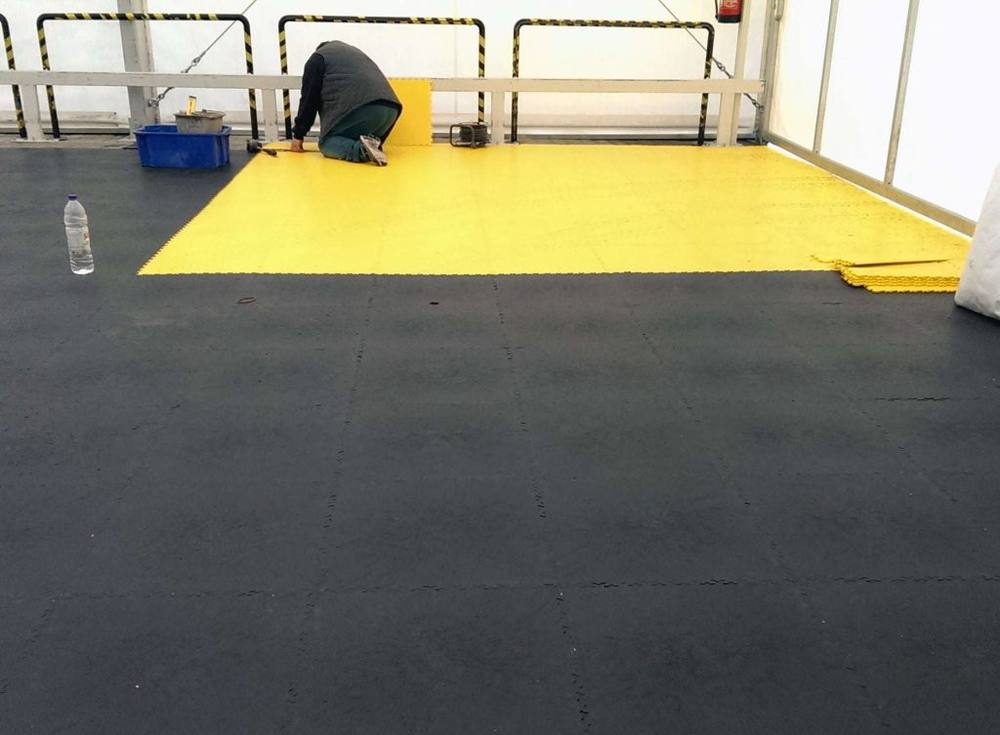
An alternative to these two options are the coloured Fortelock PVC tiles. You click them together like a puzzle once and the job is done. The colour is permanent and the tiles last forever. And should you manage to damage one after all, you simply replace that single piece. A huge advantage is also the quick installation. Operations don't have to be halted for long, as would be the case, for example, with epoxy paint, which takes 12–18 hours to dry.
With Fortelock tiles you can mark out anything
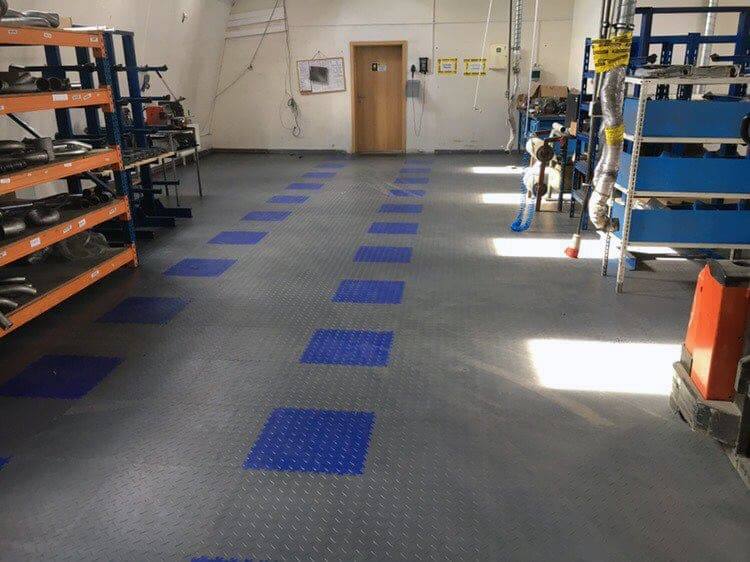
For warehouses, the ideal choice is Fortelock Industry PVC flooring, which is ready for heavy loads from forklift trucks and other equipment. It comes in three different anti-slip patterns and 12 colours. Using tiles of various colours, you can create almost anything – there are no limits to your imagination. You can match the floor to your corporate colours, mark out corridors and work zones for better workplace safety, or use red to cordon off an area that is off-limits.
In a warehouse, however, practicality should come before design. That is why Fortelock PVC flooring thinks of everything, and you can also purchase floor ramps – these will come in handy for the coloured lanes intended for forklift traffic. For zones where people move around, it is a good idea to choose a texture with a rougher anti-slip pattern. The same applies to parts of the warehouse where the floor is likely to be wet. You can, after all, also highlight those with a special tile colour.
Marking strips for precise marking
In addition to whole coloured tiles, Fortelock offers marking strips for the Industry, Industry Ultra and XL ranges. The narrow and wide tiles together make up the size of one standard tile, so the markings fit into the grid without cutting, and a corner piece closes the strip at the perimeter. For Industry, the narrow tile measures 128.5 × 510.5 mm and the wide one 396 × 510.5 mm. The strips have the same compressive point load of 520 kg/cm² and the same R10 slip resistance as standard tiles. For temporary or high-contrast boundaries, there is marking tape on a 33 m × 5 cm roll in yellow or black and yellow. The Green version of Industry Ultra is specifically designed to distinguish traffic routes and safety corridors.
How wide should the pathways be?
Warehouse health and safety rules state that the width of a route used by transport equipment must be at least 0.4 m greater than the width of the largest machine moving along it. Forklift trucks, for example, are usually around one metre wide, so the pathway should be about 1.5 m. That works out to 3 Fortelock tiles side by side. A pedestrian pathway should be at least one metre wide, which makes two tiles.
Colour coding of zones should be practical and make life easier. Keep that in mind.
Frequently asked questions
What tile colours can be used for marking in a warehouse?


The Industry and Industry Ultra ranges are made in Black, Blue, Graphite, Green, Grey, Rosso Red and Yellow. The colours and dividing tiles are used to mark out parking spaces, storage zones, traffic routes and safety corridors. Green Industry Ultra is specifically designed for corridors and routes.
How wide should a forklift aisle be in a warehouse?
According to the health and safety rules cited in the article, a route should be at least 0.4 m wider than the largest machine that uses it. For a truck about 1 m wide, that works out at roughly 1.5 m, i.e. 3 Fortelock Industry tiles side by side. A pedestrian walkway should be at least 1 m wide, i.e. 2 tiles.
Does colour marking with tiles last longer than paint or tape?
Yes, because the colour is not just on the surface. Industry tiles are homogeneous, with the wear layer making up the full 7 mm thickness, so the marking does not wear off like paint or peel off like tape. If a tile gets damaged, only that tile is replaced. What's more, installation requires no drying time.
Can zone marking in a warehouse be changed later?
Yes, at any time. Coloured tiles and marking strips can simply be released from the locks and replaced with others, so you can adapt routes, corridors and storage zones to a new layout without grinding or painting. Further marking options are described in the article Operations using forklifts.
What slip resistance do the tiles have in pedestrian zones?
All standard Fortelock ranges have an R10 slip resistance rating according to DIN 51130. Industry and Industry Ultra are made in diamond, leather and coin textures. If higher slip resistance is needed, Fortemix offers a surface treatment as part of its professional cleaning service that raises it up to R11.