10. 3. 2021
PVC also stands its ground as industrial flooring
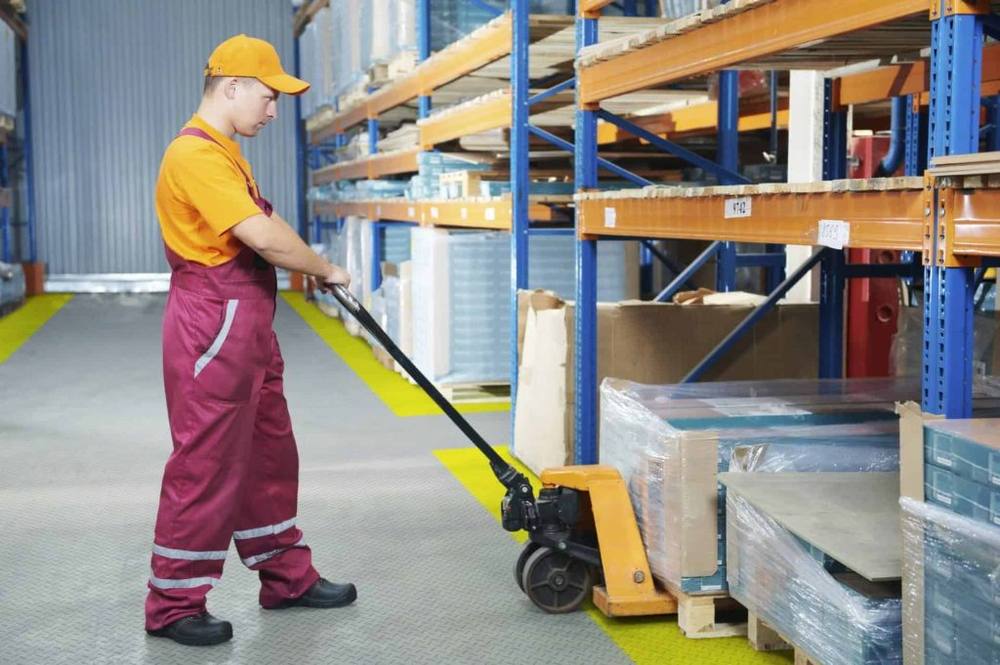
Whether you run an industrial warehouse or a car repair shop, in large halls the floor always plays a key role. It should be easy to clean, cope with heavy loads and last a long time. Unlike other alternatives, PVC flooring meets all of these requirements.
Anyone planning to renovate industrial floors should first think carefully about which repair option really pays off for them. It is not just about the price; there are much more important aspects at play. A concrete floor can be renovated in various ways, and the most common ones include laying PVC flooring and applying an epoxy coating.
It has to withstand loads and chemicals
Forklifts move around production halls, heavy machines stand there, and material is often stored on the floor. In the case of PVC flooring, it is therefore necessary to opt for a variant designed for heavy loads, which in demanding operations will easily last more than ten years. Most companies produce such a variant, and Fortelock also has flooring for enormous loads, namely the Fortelock Industry range. Throughout that time it remains colour-stable, since resistance to most oils and acids is a property of its polymer structure. Every now and then it is enough to take water, detergent and a mop and wipe the floor down.
An epoxy floor, so popular in many operations, has entirely different properties when it comes to durability. Compared with other types of flooring it is cheap, and you can even paint a company logo on it. However, it is not very suitable for operations where a forklift or even a car might drive. With a forklift the narrow wheels are a problem, while with cars the high weight and hot tyres are harmful, causing it to peel, and chemicals discolour it. If you do not choose an anti-slip treatment, a slippery surface will be an issue too. You won't experience that with PVC tiles, which are always manufactured with a coarse surface.
Installation should be easy, and so should repairs
The larger the hall, the more its covering will cost - not only in terms of material but also of labour. The time needed to lay the floor also plays a role in how long operations in the hall will have to be interrupted. With an epoxy floor, three layers usually need to be applied (a priming resin, a self-levelling layer and then an epoxy resin). The first should dry for 24 hours, and a similar wait is needed after the final layer has been applied. And once the coating starts to crack in some part of the hall, there is nothing left to do but redo the whole floor.
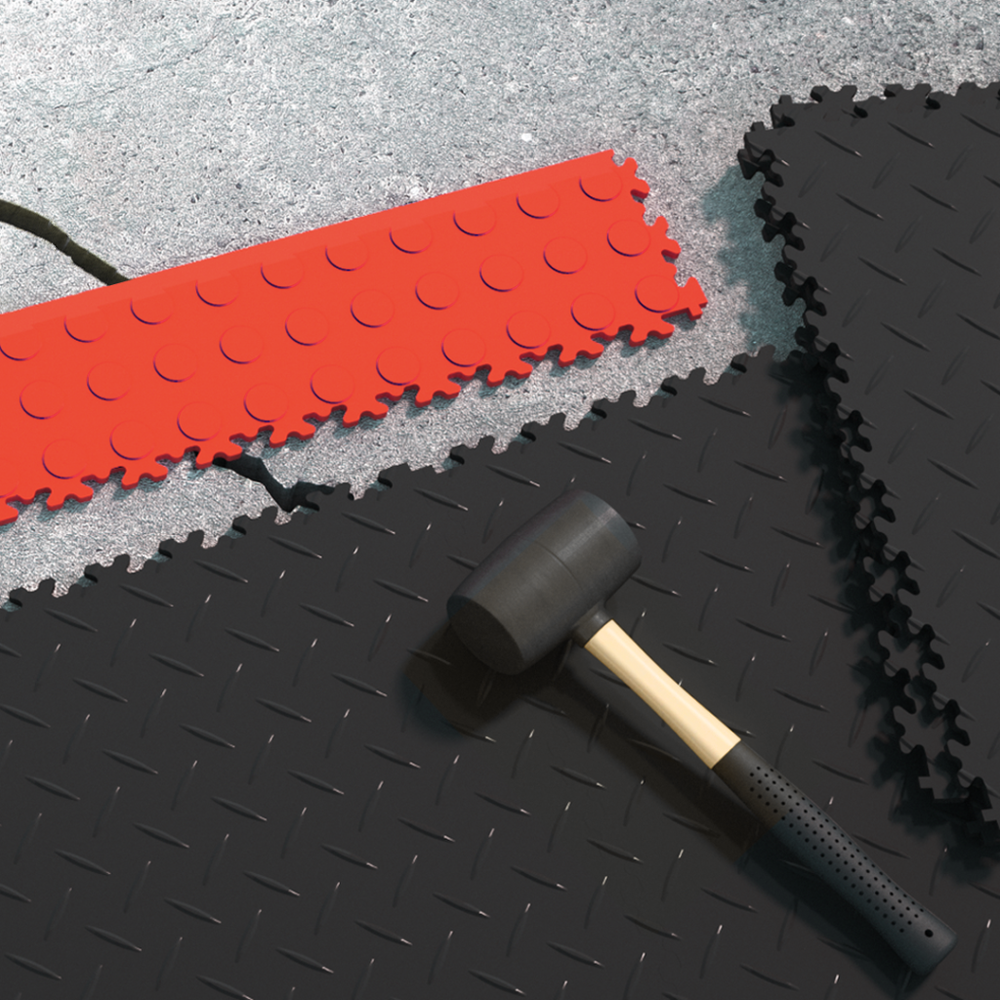
Laying Fortelock flooring in a warehouse
Laying PVC flooring, by contrast, is considerably simpler. The tiles should be stored in the room for 24 hours before installation so that the temperature evens out and the tiles no longer move. In the case of an uneven surface, a self-levelling compound must be used to fill holes and cracks, and in damp areas it is a good idea to add a cement screed as well. Levelling dries in just a few hours. Then it is the flooring's turn, which is simply laid rather than glued, and the whole process is very quick. There is nothing to dry, so there is no need to wait any longer. And should it happen that one tile breaks, there is no problem replacing it individually.
Floating PVC flooring is finding use in industrial halls more and more often. The advantages are obvious and there is practically only one disadvantage - the higher price. Everyone has to decide for themselves whether the investment is worth it.
I WANT A SAMPLEInstallation conditions according to the technical data sheet
The current Fortelock technical data sheet specifies acclimatisation for at least 48 hours at 18–26 °C directly in the room of installation, with the tiles taken off the pallets and spread out in smaller stacks. The subfloor temperature must not fall below 15 °C, and the working temperature should remain constant during installation and for 24 hours afterwards. Concrete or cement screed may have a moisture content of no more than 3.5%, anhydrite screed 0.5%. A 10 mm expansion gap is left from walls, columns and racking. For areas over 100 m², a grid of perpendicular lines is marked out to guide the installation.
Frequently asked questions
What is industrial PVC flooring and where is it used?


It consists of interlocking tiles made of homogeneous PVC that are laid without glue on the existing subfloor. Fortelock Industry is 7 mm thick, Industry Ultra 10 mm, and both ranges have an area of use of 34–43. They are used in production halls, warehouses with forklifts, workshops, service centres and garages.
What does floating PVC flooring mean?
Flooring that is not glued to the subfloor and is held together only by its locks. In most cases, Fortelock is loose-laid. Glue is only used in places exposed to direct sunlight or a heat source, in spaces with temperature fluctuations above 15 °C, and in areas for use class 43, where full-surface bonding is required.
How dry does concrete have to be before laying PVC tiles?
Concrete or cement screed may have a moisture content of no more than 3.5%, anhydrite screed 0.5% and wooden subfloors 10%. The subfloor should be level and firm. In damp spaces, glued tiles must also not be laid where the subfloor is not sufficiently insulated against rising damp.
Can industrial PVC tiles be laid over old tiles or linoleum?
Often, yes. Ceramic and stone tiles must be firmly fixed, with joints of no more than 4 mm. For PVC, linoleum and epoxy, the technical data sheet requires a firm, cohesive surface and a compatibility test first, as old plasticised PVC can damage Fortelock tiles. Rubber subfloors are covered with an insulating layer.
Why are halls replacing epoxy with PVC tiles?
Mainly because of downtime and ease of repair. Epoxy is applied in several layers and, according to the Fortelock website, takes 3 to 7 days to dry, whereas PVC tiles are laid with no drying time and an individual damaged piece can be replaced. You will find a detailed comparison in the article Epoxy or PVC tiles?