22. 3. 2021
How to repair the floor in a car service centre?
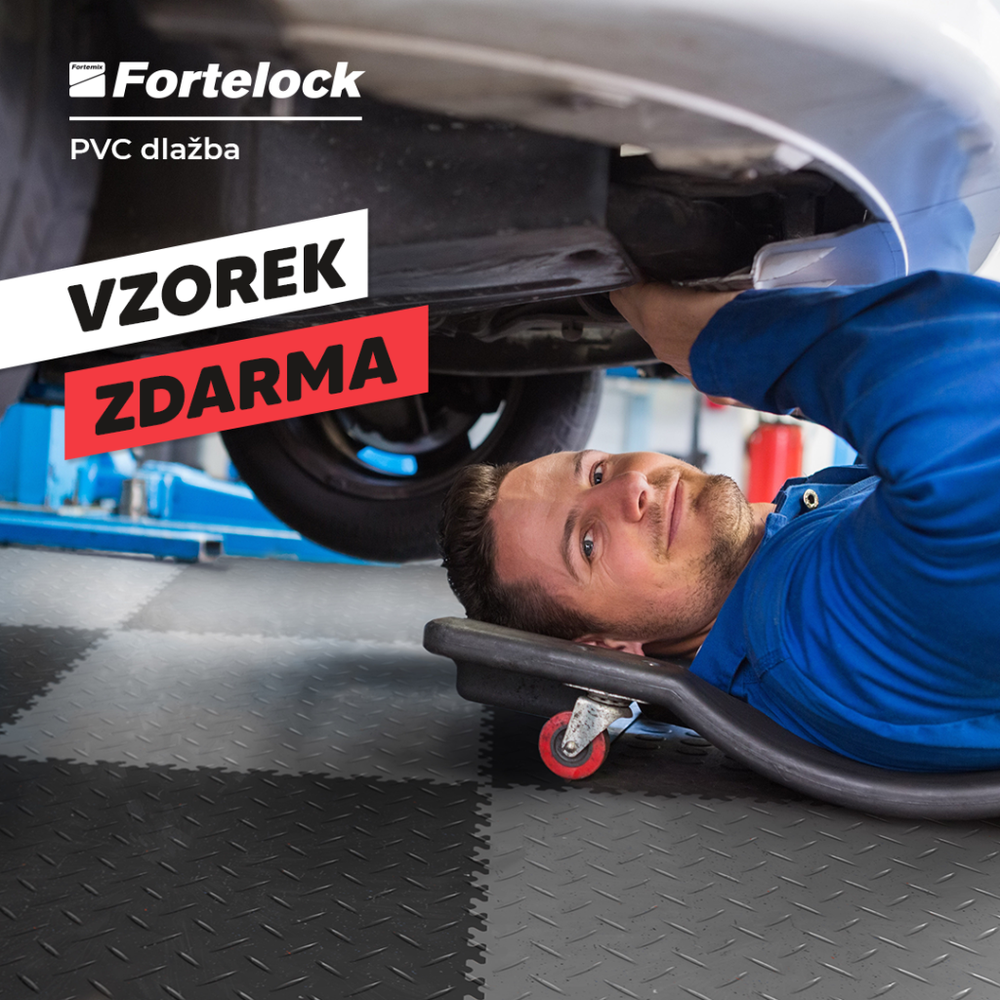
Are you considering renovating the floor in your car service centre? You need a durable, functional and almost maintenance-free floor. Let's compare concrete and PVC floors here.
Most car service centres have a concrete floor, which is cheap and should be durable and long-lasting. Over the years, however, the concrete floor may start to crack. Cracks not only create dust, but they also need to be repaired to prevent them from spreading and causing greater damage.
Such a floor is then not easy to repair, because it is usually oily and cracked. That is why coatings will not hold on it for long, and often neither will screeds or tiling. One option is therefore to concrete the floor again. This gives you a brand-new floor again, but it costs time, downtime and quite a lot of money.
The second repair option is to lay highly durable Fortelock tiles. You can lay the plastic tiles yourself and in a fraction of the time. You don't need tradespeople, you don't have to buy additional material or laboriously remove or adjust the original subfloor. If the floor is level, all you need to do before installation is sweep it and remove dirt. What's more, Fortelock tiles withstand heavy mechanical loads as well as technical fluids, you can easily install them in sections outside business hours, and the anti-slip patterns and insulating properties of the tiles make working under a vehicle more pleasant and reduce noise. The high durability of Fortelock PVC tiles also comes with a long service life of up to 25 years!
You can find out more about using Fortelock tiles here.
What subfloor the tiles need
Cracked concrete need not be an obstacle. According to the technical data sheet, cracks up to 4 mm wide do not need to be repaired; wider ones must be filled. High spots of more than 7 mm over 2 m are ground down. Concrete or cement screed should have a moisture content of no more than 3.5% and be firm. Fortelock can be laid on both new and old subfloors. If you do not want to do the preparation yourself, professional installation by the manufacturer also includes repairing uneven, holed or damaged floors and gluing in heavily stressed areas.
Frequently asked questions
Does a car service centre have to close for a new floor?


No. The tiles are laid in sections, for example outside opening hours, with no gluing, no drying and no downtime. The finished section can be used immediately, so the service centre can keep running. The Fortelock website quotes installation speeds of up to 30 m² per hour.
Can PVC flooring in a car service centre withstand lifts and tools?
Yes. According to the manufacturer, the Fortelock floor is designed for daily workshop operation with lifts, ramps and tools. The compressive point load is 520 kg/cm², which the feet of a lift should not exceed. If a heavy machine stands permanently on the floor, the tiles are glued or mechanically secured at that spot.
Do tyres leave marks on PVC flooring in a workshop?
They can, but according to the manufacturer this is not damage to the material; the floor is neither degraded nor deformed. The brown stains are caused by a reaction between the antioxidant 6PPD in tyres and the PVC plasticiser. They can be prevented with a two-component PU lacquer, such as Dr. Schutz PU Anticolor, which Fortemix applies as a protective coating.
What is the service life of PVC flooring in a car service centre?
The Fortelock website states a service life of 25 years and a warranty of up to 12 years. The warranty covers primary PVC tiles not wearing through, tearing or having manufacturing defects under normal use. It does not cover mechanical damage, sharp wheels or wheel spin, nor tiles made from recycled material.
What does professional installation of a car service centre floor involve?
Complete execution of the project, from the subfloor to the final finish. The service includes subfloor preparation, installation using machine equipment, gluing and fixing in heavily stressed and heat-exposed areas, fitting skirting and ramps, sealing expansion joints, deep cleaning and, if required, a protective PU layer. The contact is info@fortemix.cz.