11. 3. 2026
A CrossFit gym floor that can withstand barbell drops
Why the gym floor matters more than the barbells themselves
Many gym owners make the same mistake at the start: they invest most of their budget in expensive bars and plates while trying to save on the floor by buying cheap rubber granulate mats. Yet it is precisely the floor that determines how long those expensive bars and plates will last.
Protecting the concrete subfloor from destruction
The concrete slab beneath the floor is a structural part of the building. If heavy bars keep landing on it through a thin or low-quality rubber layer, the concrete will start to degrade under the effect of micro-cracks and crumble.
Repairing damaged concrete beneath the floor then costs many times more than any premium floor covering. A quality floor must act as a shock absorber that spreads the kinetic energy of the impact across the surface and keeps it away from the base.
Safety and the health of your athletes
CrossFit alternates dynamic movement with maximum strength. The floor therefore must have perfect anti-slip properties even when it is covered with sweat and a layer of chalk. A floor that is too soft absorbs impacts well, but during heavy squats it causes ankle and knee instability, which leads to injuries. The ideal surface must be hard for stability and tough for shock absorption.
Acoustic comfort and good neighbourly relations
Unless your gym sits in a lone building in the middle of nowhere, the noise of dropping barbells will be your biggest enemy. Vibrations travel through the structure of the building at incredible speed. A quality floor with a damping layer, however, can absorb the impact noise and ensure your neighbours won't want to sue you after every training session.
The physics of a barbell drop and what happens beneath the surface
When a lifter drops a barbell from overhead, an enormous amount of energy is released at the moment of impact. At that moment the floor has three main jobs, and they decide how long it will last.
Impact absorption and shock toughness
This property determines how much the material can deform and return to its shape without permanent damage. Cheap rubber mats get “beaten out” under repeated blows, lose their elasticity and start to tear. By contrast, materials such as the homogeneous PVC of the Fortelock Industry range are designed to absorb this energy for thousands of cycles without any change to their structure.
Spreading point pressure across the surface
When a plate lands on its edge, extreme point loading occurs. Thanks to its rigidity and interlocking system, however, a quality modular floor can spread this pressure into the neighbouring tiles. This prevents the floor from being “punched through” to the concrete at the point of impact.
Rebound and plate stability
A floor that is too springy will make the barbell bounce dangerously after landing. In a packed gym where ten people train side by side, that is a gamble with people's health. The right floor has to “tame” the impact. The barbell must stay in place after landing without rotating or bouncing uncontrollably.
Comparing technologies for functional training and weightlifting
When choosing a floor for a CrossFit gym, you will come across three common solutions that may look similar at first glance, but their behaviour under load is worlds apart. Each of these materials has not only its advantages but also its limits, and it is important to know where economic value ends and gambling with the concrete subfloor begins.
Classic rubber granulate mats for basic damping
Rubber mats made from recycled SBR granulate (often from tyres) are the absolute standard in commercial gyms. The material is produced by shredding rubber into small pieces, which are then bonded with polyurethane adhesive under high pressure. The result is a tough and very springy surface that dampens noise and vibrations extremely well.
In a CrossFit environment, however, problems arise under extreme mechanical stress. The granulate structure is not homogeneous, which means that under repeated impacts and shear stress (for example during fast burpees or lunges) the binder starts to fatigue and the rubber literally crumbles to pieces.
Advantages of rubber granulate mats
- They offer very good impact-noise damping when lighter weights are dropped.
- They are the most affordable option for start-up projects and home gyms.
- The naturally anti-slip surface ensures safe movement without any additional treatment.
- Easy trimming with an ordinary knife allows installation even in irregular spaces.
Disadvantages of rubber granulate mats
- Under repeated drops of heavy bars the material crumbles and loses its thickness.
- The porous structure soaks up sweat and liquids, which leads to unsolvable hygiene problems.
- Gaps full of dust and chalk gradually form between the individual mats.
- The distinctive smell of recycled rubber is very intense in enclosed spaces.
Poured polyurethane floors as a seamless aesthetic solution
Poured systems are synonymous with luxury and clean design in modern fitness centres. They are liquid mixtures spread onto a perfectly prepared base which, once cured, form a single continuous layer.
This technology is excellent for aerobics studios or cardio zones, but in the free-weights zone it runs up against its own fragility. A polyurethane screed is more flexible than epoxy, but it is still a relatively thin layer. If a 150 kg bar lands on it, the kinetic energy passes straight through the thin screed into the concrete, which can cause it to crack, even though the floor surface looks undamaged at first glance.
Advantages of poured polyurethane floors
- A perfectly smooth surface without a single joint allows lightning-fast cleaning and disinfection.
- Thanks to its non-absorbency, the material forms a perfect barrier against bacteria and mould.
Disadvantages of poured polyurethane floors
- Installation requires a specialist company and several days of downtime for the entire space.
- Every crack in the concrete subfloor immediately transfers to the surface of the screed.
- Repairing a chipped section after a sharp object falls is costly and aesthetically imperfect.
- The high purchase price and the impossibility of dismantling the floor when relocating increase the financial risk.
The Fortelock Industry modular PVC system for extreme impact loads
Fortelock Industry is a hybrid solution that takes the best of the industrial world and brings it into the sports environment. The tiles are pressed from high-density homogeneous PVC, which gives them incredible impact toughness. Unlike rubber they do not crumble and unlike screeds they do not crack.
The system of solid interlocking joints turns the floor into one compact unit that behaves like a floating slab. That is ideal for CrossFit, because the floor can spread the energy of a barbell drop across a larger area, protecting both the athlete's health and the integrity of the concrete subfloor. On top of that, the surface is not cold and provides the stability lifters need for maximum performance.
Advantages of PVC flooring
- The extreme density of the material allows heavy loaded bars to be dropped regularly.
- The unique interlocking system holds the tiles firmly together even without full-surface gluing.
- The floor is ready for training the moment the last joint clicks into place.
- The closed surface does not absorb chalk or sweat and is easy to keep clean.
- The option of dismantling and relaying the floor makes it a movable company asset.
Disadvantages of PVC flooring
- The initial investment in the material can be higher than for other materials (but it pays back quickly).
- The visible interlocking joints can look less seamless than poured surfaces.
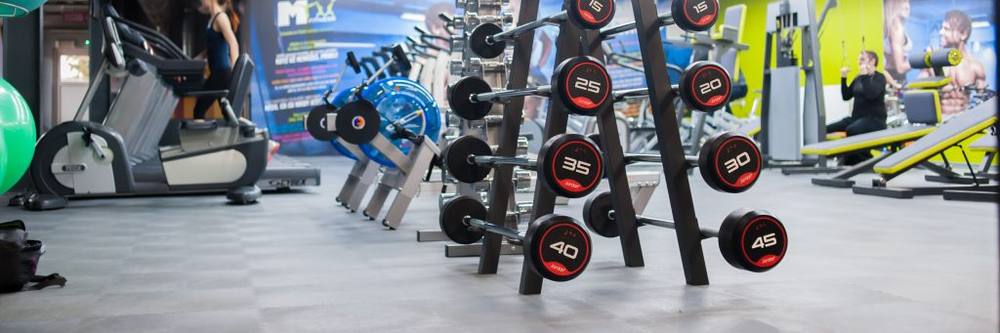
Why Fortelock handles CrossFit loads better than rubber
You may be wondering why choose PVC when rubber is softer. The answer lies in the density and structure of the material. A Fortelock floor is no ordinary plastic – it is a tough composite designed for forklift traffic.
Stability during lifting as the cornerstone of performance
During squats or the snatch you need one hundred percent support. If you stand on soft rubber, your foot sinks slightly, which leads to instability. Fortelock Industry has a high hardness (92 Shore A) that provides a firm platform comparable to a weightlifting platform, but with the bonus of impact damping.
Resistance to chalk and easy maintenance
Every CrossFitter knows that chalk gets everywhere, and with granulate rubber the powder works its way into the pores, leaving the floor forever grey and dirty. Fortelock has a closed surface. The chalk stays on top, where you can easily vacuum or wipe it away. That way your gym looks presentable even after years of operation.
Modularity as insurance for your wallet
The areas that suffer most in a gym are under the pull-up bars and where the barbells are dropped. With a poured floor you have to sand down a large area whenever it gets damaged. With Fortelock you simply swap the tiles from the corners into the most heavily used centre after a year, or at worst replace a few damaged pieces with new ones. Your investment is thus spread over a much longer period.
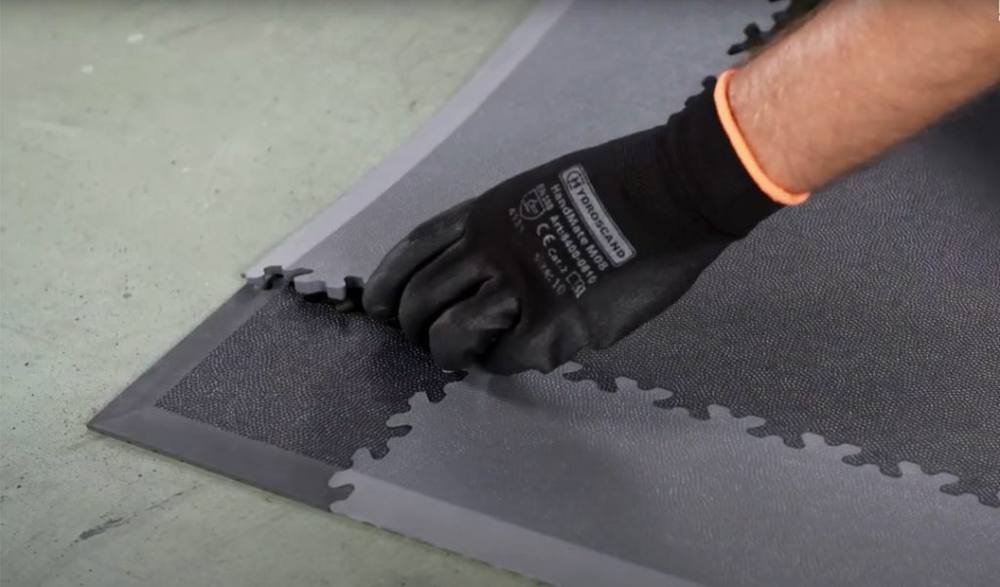
Installing a Fortelock floor in a CrossFit gym
Most gym owners want to lay the floor themselves to save on tradesmen. With the Fortelock system that is an entirely realistic plan. The tiles are joined together with a rubber mallet, and for the cuts along the walls all you need is a jigsaw or a sturdy knife.
When gluing the tiles in a gym is necessary
Although the system is presented as floating, CrossFit represents an extreme load. We therefore recommend gluing the tiles to the subfloor over the whole surface in the following cases:
- Drop zones – Where barbells land most often, adhesive prevents slight movement of the tiles within the joints.
- Areas in direct sunlight – If you have large windows, the sun can heat the PVC and cause it to expand.
- Under heavy machines and rigs – Stabilising the floor beneath a fixed structure increases the safety of the whole gym.
A strategic investment in a safe gym
When you open a gym, the budget vanishes before your eyes. Rigs, bars, bumpers, rowers… and then it's the floor's turn. People often skimp on it, because after all it's just rubber. Yet the floor you choose determines how people will feel in your gym and how long the rest of your equipment will last.
So reach for a solution that may not be the cheapest on the market, but is one you can rely on. With a Fortelock floor you won't be dealing with the smell of old tyres, with mould under the floor or, above all, with what is happening to the concrete beneath you. And when you one day decide to move to bigger premises, you simply take the floor apart and take it with you. If you want a gym that runs like clockwork and looks great even after years, Fortelock is a safe bet.
Want to see how Fortelock would look in your gym?
Whether you are fitting out a small home gym in your garage or opening a commercial centre for hundreds of people, we will be happy to help you with the technical specification and with choosing the right colour combination for your brand. Just get in touch or order a free Fortelock floor sample right away.