16. 3. 2023
A DIY garage floor
Are you building or renovating a garage? Are you a keen DIY enthusiast with a passion for your own projects, or someone looking for a low-effort renovation?
A DIY garage floor is a topic that interests many people, and many of them go on to become our satisfied customers. That's because Fortelock PVC tiles are unique in their properties and easy to lay, and they meet all the requirements for a garage floor.
Where to start? By choosing the right flooring.
When choosing a garage floor, you should consider the following factors:
Purpose of the garage
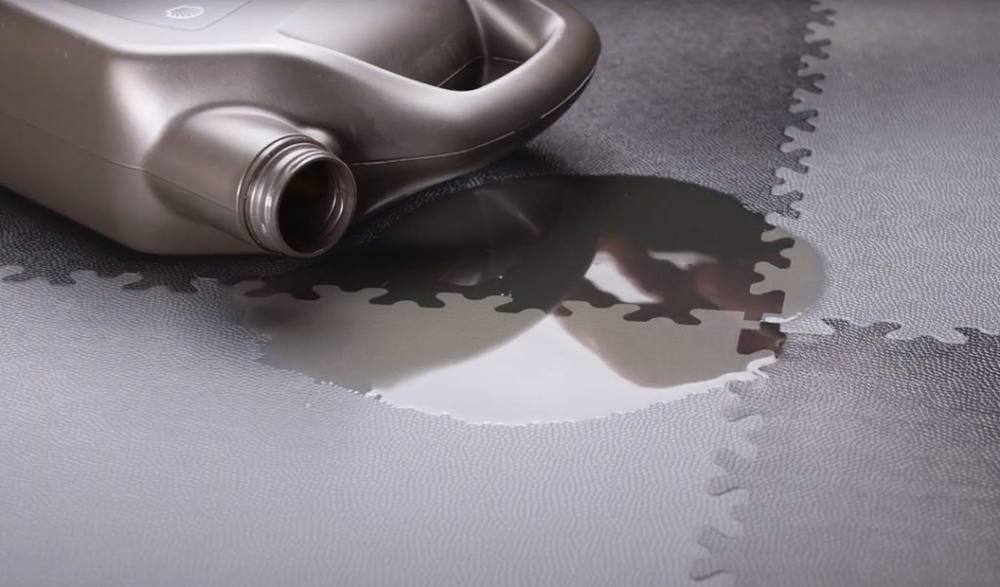
If you use your garage for parking vehicles, the floor should be sufficiently strong and resistant to mechanical damage. If you use the garage as a workshop or storage space, resistance to chemicals and oils may be more important. In both cases, we recommend the Fortelock Industry floor, which withstands the impact of heavier objects as well as brief exposure to chemicals.
Material
Many materials are used for garage floors, including concrete, epoxy coatings, tiles, vinyl, laminate and wood or durable PVC. Each material has its advantages and disadvantages, but PVC garage tiles meet most of the requirements.
Durability
A garage floor should be resistant to mechanical damage, chemicals and oils. As we have already mentioned, Fortelock Industry tiles are highly durable. However, should local damage occur, it is easy to replace just the damaged piece with a new one.
Maintenance
A garage floor should be easy to maintain and clean, especially if it is used for parking vehicles. That is why it is advisable to choose PVC tiles, which are easy to maintain. Greasy stains do not remain on them and they do not crumble like a concrete floor. Find out more about cleaning Fortelock flooring in our video. You will find cleaning products in our range of accessories.
Price
The choice of garage flooring may also be influenced by price. Some materials are cheaper than others, but they may be less durable or less attractive. Others require a professional to lay the floor. With PVC tiles, you can handle the installation yourself, without having to invest extra money in a tradesperson.
Appearance
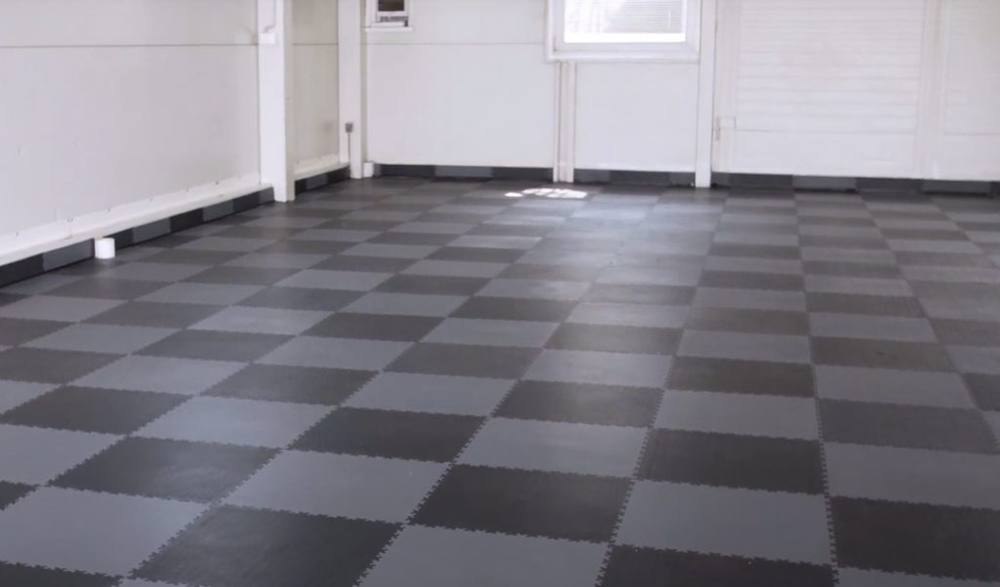
The appearance of a garage floor is related to its purpose. For some people it plays a minor role, while for others the garage is another room in the house. PVC tiles offer the option of combining different colours and provide a modern, distinctive design. To visualise Fortelock flooring in your garage, use our Visualiser.
Consider these factors when choosing the flooring for your garage, and consult our experts if you are unsure which floor is best for you.
What next? We'll tell you how to lay a garage floor yourself:
- Prepare all the necessary tools and materials – a tape measure, a cutting knife, a hot air gun, glue or fixing tape if needed, and the floor covering, skirting, ramps and corners.
- Measure the size of the garage and calculate the number of tiles required according to the chosen type. Our configurator will help you with this.
- Prepare the subfloor. It is not demanding – simply remove larger unevenness with filler and clear the original surface of larger dirt and dust.
- Think about the look you want. Arrange the pattern according to your needs and taste. Combine colours and divide the space into separate sections or highlight certain areas. Take advantage of our original CUSTOM print with your own graphics.
- Lay the floor tiles according to the instructions in the technical data sheet and the installation manual. If the floor in your garage is exposed to sunlight, glue the floor down. Don't forget to leave expansion gaps around the perimeter of the floor.
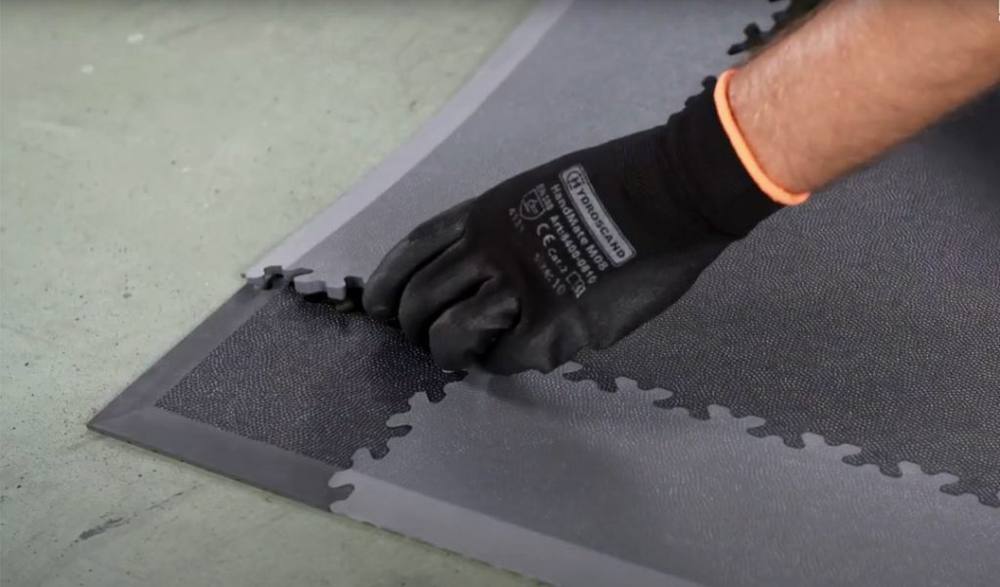
- Finish the installation using skirting boards, ramps and corners.
- Don't forget to remove all waste and tidy up the garage. For proper cleaning, get inspired by our video or article on cleaning.
It is important to realise that installing a garage floor requires considerable attention and care. However, even children can manage to lay our flooring, so don't worry and get started. Our installation guide video will help you.
Take a look also at the references from our customers.
Before you start laying: a checklist
- Let the tiles acclimatise in the garage for at least 48 hours at 18–26 °C, taken off the pallet and spread out.
- The substrate must not be colder than 15 °C; grind down raised areas of more than 7 mm over 2 m and fill cracks wider than 4 mm.
- Add about 5% for offcuts to the quantity worked out by the calculator.
- Lay Industry and XL from the entrance along two perpendicular lines from the centre of the garage, and turn each subsequent tile 90° relative to the previous one.
- After cutting, the perimeter tiles should be wider than a third of a tile.
- Leave a 10 mm expansion gap at walls and other fixed points.
Frequently asked questions
What tools do I need to lay PVC tiles in a garage?


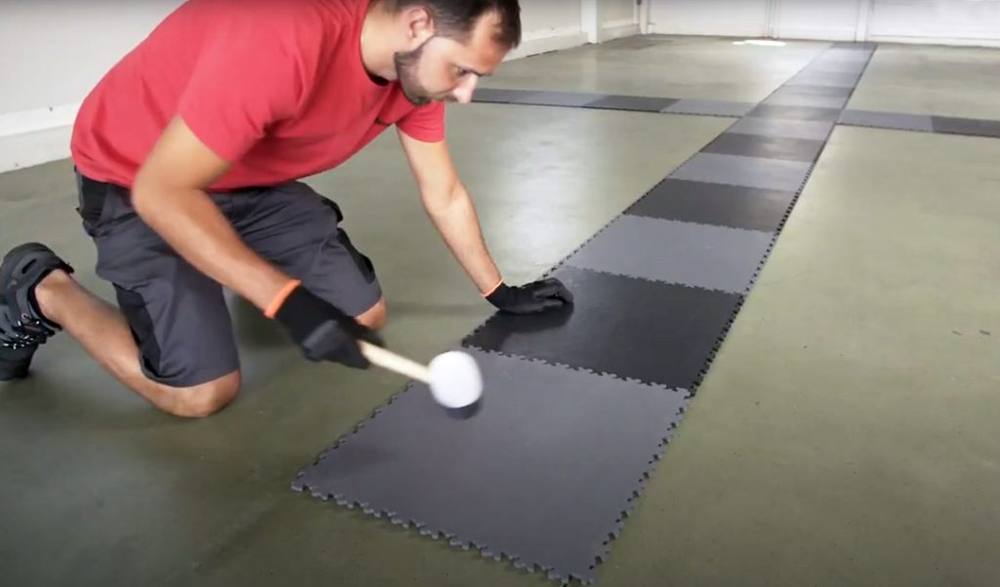
A tape measure, a snap-off utility knife or a jigsaw for cutting the perimeter tiles, a rubber mallet for seating the locks and a hot air gun for more complex cut-outs. For areas exposed to the sun, have adhesive or fixing tape ready. To finish off, you will need skirting boards, ramps and corners.
How many tiles do I need per 1 m² of garage?
It depends on the range: Industry and Industry Ultra take 4 tiles, Invisible 5 tiles and XL 2.5 tiles per m². It is a good idea to add about 5% to the calculated quantity for offcuts. The configurator will calculate the exact number for your garage based on the room's dimensions.
What is the best way to cut PVC tiles?
Straight cuts can be made with a snap-off knife, a guillotine for resilient flooring or a jigsaw. More complex cut-outs, for example around a post or pipe, are easier with a hot air gun; always heat the underside of the tile, which will not be visible. Perimeter pieces should be wider than a third of a tile.
Where should I start laying tiles in a garage?
For Industry, Industry Ultra and XL, start from the entrance along two perpendicular lines running from the centre of the room, with the visible part of the lock facing the direction of laying. Invisible is laid from left to right and downwards diagonally from a corner. If the ramps need to fit precisely, lay two rows of tiles along the entrance first and connect the ramps to them.
How long does it take to lay a garage floor?
The installation itself is quick: the website states up to 30 m² per hour and, by comparison with epoxy, a finished floor in 3 to 4 hours, whereas epoxy takes 3 to 7 days to dry. Beforehand, however, allow 48 hours for the tiles to acclimatise. See also A garage floor in two hours?
What should I clean the floor with after installation?
The floor must be cleaned after installation; Forteclean Intense Cleaner is recommended. For routine cleaning, water with an ordinary detergent or Forteclean Daily Cleaner is then sufficient. Do not use solvents or abrasive pads. You will find more tips in the article Cleaning Fortelock tiles.