18. 4. 2026
How to choose flooring for a detailing studio
What a detailing studio floor has to withstand
At first glance it is "just" about working with a car. In reality, however, the floor in a detailing studio takes a beating from several directions at once. Water, chemicals, mechanical loads and high demands on appearance all combine here.
Water and moisture every day
Car washing, rinsing, wet wheel arches or water from hoses… In detailing, the floor is practically wet all the time. This is not occasional spillage, but everyday operation where water regularly covers a large part of the surface.
If the material absorbs or retains water, it starts to show very quickly. Watermarks and stains appear, the surface deteriorates and in worse cases even degrades. At the same time, the risk of slipping increases, which is a fundamental safety problem in an environment where you work with cars.
The floor should therefore:
- be non-absorbent
- dry quickly
- stay stable even when wet
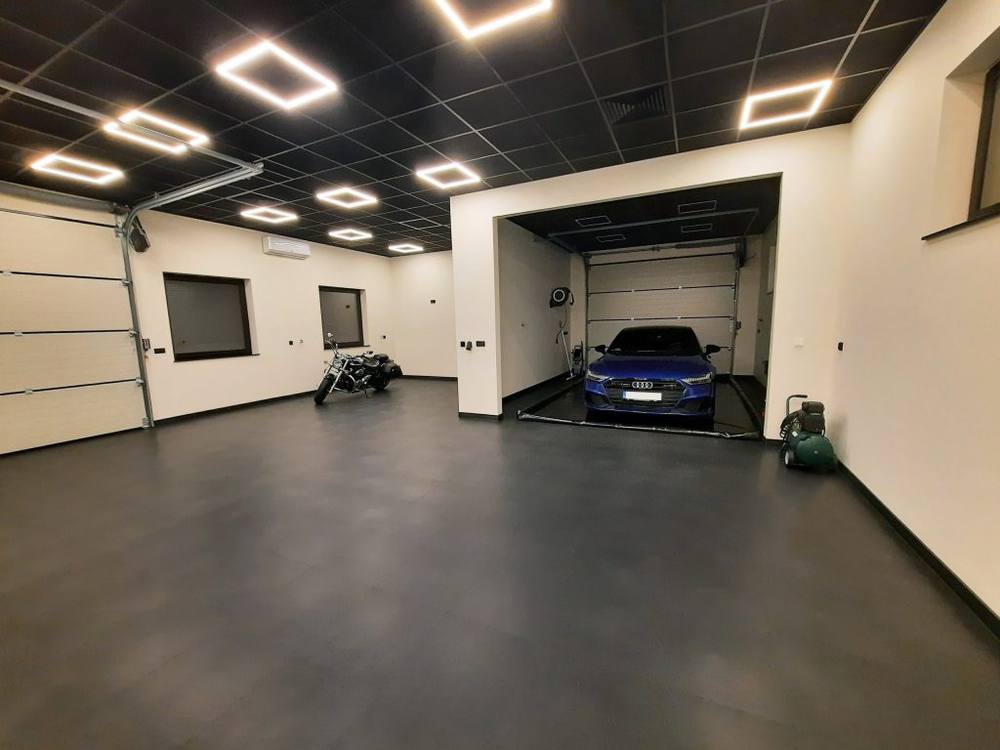
Harsh chemicals
Detailing means working with a wide range of products – from shampoos and wheel cleaners to degreasers, waxes and ceramic coatings. Some are gentle, others very aggressive, and with long-term contact they can damage ordinary surfaces.
The floor in such an environment must handle not only accidental spills but also repeated contact with chemicals. If it is not resistant enough, it will start to change colour, lose its texture or develop permanent stains that can no longer be removed.
What is essential is therefore:
- resistance to chemicals
- easy cleaning
- a surface that keeps its appearance in the long term
Point loads from cars and equipment
A parked car creates a high point load through its tyres. Several hundred kilograms are transferred to a relatively small area, and if the floor is not strong enough, it will gradually deform.
Add to that the other equipment typical for detailing, such as jacks, compressors, detailing trolleys or various machines. These put additional pressure on specific spots and increase the overall stress on the surface.
The floor should therefore:
- withstand long-term loads without deformation
- not soften under the weight of a car
- maintain a stable surface even with daily use
Floor aesthetics are part of the impression
While in an ordinary car repair shop a bit of dust or grease on the floor is somewhat expected, in a professional detailing studio the standards are set much higher. It is a place where customers often stop to watch the work in progress, or where the car is handed back to its owner as a finished work of art.
In such an environment, the client notices everything – from the quality of the lighting to the cleanliness of the corners of the room. In detailing, the floor therefore does not serve a purely technical function; it is a key element that completes the overall impression of your professionalism.
What spoils the impression of a detailing studio floor
It is on the floor that everyday operation shows most visibly. Water droplets from washing, polishing paste residue, marks from hot tyres or an accidental drip of chemicals – all of these are things that leave permanent traces on an unsuitable surface.
If the floor looks "worn out", develops stains that cannot be cleaned or constantly looks trampled, it undermines the perceived quality of the whole studio. Even if you do a perfect job on the car's paintwork, the overall impression in a poorly maintained environment will never be one hundred percent.
What a detailing studio floor should look like
The ideal detailing surface has to work in real operation, not just in photos taken at the opening. The main requirements include:
- An easy-to-maintain appearance – The floor should look good even during the working day, when you don't have time to mop after every task.
- Stain resistance – The surface must not be porous, so it doesn't soak up chemicals or dirt that can no longer be removed.
- Visual unification of the space – It doesn't matter whether you prefer a technical look or clean minimalism. The floor must match the space and create a coherent whole.
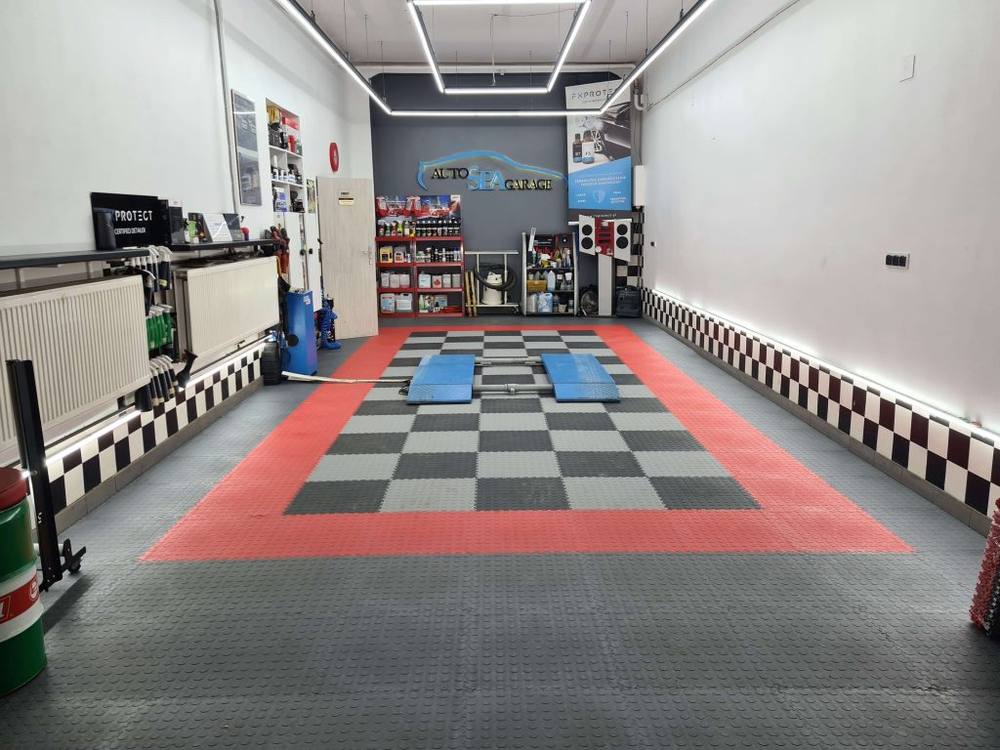
What floors are used in detailing (and their limits)
At first glance, choosing a floor for a detailing studio may seem simple. In practice, however, it very quickly becomes clear that not every material can handle the combination of water, chemicals, mechanical loads and demands on appearance. Let's look at the most common solutions – and above all at their limits in real operation.
Concrete
Concrete is the simplest and cheapest option, which you will come across in many garages and older studios. For detailing, however, it does not work in the long run.
Untreated concrete is absorbent, so it quickly soaks up water, chemicals and dirt. The result is dark watermarks, stains from oil or cleaners and, over time, degradation of the surface. On top of that comes dustiness, which is a big problem in an environment where you work with a car's paintwork.
Painted concrete does not solve the problem
Coatings can improve the situation for a while, but usually only temporarily. Over time they start to peel, creating uneven patches and stains that can no longer be unified. The floor then looks worn, even if it is relatively new.
Epoxy floors
Epoxy is often considered a "professional" solution. The smooth, glossy surface looks great at first glance and is easy to maintain. In detailing, however, it runs into several practical problems.
In contact with water, epoxy can be slippery, which is a fundamental disadvantage in an environment with frequent washing. The surface is also more prone to scratching (for example from small stones stuck in tyres or when handling equipment). Over time, watermarks, scuffs or hairline cracks may appear, especially if the substrate is not ideal.
Another limitation is repairs. Once epoxy is damaged, a local repair is almost always visible. Differences in shade or gloss appear, and the floor loses the uniform appearance that was its biggest advantage in the beginning.
Vinyl or ordinary PVC rolls
Vinyl floors or PVC rolls are popular for their appearance and easy maintenance. In detailing, however, they run into their structural limits.
These materials are not designed for higher point loads. Under car tyres they can deform over time, develop indentations or become locally damaged. In addition, working with chemicals can cause changes to the surface or permanent stains.
Another disadvantage is the installation method. They often require gluing, which means a more complicated installation and problematic repairs. Once part of the floor is damaged, fixing it usually requires a major intervention.
Why PVC tiles are used in detailing more and more often
It is precisely the combination of all the high demands placed on a detailing studio floor that leads many studios to look for a solution that can handle everything at once – without compromise. And this is where modular PVC tiles are increasingly gaining ground.
Unlike conventional floors, they solve several problems at the same time:
- They do not absorb water or chemicals, so no watermarks or stains appear.
- They have an anti-slip surface that grips even when wet.
- They handle point loads from cars without deformation.
- They are easy to clean and keep their appearance in the long term.
- They can be installed quickly, without gluing and without shutting down operations.
Design flexibility is another big advantage. Using colours, printing and combinations, you can create zones for washing, polishing or parking and visually unify the whole space. The floor is then not just functional – it becomes part of the studio's overall style.
Chemicals and Fortelock tiles: what to watch out for
Chemical resistance does not mean that spilled products do not matter. The Fortelock surface is resistant to oils, petrol and common chemicals, but the technical data sheet recommends removing petroleum-based substances as soon as possible, otherwise there is a risk of discolouration and deformation. The sales department can advise on resistance to a specific product. Do not use solvents or abrasive pads when cleaning, as they damage resilient floor coverings. Undiluted Forteclean Daily Cleaner is suitable for stubborn stains. For greater protection against discolouration, the floor can be given a protective PU coating.
Which types of Fortelock tiles are suitable for detailing
Not all tiles are created equal. Although at first glance it may seem to be just a matter of colour and pattern, in the detailing world what matters most is how much of a beating the floor will take and what visual standard you want to set. Fortelock offers several variants, but for a studio's needs the decision usually comes down to two main ranges.
Fortelock Industry – durability first
The Industry range is the go-to choice for detailing studios where functionality and a long service life are the priority. It has a robust construction that easily handles cars driving over it every day, the handling of equipment, and work with water and chemicals.
The surface is sufficiently textured, so it does not slip even when wet, and at the same time it is easy to clean. It is particularly suitable for:
- washing zones
- working areas of the studio
- places with higher loads and frequent car movement
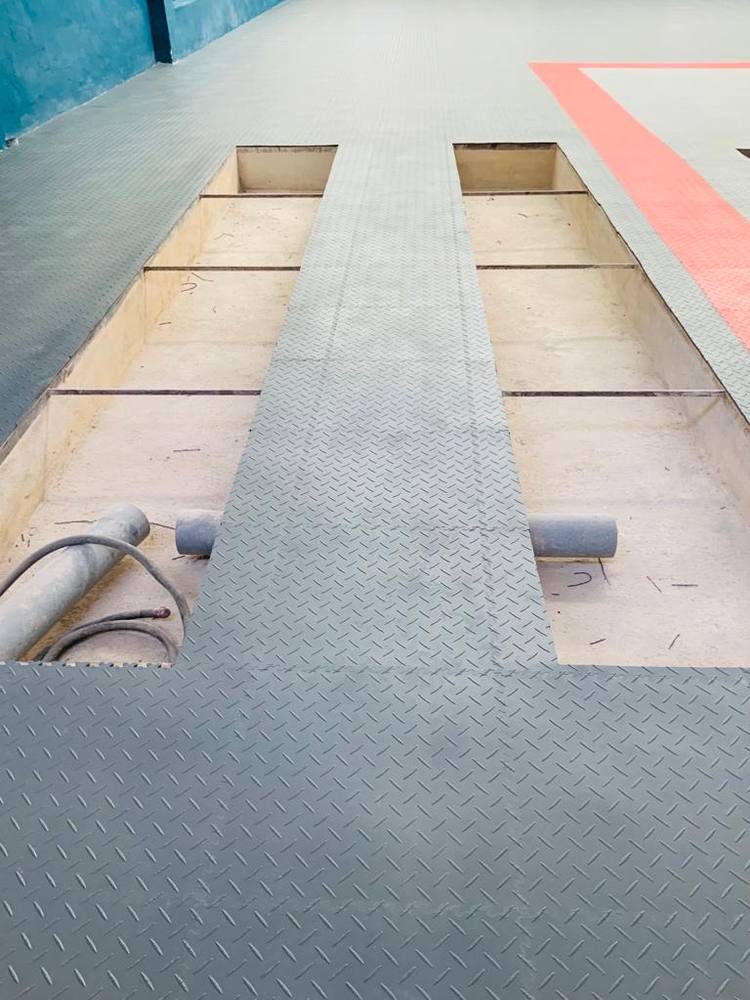
Fortelock Invisible – when you want a clean, presentable look
If you place great emphasis on aesthetics and want the floor to look like one seamless piece, the Invisible range is a bullseye. In technical properties and durability it is similar to the Industry range, but it has one fundamental difference: hidden interlocks. Once assembled, the joints are almost invisible, creating a very compact and presentable surface.
It is ideal wherever visual impression matters:
- polishing zones
- customer handover areas
- showroom sections of the studio
In practice, Fortelock Invisible is often combined with the Industry range. Each part of the studio then gets exactly what it needs.
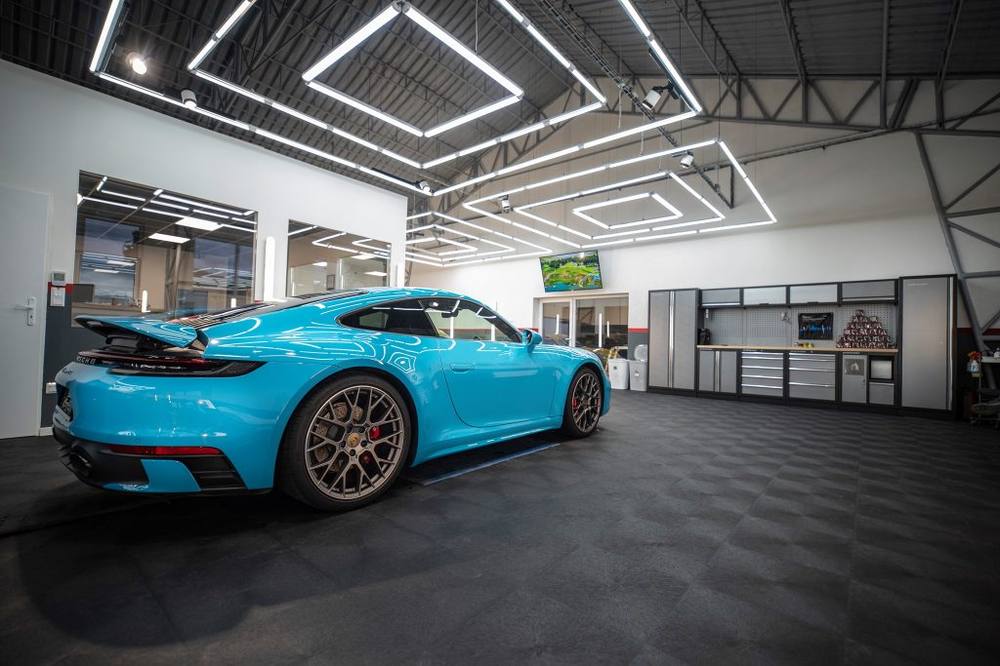
How to design the floor in a detailing studio (zoning, water drainage, colours)
Choosing the right material is only half the battle. The other half is a smart layout of the entire space. In professional detailing, one universal surface for everything simply does not work. Each activity has its own specific demands on cleanliness, safety and logistics.
Zoning the space
Dividing the studio according to the type of work works very well. Thanks to the tile system, you can separate these zones visually without having to install partitions or barriers.
A typical layout of a professional studio looks like this:
Wet (washing) zone
Here the main roles are played by water drainage, chemical resistance and maximum slip resistance. This is where decontamination and pre-washing take place, so the floor must withstand constant contact with water and more aggressive cleaners.
Working and polishing zone
Here the priority is stability and cleanliness. You need a surface on which trolleys with car-care products and stools move smoothly, and which does not tire your feet during long hours of polishing.
Presentation and handover zone
The place where the client comes to pick up the finished car. Here we bet on a presentable look and a design that highlights the result of your work.
Water drainage and slope
Water is an everyday reality in detailing, so it is important to think about where it goes. Ideally you should:
- maintain or create a slight slope
- connect the floor to existing drains
- avoid places where water would pool
In this respect, one of the biggest advantages of Fortelock tiles is the AirFlow system of drainage channels on their underside. It ensures that the floor "breathes", water does not remain standing underneath and the surface beneath the tiles dries naturally, which prevents mould. PVC tiles themselves do not absorb water, so the main thing to deal with is where the water will drain.
Colours and overall appearance
The colour of the floor affects not only the aesthetics but also how comfortable the space is to work in.
- Light shades (e.g. grey) are great for brightening the space and optically enlarging smaller garages. On the other hand, every bit of dirt shows on them, so they require more frequent maintenance.
- Dark shades (graphite, black) look very luxurious and "technical". They are more practical for masking tyre marks, but they can absorb light, which is not what you want when polishing paintwork.
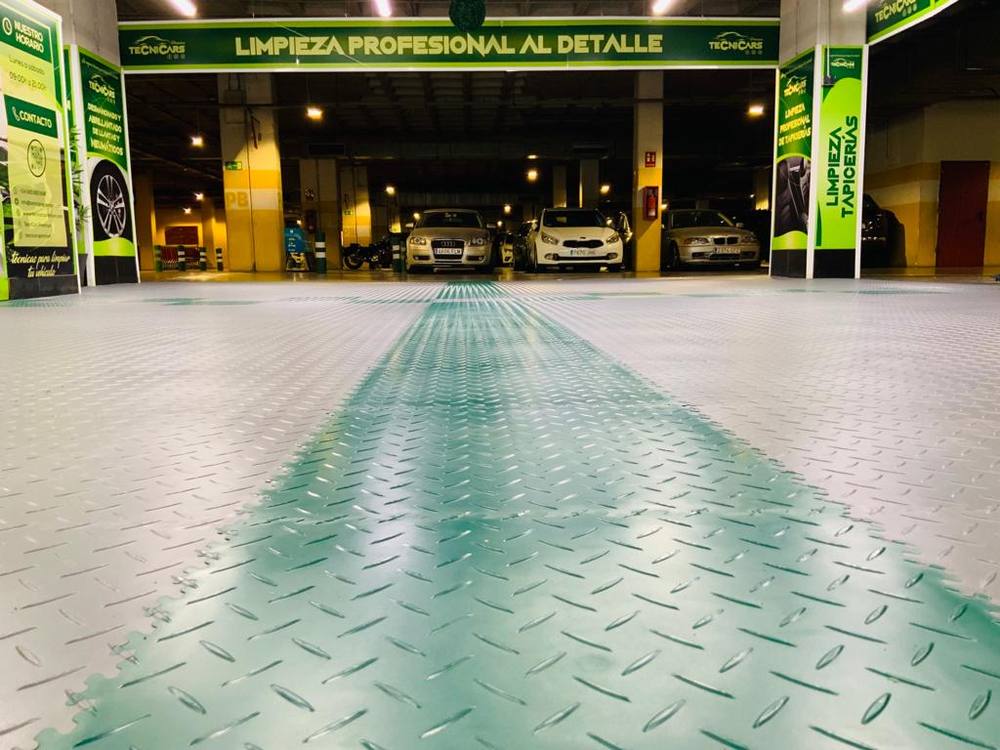
- Contrasting elements (for example a grey base combined with contrasting stripes in yellow or red) are very popular in detailing. They mark out working areas or driving paths, help with orientation and give the studio a modern, professional look.
Frequently asked questions
Are PVC tiles slippery in the wash bay of a detailing studio?


No, Fortelock tiles have a slip resistance of R10 according to DIN 51130, and the surface of the Industry range is textured, so it grips even when wet. Even so, it is advisable to drain water to the drains with a slight slope so that it does not stand on the surface. If you need higher slip resistance, professional cleaning can increase it up to R11.
Can Invisible tiles handle cars driving over them as well as Industry?
Not quite. For loose-laid installation, the technical data sheet states vehicles with tyres of up to 6,600 kg for Industry and up to 3,500 kg for Invisible. For a pallet truck it is 500 kg for Industry and 300 kg for Invisible. That is why Industry is chosen for washing and working zones with the highest loads, and Invisible rather for the polishing and handover areas of the studio.
Can tyres leave stains on a studio floor?
Yes. Tyres can leave marks on the floor, but according to the manufacturer this is not damage to the material. Some tyres also create brown stains through a reaction of the antioxidant 6PPD with the PVC plasticiser, so the technical data sheet recommends a two-component PU sealing coat, such as Dr. Schutz Anticolor. Experience from tyre-handling premises is summarised in the article Flooring for tyre shops.
How long does it take to lay a floor in a detailing studio?
Usually hours, not days. Fortelock tiles are laid without glue, drying time or shutdowns, and the website states an installation speed of up to 30 m² per hour. In service operations the floor can be laid in sections while work continues, so the studio does not have to close. The exceptions are places with direct sunlight or a heat source, where the tiles are glued.
What colours can studio tiles be ordered in?
The Industry, Industry Ultra, Invisible and XL ranges are made in Black, Blue, Graphite, Green, Grey, Rosso Red and Yellow. The studio logo or your own graphics can be printed on the tiles with the CUSTOM printing service. Printing is recommended outside the main traffic route, and in busy areas it must be protected with PU lacquer.